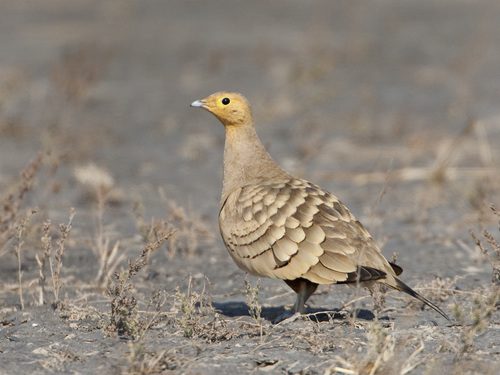
About Pterocles exustus Temminck, 1825
Species Naming and Size
Pterocles exustus, the chestnut-bellied sandgrouse, is a small to medium-sized sandgrouse species.
In-Flight Appearance
In flight, it shows brownish plumage and an elongated, pointed tail.
Grounded Posture
When grounded, it appears to have very short legs and a small head, and individuals stretch out their long necks when wary.
Sexual Dimorphism
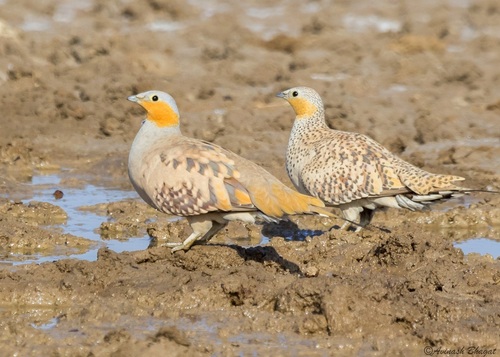
This species is sexually dimorphic in plumage colouration.
Subspecies Overview
There are six recognised subspecies of chestnut-bellied sandgrouse, and overall plumage colouration varies between these subspecies.
P. e. floweri vs Nominate Subspecies
The Nile Valley subspecies P. e. floweri has darker and greyer colouration on the head, mantle and breast, and less yellowish colouration on the upper wing-coverts and scapulars, compared to the nominate subspecies P. e. exustus, which occurs in Senegal, Gambia, Mauritania and Sudan.
Paler Grey Subspecies
P. e. ellioti, found from southeastern Sudan to Somalia, P. e. erlangeri, found in southwestern Saudi Arabia, Yemen and Oman, and P. e. hindustan, found in Iran, Pakistan and India, are all paler and greyer than the nominate subspecies.
P. e. olivascens Traits
P. e. olivascens, ranging from South Sudan to Northern Tanzania, has distinct greyer olive colouration on the upperparts and wings; females of this subspecies have more heavily barred and streaked underparts than the nominate subspecies.
Thar Desert Subspecies Sex Distinction
For the subspecies abundant in the Thar and Sindh Deserts, sexes are easily distinguishable by plumage colour.
Thar Desert Male Upperparts
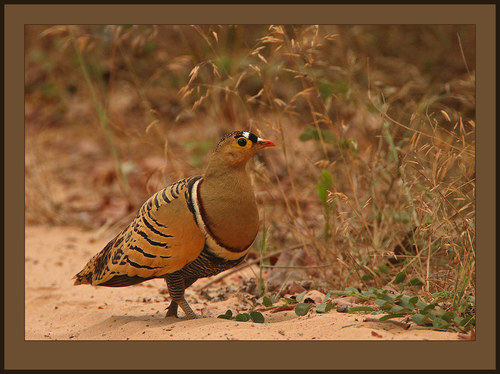
Males of this population have isabelline-grey to brown upper parts from the crown to the upper tail coverts.
Thar Desert Male Head and Neck Coloration
The lores, cheeks, chin, and throat are dull yellow-ochre, often tinged with orange-buff that extends around the neck like a collar, shading off toward the scapular and interscapular feathers, and shading into ocherous-buff at the tips, where feathers are edged with brown.
Thar Desert Male Wing Coloration
Wing feathers are buff or ocherous-buff, shading into olive toward the inner lower wing.
Thar Desert Male Breast and Abdomen
The upper breast is vinous-buff, separated by a narrow black band bordered with white. The lower breast is dull yellow-buff, which gradually changes to chocolate, with the centre of the abdomen being black.
Thar Desert Male Undertail and Tail
The undertail and tarsus are creamy-buff. The central tail feathers are the same isabelline-grey/brown as the upper tail feathers, becoming black toward the long, narrow tip.
Thar Desert Female Upper Plumage
Females have dull-buff upper plumage streaked with dark brown marks on the back of the neck; these marks increase to blotches further down, and become broad bars on other parts of the body.
Thar Desert Female Wing Features
Wing feathers match the colour of the back, but are broadly tipped with buff, with some coverts edged with brown.
Thar Desert Female Head and Breast
The neck, breast and sides of the head are vinous, with black spots.
Thar Desert Female Lower Body
The lower breast is dull pale ochre-buff, and the abdomen to vent are closely barred with dark brown. Undertail covert feathers are creamy buff.
P. e. floweri Sex Distinction
P. e. floweri, the endemic Nile Valley subspecies found in Egypt, also has easily distinguishable sexes.
P. e. floweri Male Traits
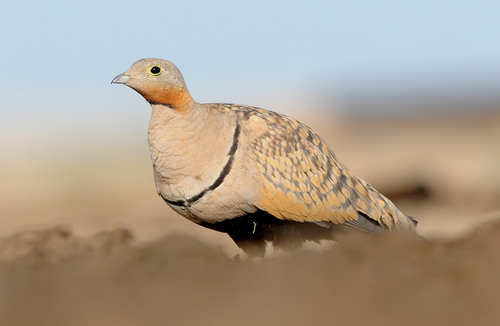
Males have an orange tone around the neck and face, with a sharply demarcated black line across the pale upper breast. The male’s face and throat are yellowish, which faintly contrasts with the greyish crown, neck and breast.
P. e. floweri Female Traits
Females have heavily brown and white mottled breast and neck, and lack the black breast line found in males.
Species Global Distribution
The chestnut-bellied sandgrouse is distributed across most of northern and central Africa, and extends east into western and southern Asia. It occurs mainly in the Afrotropic and Indomalayan biogeographic realms.
Habitat Preferences
This species prefers bare, bushy arid and sandy plains as its habitat. In India, it is most abundant in the Thar or Sindh Desert.
Summer Flocking Behavior
When water is scarce in summer, thousands of these birds often congregate at single waterholes to drink.
Rainy Season Flocking Behavior
When water is more plentiful during the rainy season, the birds travel in smaller flocks.
P. e. floweri Discovery and Early Status
P. e. floweri was first discovered in the mid-19th century, and is endemic to the Nile Valley in Egypt. By the late 19th century, it was the most abundant sandgrouse species in Egypt, but it was already scarce by 1929.
P. e. floweri Rediscovery
The last recorded observation before rediscovery was made on 4 March 1979. This subspecies was rediscovered in the Egyptian Nile Valley in March 2012 by a team of Austrian and German ornithologists.