About Psittacula eupatria (Linnaeus, 1766)
Taxonomy and Naming
The Alexandrine parakeet, with the scientific name Psittacula eupatria (Linnaeus, 1766), is one of the largest parakeet species.
Body Size and Measurements
Individuals measure 56 to 62 cm (22 to 24 in) from the top of the head to the tip of the tail, weigh 200 to 300 g (7.1 to 10.6 oz), and have tails that are 28 to 35 cm (11 to 14 in) long.
Plumage: Head and Torso
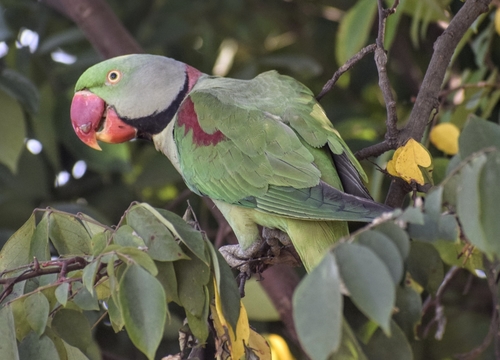
This parakeet is predominantly green, with a light blue-grey sheen covering the cheeks and nape, the back of the neck. It has a yellow-green abdomen, a red patch on the shoulders, and a large red beak with yellow tips.
Tail Coloration
The upper side of the tail shifts from green at the base to blue further along its length, ending in a yellow tip. The underside of the tail is entirely yellow.
Sexual Dimorphism
Alexandrine parakeets are sexually dimorphic as adults. Adult males have a black stripe across their lower cheeks and a pink band on their nape, while adult females have neither marking.
Juvenile Appearance
Young birds look similar to adult females but have shorter tails.
Habitat and Elevation Range
In terms of ecology and behaviour, the Alexandrine parakeet inhabits forests, woodlands, agricultural lands, and mangrove forests, at elevations up to 900 m (3,000 ft).
Diet
It feeds on a wide range of wild and cultivated seeds, buds, fruits, and nuts.
Crop Damage Impact
Flocks of this species can cause extensive damage to ripening fruits and grain crops including maize and jowar.
Social Grouping
It typically lives in small flocks, but will gather into larger groups in areas with abundant food or at communal roosts.
Vocalization Repertoire
The Alexandrine parakeet produces a variety of calls: these include a ringing trrrieuw, loud kree-aar or keeak, repeated deep klak-klak, and a resonant gr-aak. Its calls are generally deeper, harsher, and more resonant than the calls of the rose-ringed parakeet.
Context-Dependent Vocalizations
Its voice becomes harsher when it is alarmed, and it shrieks loudly when mobbing predators. Flocks will occasionally vocalize together excitedly.
Captive Mimicry Ability
This species is known to be capable of imitating human speech when kept in captivity.