About Psitteuteles versicolor (Lear, 1831)
Scientific Naming and Size
The varied lorikeet, scientifically named Psitteuteles versicolor (Lear, 1831), reaches about 19 centimetres (7.5 in) in total length.
Plumage and Distinctive Markings
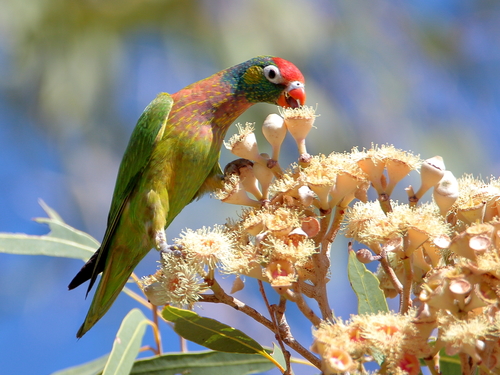
Its plumage is mainly green, marked with short yellow longitudinal streaks; fine yellow streaking and a broad orbital patch are the species' distinctive features.
Head and Facial Features
The lores, forehead, and crown are red, the beak is red, the bare eye-rings are white, the lores are bare, and the irises are orange-yellow.
Breast and Leg Coloration
The upper breast is mauve, with additional longitudinal yellow streaks, and the legs are bluish-grey.
Sexual Dimorphism
Females have less extensive red coloring on the head, and their breast plumage is duller than that of males.
Juvenile Appearance
Juveniles are much duller overall, and are mainly green, with an orange forehead, pale-brown irises, and a brown beak that is orange at its base.
Flight Characteristics
This species has a swift, direct flight, and its contact call is a distinct, shrill screech.
Vocalization Behavior
It gives this call constantly while flying, so flocks are often heard before they are seen.
Movement Pattern
The varied lorikeet is a blossom nomad.
Habitat Types
It inhabits tropical eucalypt forests, wetlands, and grassland areas in northern Queensland, the Northern Territory, and Western Australia.
Geographic Range
Its range extends from Broome in Western Australia across into the Gulf region of the Northern Territory, south to Mount Isa, and north to the Jardine River in Queensland.