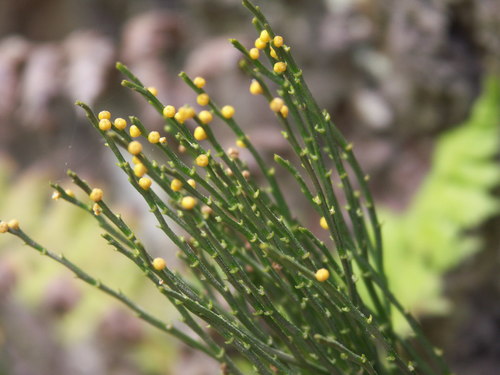
About Psilotum nudum (L.) P.Beauv.
Taxonomic Classification
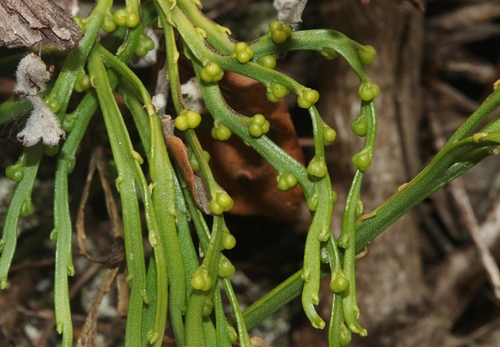
Psilotum nudum, commonly called the whisk fern, is a fern species belonging to the order Psilotales.
Root Morphology
Like all other species in this order, it does not have roots.
Etymology of Scientific Name
Its scientific name translates to "bare naked" in Latin, a reference to the fact that evolutionary reduction has left it lacking, or appearing to lack, most of the organs found in typical vascular plants.
Leaf Morphology
While it is not actually leafless, its leaves are greatly reduced in size.
Global Distribution
P. nudum occurs in tropical Africa, Central America, tropical and subtropical North America, South America, tropical Asia, Australia, Hawaii, southern Japan, Lord Howe Island, and New Zealand, with a small number of isolated populations located in southwestern Europe, specifically in Los Alcornocales, Cádiz province, Spain.
Weed Status
Most weeds are flowering plants, so P. nudum is an unusual weed: it is both nonflowering and rootless.
Tropical Habitat
In tropical regions, this plant often grows as an epiphyte.
Temperate Habitat
In more temperate areas such as southeastern Australia, it typically grows in rock crevices, and thousands of people walk past populations of this species at the Sydney Opera House forecourt every day.
Japanese Cultivation History
This plant grows wild in southern Japan, and was once widely cultivated as an ornamental in Japanese gardens.
Japanese Cultivars
Just over 100 distinct garden varieties were given elaborate, unusual names.
Japanese Cultural Significance
In Japanese, it is called matsubaran, meaning "pine-needle orchid", and it was considered one of the noble plants during the Edo period from 1603 to 1867.
Hawaiian Distribution
The species grows naturally on all of the main Hawaiian Islands.
Hawaiian Common Name
Local Hawaiians know it as Moa, named for its stems that resemble chicken feet.
Traditional Spore Use: Chafing Prevention
Hawaiians historically collected large quantities of its spores to use like talcum powder, applying them under loincloths to prevent chafing.
Traditional Spore Use: Medicinal
The spores were also used medicinally as a purge.
Traditional Hawaiian Children's Game
Hawaiian children played a game called "moa nahele", or cockfighting, using the plant's branch stems. Players interlocked the twigs of Moa and pulled on the ends; the loser's twig broke, and the winner crowed like a rooster.
Hawaiian Lei Use
This species is still commonly used to make traditional Hawaiian leis.
Whisk Fern Etymology
Its common name whisk fern refers to its past use to make small brooms, created by tying a handful of its branches together.
Cultivation Status
It is sometimes grown in cultivation, either accidentally as a weed in greenhouses, or deliberately as one of several cultivated varieties.
Potential Biochemical Use
It may be a useful source of antimicrobial chemicals.