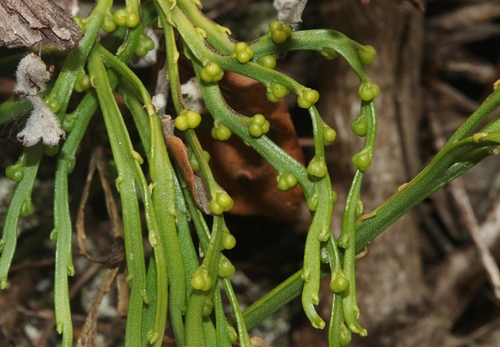
About Psilotum complanatum Sw.
Common Name and Taxonomic Placement
Psilotum complanatum, commonly known as the flatfork fern, is a rare herbaceous epiphytic fern ally belonging to the genus Psilotum. Some evidence suggests it may actually be a true fern that has lost several typically fern-like characteristics.
General Morphology
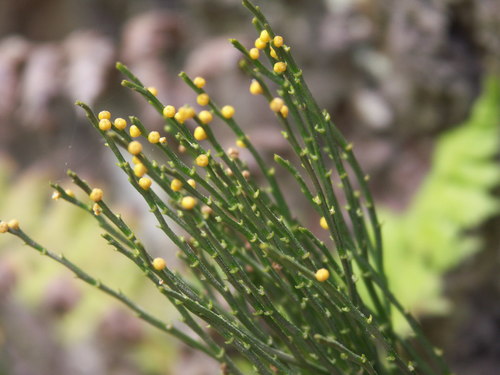
Morphologically, this species is very simple: it lacks true leaves and roots, and produces hanging stems that grow via dichotomous branching. Instead of developed leaves, its stems only bear minute scales.
Stem Vascular Structure
The stems and branches have a protostele structure, with a triangular core of xylem tissue.
Scale Arrangement
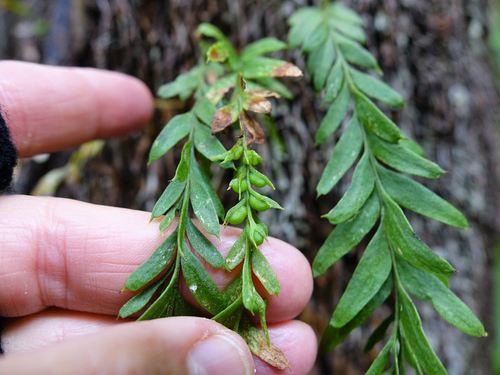
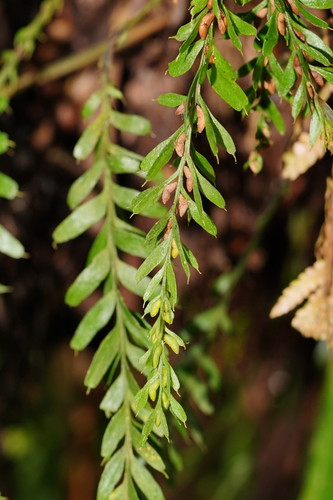
The minute scales are arranged in two rows along the flattened stems and branches.
Stem and Branch Dimensions
Stems are broadly triangular in cross-section, reaching 5 mm in width, while branches measure 1.5 to 2 mm wide. Mature P. complanatum plants reach a total length of 10 to 75 cm.
Stem Branching and Rhizoids
Stems branch repeatedly in pairs along their length, and are covered with brownish hair-like rhizoids.
Sporangia and Sporophylls
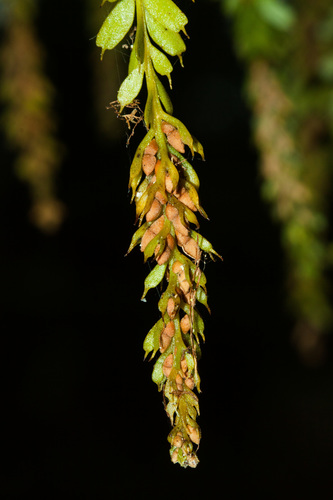
Small stalks terminate in simple sporangia that grow from the axils of minute, bifid, rounded sporophylls.
Spore Characteristics
This species produces bean-shaped, monolete spores. Spores germinate best in dark environments that contain ammonium.
Gametophyte Traits
Its gametophyte is non-photosynthetic, and relies on an association with a fungus to meet its nutritional needs.
Rhizome Traits
Above-ground plants grow from a subterranean rhizome, which anchors the plant and absorbs nutrients through filament-like rhizoids.
Evolutionary Significance
Some botanists consider P. complanatum a surviving member of a very primitive lineage of fern-like vascular plants.
Species Distribution
Psilotum complanatum inhabits moist evergreen forests, and has been recorded on the Malay Peninsula, Australia, the Fiji Islands, Mexico, Hawaii, South America, and in India it has only been reported from the Nicobar group of islands.
Growth Habit
It is typically found growing hanging from tree trunks or other epiphytic plant species.