About Pseudowintera axillaris (J.R.Forst. & G.Forst.) Dandy
Taxonomic Classification
Pseudowintera axillaris is one of four species in the Winteraceae family, and is endemic to New Zealand.
Growth Form and Size
It is a small shrub-like tree that grows up to 8 metres tall, with a trunk reaching up to 10 centimetres in diameter.
Habitat Preference
This species prefers damp, cold, shaded locations in New Zealand forests of the North Island and northern parts of the South Island.
Distinguishing Features Overview
It can be distinguished from other Winteraceae species by several identifying features.
Leaf Appearance
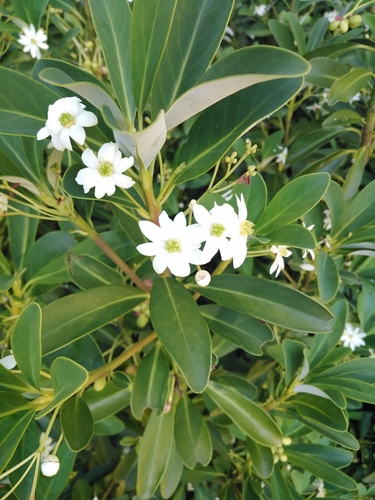
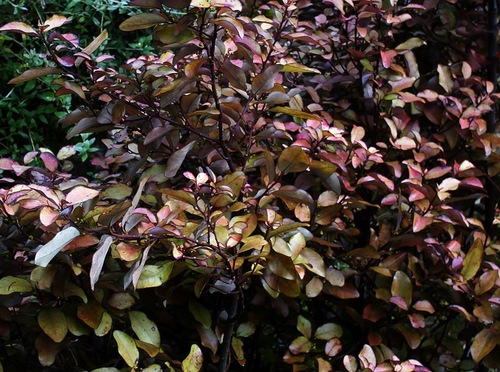
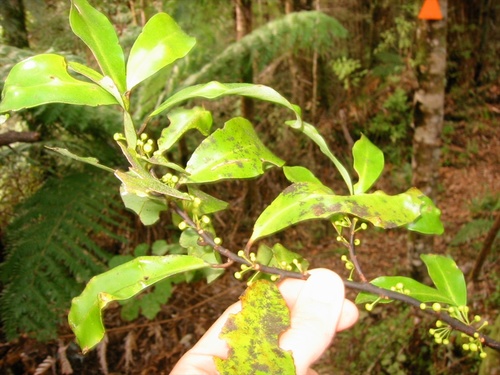
Its leaves are dark green with a natural glossy wax; the underside is pale to glaucous (not white), and the midvein has a pale appearance.
Leaf Markings
Leaf margins are smooth, and unlike many other plant species, P. axillaris usually does not have red or brown blotches or discolouration.
Adult Leaf Dimensions
Adult leaves grow 6–10 cm long by 3–6 cm wide, with red leaf stalks, yellowish midribs, and smooth margins.
Juvenile Leaf Traits
Juvenile leaves have distinctive white net-like secondary veins on their upper surface.
Leaf Taste and Defense
When chewed, P. axillaris has a slight, pleasant peppery taste that deters plant-grazing insects; this is much milder than the extremely spicy peppery taste of related Pseudowintera colorata, which is compared to chili.
Branch and Branchlet Coloration
P. axillaris has very dark red to black branches, with branchlets typically turning more black closer to the leaves.
Species Commonness and Evolutionary Status
It is a very primitive flowering plant, and is the second most common of the four Pseudowintera species (after P. colorata).
Flower General Characteristics
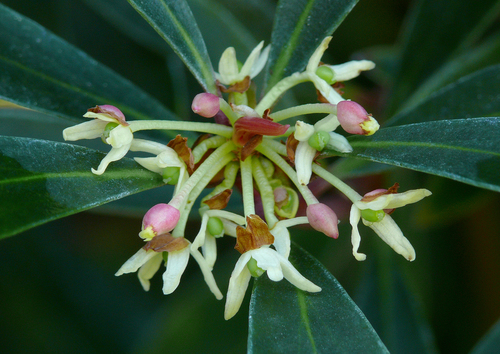
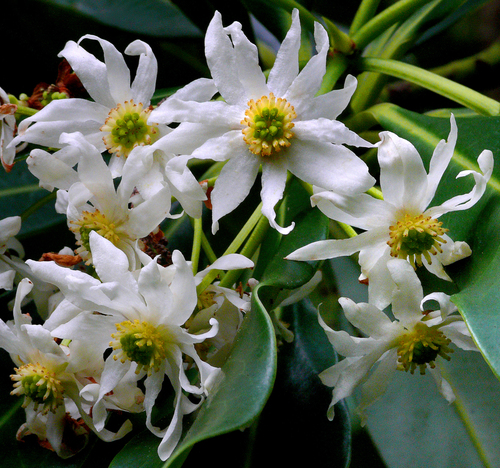
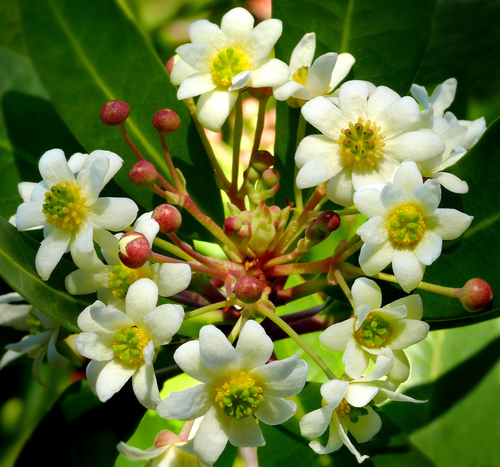
Its flowers are small, 10 mm across, bisexual, borne on fairly long stalks, and greenish-yellow in colour.
Flower Placement
Flowers grow in clusters in leaf axils or in the scars left by fallen leaves.
Flower Perianth Structure
They have 4 to 7 free petals, and a cup-shaped calyx.
Petal Morphology
Petals are 5-6 mm long, narrow-oblong to narrow-obovate, with an obtuse apex.
Flower Reproductive Parts
The flower has 1–6 carpels with apical stigmas, and 6 to 20 very short stamens crowded around a small number of short ovaries.
Fruit Characteristics
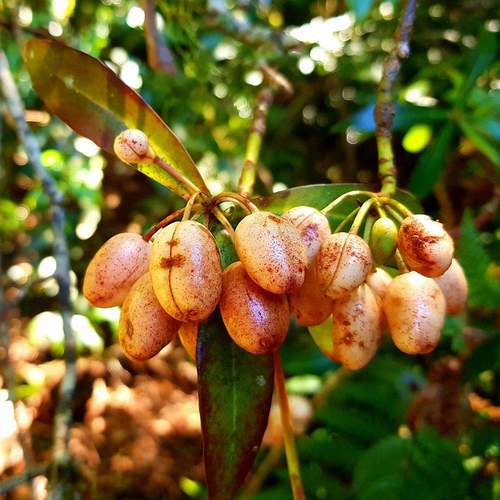
Fruits of P. axillaris are berries: one berry develops from each ovary, forming a fleshy globose to subglobose berry 5-6 mm in diameter that holds 3–6 seeds, and turns orange to red when ripe.
Global Endemism
Globally, P. axillaris is endemic to New Zealand.
Family Distribution Context
It belongs to the Winteraceae family, whose other species are mostly found in southern North America and temperate Asia.
New Zealand Distribution Range
Within New Zealand, P. axillaris is commonly found in lowland and lower montane forests across the North Island and northern South Island, ranging from Kaitaia in the north down to the Marlborough Sounds and the north-west of the South Island.
Regional Abundance
It is particularly common just south of Auckland, especially in the Waitakere region.
Niche Differentiation from Congeners
P. axillaris and P. colorata are very similar and often grow in the same locations across New Zealand; they coexist without strong competition because they occupy different niches: P. axillaris prefers shaded, damp areas and is more common in lowland montane forests, while P. colorata prefers higher light conditions and is more often found along forest edges.
Flowering Period
In terms of life cycle, flowers grow in axillary fascicles from spring (September) to early summer (December).
Fruit Development Timeline
Fruits ripen to red from late spring (October) through January, and persist on the plant until winter (June).
Phenology in Summer Months
The species shows little phenological change during January and February.
Pollination System
Research on the reproductive ecology of P. axillaris found its pollination system is flexible; pollen is transferred by Thrips obscuratus, small flies, and also carried by wind.
Flower Longevity
P. axillaris flowers remain on the plant for 7–11 days.
Anthesis Process
During early anthesis, stigmatic crests are receptive and secrete a small amount of nectar; anthers shed pollen during the last days of flowering.
Pollinator Foraging Behavior
After feeding on one flower, thrips crawl to the next flower, usually on the same inflorescence or branch, visiting both nectar-producing early anthesis flowers and pollen-containing late anthesis flowers.
Reproductive Outcome for Isolated Plants
These insect visits are infrequent, so isolated plants produce very few fruits, and each fruit has a low number of seeds.
Self-Sterility Mechanism
Along with the entire Pseudowintera genus, P. axillaris has high rates of self-sterility, which uniformly occurs at the zygotic stage of embryo development.
Traditional Medicinal Uses Overview
P. axillaris (also called lowland horopito) has a history of medicinal use.
Māori Traditional Applications
In traditional cultures, a decoction of its leaves was used as a stimulant, and to treat stomach aches, skin conditions, and venereal disease; sap or bruised leaves steeped in water were applied to the skin.
Pain Relief Traditional Uses
The internal decoction of leaves was known as 'Maori painkiller' or 'bushman's painkiller' used for stomach aches and pains.
Toothache Treatment
Chewed leaves were applied to treat toothaches.
Early European Settler Uses
Early European settlers used the bark as a substitute for quinine, and sap to treat skin diseases and cure gonorrhoea.
European Internal Uses
They ingested horopito internally as an analgesic and antiseptic, and used it as a quinine substitute for chronic diarrhoea and stomach pain.
Respiratory Condition Traditional Uses
Traditional uses also included treating colds, flus, chest infections, and asthma.
Modern Antifungal Applications
In more recent times, horopito has been used for its antifungal properties to treat bacterial and fungal infections such as Candida albicans.
Medicinal Compound Content
P. axillaris specifically contains high levels of paxidal (2.2-6.9%), a medicinal ingredient used for headaches, toothaches, joint pain, period cramps, and more.
Wood Uses
The dark-red wood of Pseudowintera species including P. axillaris has been used by woodworkers for ornamental work such as carving and inlaying.