About Drimys insipida (R.Br.) Pilg.
Growth Form and Size
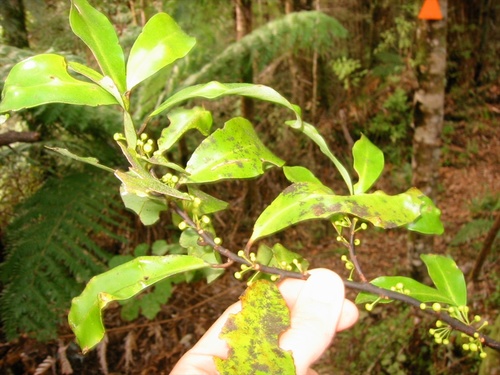
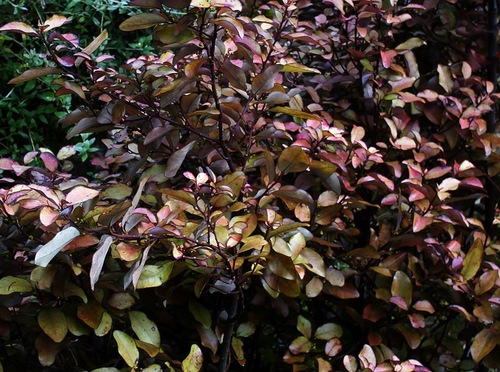
Drimys insipida, also known as Tasmannia insipida, is a shrub or small tree that typically reaches a height of 1.5 to 6 meters (4 feet 11 inches to 19 feet 8 inches), and has smooth branchlets.
Leaf Shape and Texture
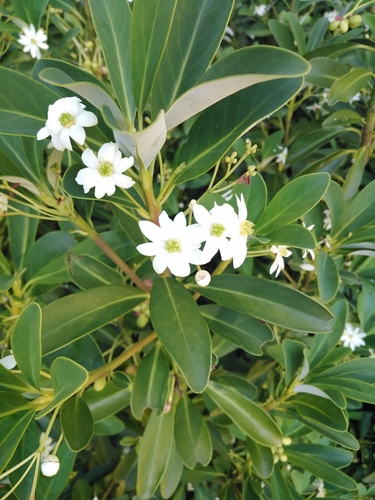
Its leaves have a paper-like texture, and are lance-shaped to egg-shaped with the narrower end toward the base.
Leaf and Petiole Dimensions
The leaves measure 80 to 200 millimeters (3.1 to 7.9 inches) long and 15 to 55 millimeters (0.59 to 2.17 inches) wide, growing on a petiole 1 to 4 millimeters (0.039 to 0.157 inches) long.
Sexual System
This species is dioecious, meaning male and female flowers grow on separate individual plants.
Male Flower Characteristics
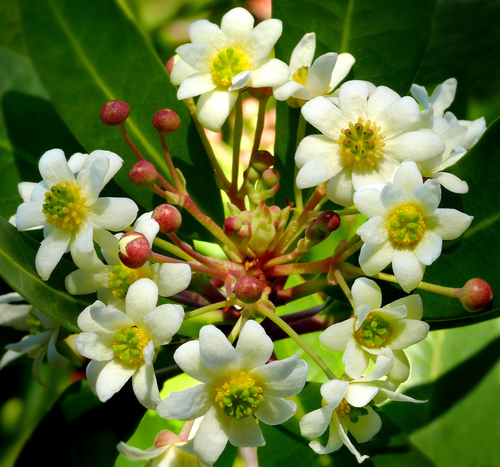
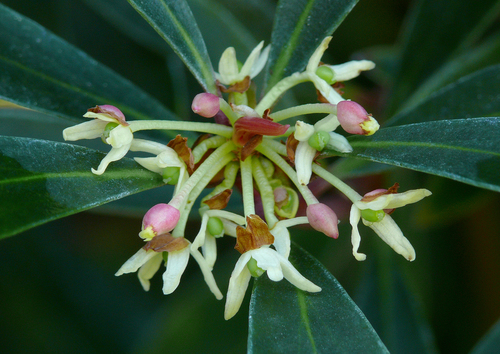
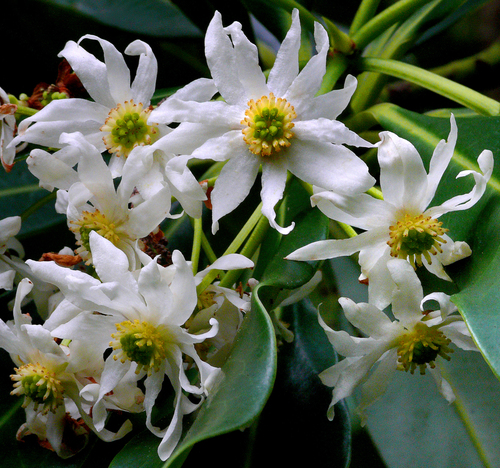
Male flowers form on a pedicel 8 to 50 millimeters (0.31 to 1.97 inches) long, have petals 6.5 to 14.5 millimeters (0.26 to 0.57 inches) long, and contain between 17 and 65 stamens.
Female Flower Characteristics
Female flowers form on a pedicel 8 to 29 millimeters (0.31 to 1.14 inches) long, have petals 5 to 10 millimeters (0.20 to 0.39 inches) long, and have a single carpel holding 15 to 40 ovules.
Flowering Period
Flowering takes place from August to November.
Fruit Characteristics
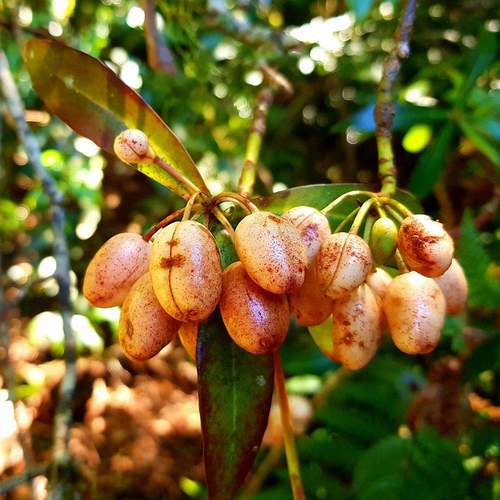
The fruit is a purplish berry 12 to 20 millimeters (0.47 to 0.79 inches) long, which holds 8 to 27 seeds.
Seed Dimensions
The seeds measure 3 to 4 millimeters (0.12 to 0.16 inches) long and 1.7 to 2.5 millimeters (0.067 to 0.098 inches) wide.
Distribution and Habitat
This species occurs in cool wet forests or coastal areas of eastern Australia, ranging from Moruya on the southern coast of New South Wales to the region around Rossville in northern Queensland.