About Pseudotsuga macrocarpa (Vasey) Mayr
Nomenclature and typical size
Pseudotsuga macrocarpa, commonly known as bigcone Douglas-fir, typically reaches 15–30 m (49–98 ft) in height and 56–155 cm (1 ft 10 in – 5 ft 1 in) in trunk diameter.
Growth form and root system
It has a straight growth form, a conical crown 12–30 m (39–98 ft) wide, and a strong, spreading root system.
Bark characteristics
Its bark is deeply ridged, formed of thin, woodlike plates that separate thick layers of cork; bark on trees over 1 m (3.3 ft) in diameter measures 15–20 cm (5.9–7.9 in) thick.
Branch structure
Main branches are long and spreading, with drooping side shoots.
Leaf traits
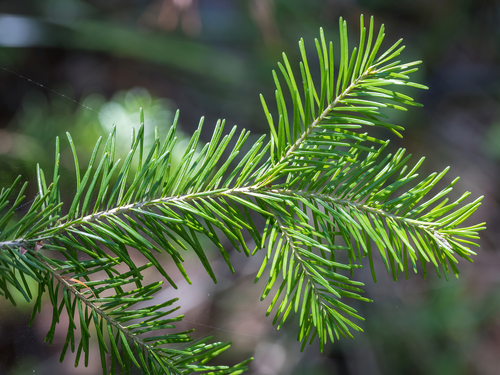
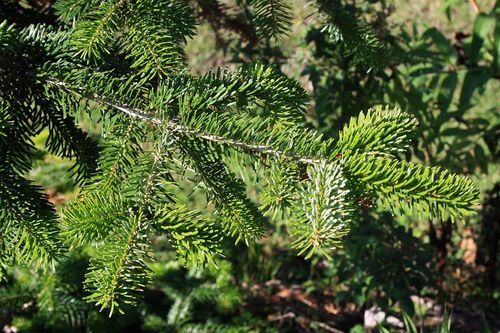
Its leaves are needle-shaped, 2.5–4.5 cm (0.98–1.77 in) long, and are shed after approximately five years.
Female cone characteristics
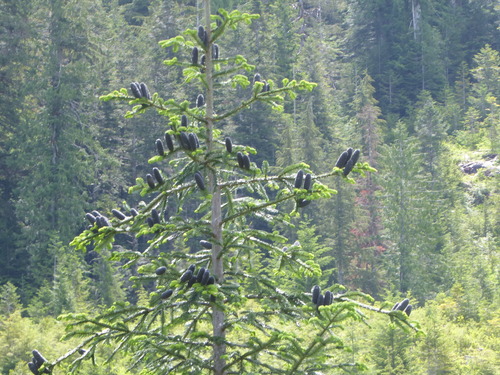
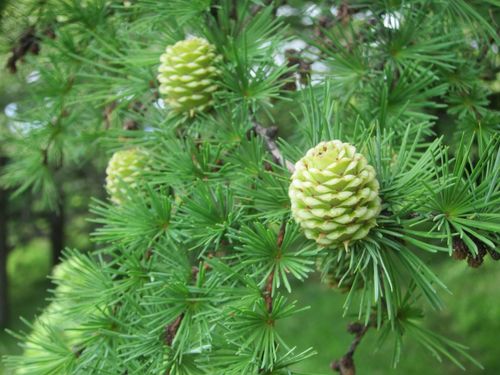
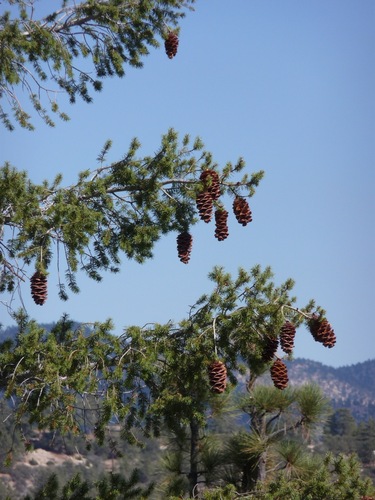
Female cones are 11–17 cm (4.3–6.7 in) long, larger with thicker scales than cones of other Douglas-fir species, and bear protruding three-toothed bracts.
Seed morphology
The seeds are large and heavy: 10 mm long, 8 mm wide, with a short rounded wing 13 mm long.
Seed dispersal
The wing is too small for effective wind dispersal, so seeds are likely dispersed by birds or mammals.
Seed production onset
Trees begin producing seeds at around 20 years of age.
Largest recorded individual
The largest known individual of this species is 53 m (174 ft) tall, 231 cm (91 in) in diameter, and is estimated to be 600 to 700 years old.
Distribution range
This species is restricted to the California montane chaparral and woodlands, and California coastal sage and chaparral ecoregions of California.
Preferred climate
It favors a Mediterranean climate, defined by hot dry summers and wet, mild winters.
Site rainfall data
Over a 30-year period, average annual rainfall at a bigcone Douglas-fir site in the San Gabriel Mountains was 75 cm (30 in), ranging from 25–125 cm (9.8–49.2 in).
Elevation range
Bigcone Douglas-fir grows at elevations between 300–2,700 m (980–8,860 ft).
Low elevation habitat
At low elevations, it grows near streams in moist, shaded canyons and draws, mostly on north- and east-facing aspects.
Mid elevation habitat
At elevations from 1,350–1,700 m (4,430–5,580 ft), it also grows on south- and east-facing slopes, as well as sloping hillsides, ridges, and benches.
High elevation habitat
At higher elevations, it occurs on south and west aspects across all terrain types.
Habitat slope characteristics
The average slope angle where it grows is 35 degrees, ranging from flat ground to 90-degree slopes, though these extreme angles are uncommon.
Occurring mountain ranges
From south to north, the mountain ranges where the species occurs are: Peninsular Ranges (Cuyamaca Mountains, Palomar Mountains, Santa Ana Mountains, San Jacinto Mountains); Transverse Ranges (San Bernardino Mountains, San Gabriel Mountains, Santa Susana Mountains, San Emigdio Mountains, Topatopa Mountains, Santa Ynez Mountains, San Rafael Mountains, Sierra Madre Mountains).
Wildfire tolerance traits
Pseudotsuga macrocarpa has multiple traits that allow it to tolerate and survive wildfire, most notably its very thick bark and the presence of numerous adventitious buds on the upper surfaces of branches.
Post-fire regrowth ability
These buds let trees survive even crown fires that burn off all branchlets; apparently dead trees regrow new green foliage the following spring.
Habitat fire interval
Wildfires in the chaparral habitats where bigcone Douglas-fir commonly grows typically occur at 15 to 50 year intervals.
Association with canyon live oak
Bigcone Douglas-fir is closely associated with canyon live oak (Quercus chrysolepis), and often establishes in the shade of canyon oaks; after roughly 50 years, it grows above the oak canopy.
Associated species richness
Bigcone Douglas-fir communities usually have few associated plant species.
Overstory associates
Common overstory associates include bigleaf maple (Acer macrophyllum), California bay laurel (Umbellularia californica), gray pine (Pinus sabiniana), and white alder (Alnus rhombifolia).
Shrub associates
Shrub associates include bigpod ceanothus (Ceanothus megacarpus), red shank (Adenostoma sparsifolium), eastwood manzanita (Arctostaphylos glandulosa), toyon (Heteromeles arbutifolia), several sage species (Salvia), and coastal sage scrub oak (Quercus dumosa).
Ground cover associates
Ground cover associates are usually sparse, and may include California buckwheat (Eriogonum fasciculatum), wild onion (Allium spp.), scarlet beardtongue (Penstemon ternatus), giant chain fern (Woodwardia fimbriata), and western bracken (Pteridium aquilinum var. pubescens).
Population decline threat
Populations of Pseudotsuga macrocarpa are suspected to be declining due to potentially larger, more extreme, and more frequent wildfires.
Wildfire distribution reduction
When compared to species extent mapped from 1930s historical aerial photos, major wildfires in its range since 2003 have clearly reduced its total distribution.
Post-fire response measurement gaps
While historical records allow detection of stand-level patch changes, post-fire resprouting of mature trees, and natural regeneration and recruitment of the species into higher canopy, have not yet been adequately measured.
Interspecific competition
Incense cedar (Calocedrus decurrens) competes directly with bigcone Douglas-fir; preliminary data shows post-fire regeneration of incense cedar is exponentially greater than that of bigcone Douglas-fir.
Station fire seedling density data
One to two years after the 2009 Station fire in the Angeles National Forest, fixed-radius plots on Mount Wilson recorded an estimated 20:1 ratio of incense cedar to bigcone Douglas-fir seedling density.
Population assessment timeline
It may be more appropriate to calculate population stability estimates five years or much later (such as 20 years) after a large wildfire.
Delayed detection rationale
This is because bigcone Douglas-fir can have immediate and delayed post-fire sprouting and regeneration, interspecific competition occurs, and the species’ strategy of germinating in shrub understories means young plants often go undetected by surveyors until much later in their life.
Mycorrhizae research need
More research is needed to evaluate the role of mycorrhizae in seed establishment of this species, as mycorrhizae are suspected to affect water access in the water-limited wildland systems of southern California where bigcone Douglas-fir grows.
Seed collection recommendation
Researchers recommend developing an aggressive seed cone collection strategy for this species, including extensive collection during heavy cone production years such as 2013, paired with a tracking system to identify correlations between cone production and climatic conditions.
Viability assessment use
This data would create a foundation for assessing species viability under different future climate scenarios.
Reforestation potential
Bigcone Douglas-fir is being considered for more extensive plantings in semiarid locations.
Favorable cultivation traits
Its favorable traits include resistance to drought, fire, insects, decay, and ozone damage, along with its aggressive rooting system and tolerance to a range of growing mediums.
Foliage dieback phenomenon
The needles of older trees sometimes turn yellow and drop, making trees appear dead, only to resprout with renewed vigor within two years.
Dieback possible causes
The cause of this phenomenon is unknown, though drought or insect activity are possible explanations.