About Larix lyallii Parl.
Scientific Name and Size
Larix lyallii Parl. is a small tree that reaches 10 to 25 meters (33 to 82 ft) in height, growing even shorter at higher elevations.
Trunk and Crown
It has a straight trunk with a sparse, somewhat conical crown.
Branch Morphology
Its branches grow horizontally, perpendicular to the trunk, and are irregularly spaced and twisted.
Twig Characteristics
Twigs are covered in fine hairs.
Needle Structure
The needles are four-angled, 20 to 35 millimeters (3⁄4 to 1+1⁄2 inches) long, and crowded in groups of 30 to 40 on short spurs.
Needle Color and Phenology
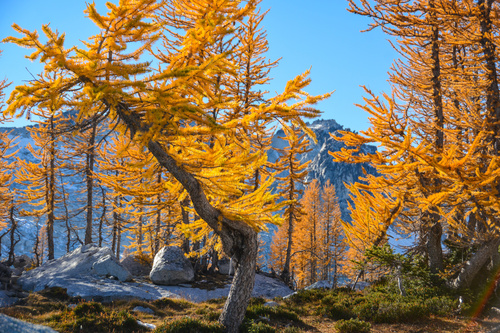
The needles are pale blue-green and deciduous, turning golden yellow in autumn.
Seed Cone Size and Color
The seed cones measure 2.5 to 4 centimeters (1 to 1+1⁄2 inches) long; they are red-purple when young and darken to dark brown as they age.
Seed Cone Morphology
These cones have thin scales and narrow bracts that extend over the scales.
Cone Reproductive Timing
Both pollen cones and seed cones become active in early summer.
Bark Color and Thickness
The bark is thin, around 2.5 cm thick, and changes color from yellow-gray to dark red-brown with age.
Bark Texture
It also develops deep furrows that divide it into small, scaly plates.
Longevity Status
This tree is one of the longest-lived tree species in the world.
Record Old Specimen
There is a recorded specimen in Kananaskis, Alberta, that is estimated to be around 2,000 years old, making it the oldest known tree in Canada.
Bark and Wood Properties
Its bark contains tannin, and its wood is strong, heavy, and durable.