About Naja annulifera Peters, 1854
Species Identification
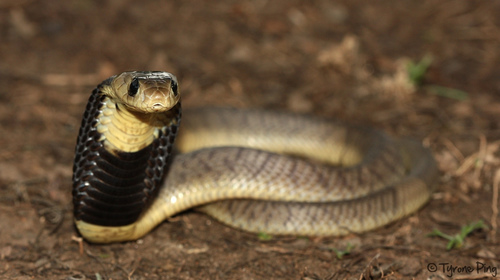
The snouted cobra (Naja annulifera Peters, 1854) is a relatively large cobra species.
Adult Size
Adult individuals average 1.2 to 1.8 metres (3.9 to 5.9 ft) in length, and may reach up to 2.5 metres (8.2 ft).
Dorsal Scale Coloration
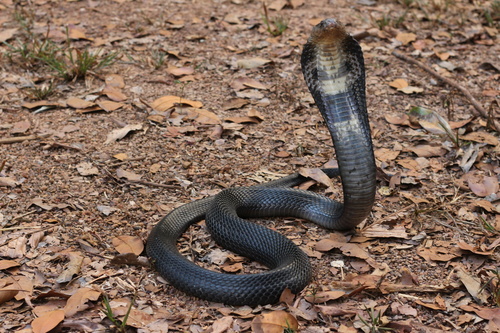
The colour of its dorsal scales ranges from yellowish to greyish-brown, dark brown, or blue-black.
Non-banded Ventral Scale Coloration
Ventral scales are yellow with darker mottled markings.
Banded Phase Characteristics
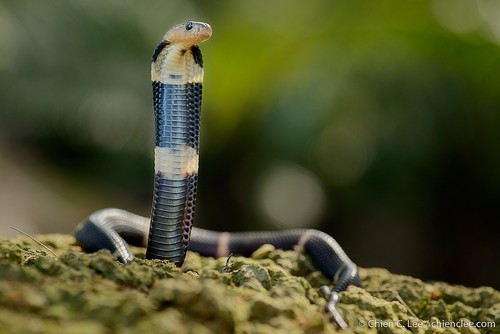
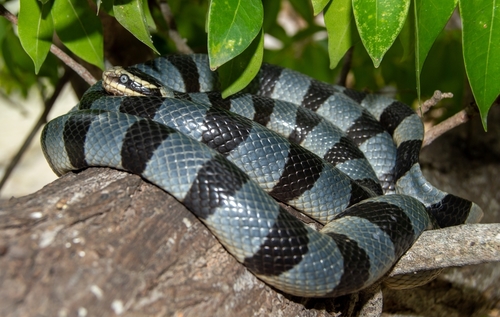
A banded colour phase occurs across the entire species range: individuals in this phase are blue-black with 7 to 11 yellow to yellow-brown cross bars, with the lighter bands half the width of the darker blue-black bands.
Banded Phase Sex Prevalence
This banded phase is more common in males.
Banded Phase Ventral Coloration
Banded phase snouted cobras have a yellow ventral surface mottled with black.
Throat Band Trait
A darker throat band is present, and it is usually more prominent in juveniles.
Geographic Distribution
This species is distributed across northeast South Africa, southern Mozambique, eastern Botswana, Malawi, all of Zimbabwe, and parts of Eswatini.
Habitat Range
Snouted cobras live in both arid and moist savanna, most often in bushveld and lowveld areas.
Unoccupied Habitat
They do not occur in forests.
Lair Preference
As a large cobra, this species typically maintains a permanent home base or lair inside an abandoned termite mound, and will remain in this location for years if left undisturbed.
Foraging Activity Pattern
It is a nocturnal species that begins foraging at dusk.
Daytime Behaviour
During the day, it basks in the sun close to its lair or retreat.
Defensive Temperament
This species can be quite nervous, and will strike to defend itself when threatened.
Typical Threat Display
Like other cobras, when disturbed it usually raises the front third of its body, extends its hood, and hisses.
Large Adult Threat Display
Very large adults can lift up to 0.5 m of their body off the ground while spreading a wide, impressive hood.
Escape Response
When given the opportunity, however, it will escape to the nearest hole or crevice.
Death Feigning Behaviour
Like the rinkhals, it may feign death when threatened, though this behaviour is rare.
Prey Items
It preys on toads, rodents, birds and their eggs, lizards, and other snakes, especially puff adders (Bitis arietans).
Poultry Raiding Behaviour
It frequently raids poultry runs and can become a nuisance.
Natural Predators
Predators of the snouted cobra include birds of prey and other snakes.
Reproductive Mode and Clutch Size
This is an oviparous species that lays between 8 and 33 eggs in early summer.
Hatchling Size
Newly hatched young average 22 to 34 cm (8.7 to 13.4 in) in length.