About Pseudanthus pimeleoides Sieber ex Spreng.
Nomenclature and Habit
Pseudanthus pimeleoides Sieber ex Spreng. is a compact shrub that typically grows up to 60 cm (24 in) tall, and produces many glabrous branchlets.
Leaf Shape and Dimensions
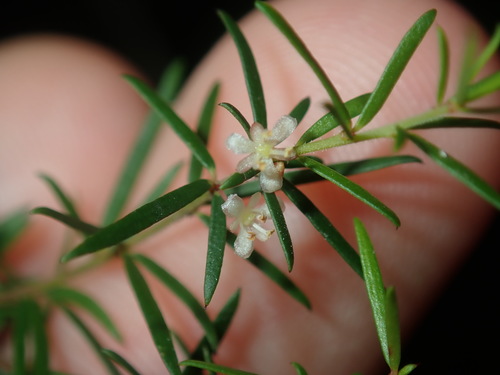
Its leaves are linear to narrowly egg-shaped, measuring 7–13 mm (0.28–0.51 in) long and 1.0–1.7 mm (0.039–0.067 in) wide, and grow from a petiole 0.4–1 mm (0.016–0.039 in) long.
Stipule Characteristics
At the base of each leaf are reddish-brown stipules, which are narrowly triangular or broadly egg-shaped and 1.0–1.3 mm (0.039–0.051 in) long.
Leaf Surface Features
The leaves themselves are glabrous, with a conspicuous mid-rib on their lower surface.
Inflorescence Arrangement
Flowers are arranged singly in upper leaf axils, with 1.0–1.3 mm (0.039–0.051 in) long bracts at their base, though they appear clustered at the ends of branches.
Male Flower Structure
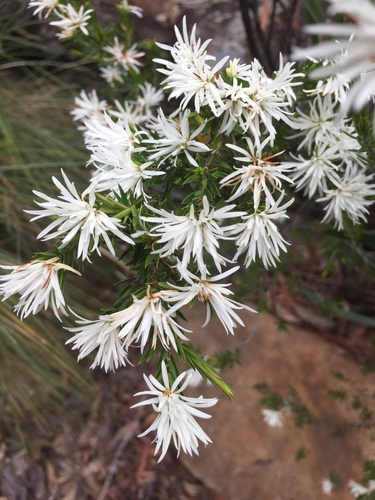
Male flowers sit on a 2–5 mm (0.079–0.197 in) long pedicel, and have six creamy-white tepals that are 5–12 mm (0.20–0.47 in) long and 0.7–1.6 mm (0.028–0.063 in) wide, plus six stamens.
Female Flower Structure
Female flowers are sessile, and have six tepals 1.4–3 mm (0.055–0.118 in) long and 0.5–0.8 mm (0.020–0.031 in) wide.
Flowering Period
Flowering of this species has been recorded from February to November.
Fruit Characteristics
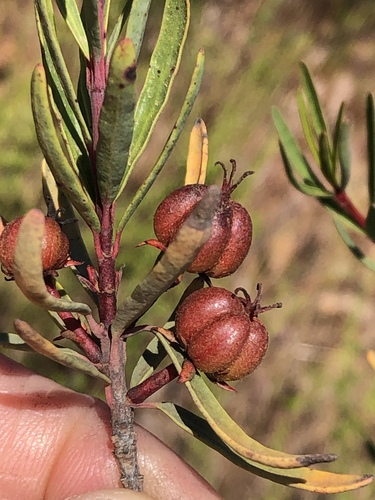
The fruit is a roughly spherical capsule about 4 mm (0.16 in) long and 2.1 mm (0.083 in) wide.
Habitat Preferences
In terms of distribution and habitat, Pseudanthus pimeleoides grows in sandy soil in moist gullies.
Geographic Distribution
It occurs between Colo Heights and Bargo in the Sydney region of New South Wales, with a small number of records also from the upper Hunter Valley.