About Petalostigma triloculare Müll.Arg.
Size
Petalostigma triloculare grows as a small tree reaching up to 15 metres (50 ft) tall, with a maximum stem diameter of 25 cm (10 in).
Trunk and Outer Bark
Its trunk is somewhat swollen at the base, and its outer bark is dark grey with vertical cracks and fissures.
Inner Bark
The inner bark has a very bitter taste.
Small Branches
Small branches are greyish brown, relatively thin, and covered in silky hairs.
Leaf Buds and Stems
New leaf buds are furry; leaf stems are also furry, grey in colour, and measure around 5 to 7 mm long.
Leaf Arrangement and Dimensions
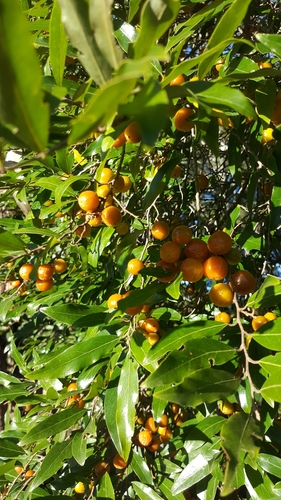
Leaves are arranged alternately along the stem, and are 3 to 9 cm long by 1 to 3.5 cm wide.
Leaf Shape and Surface
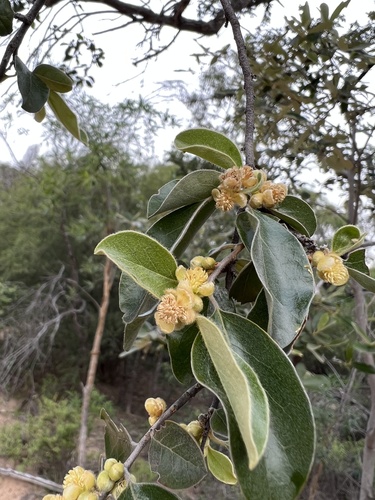
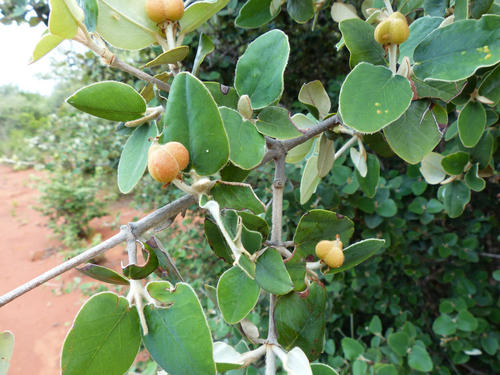
They have a narrow elliptic shape, with a smooth green surface on the upper side, and a felty, dull grey surface on the underside.
Leaf Venation
Leaf veins are more easily visible on the upper side of the leaf.
Southern Distribution
This species ranges south as far as Woolgoolga in New South Wales, where average annual rainfall measures 1,657 mm.
Western Distribution
It can also be found west of the Great Dividing Range near Coolatai and Yetman, where average annual rainfall is only around 640 mm.
Northern Distribution
It grows as far north as Shoalwater Bay, near the Tropic of Capricorn in central east Queensland.