About Pseudanthus orientalis F.Muell.
Growth Form
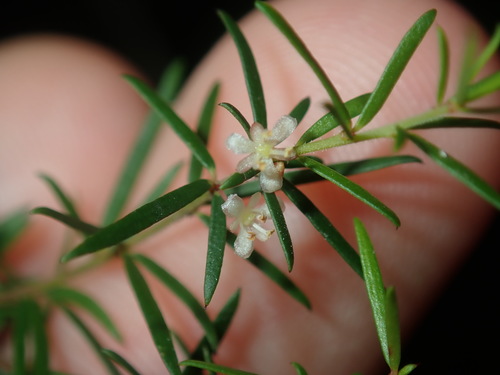
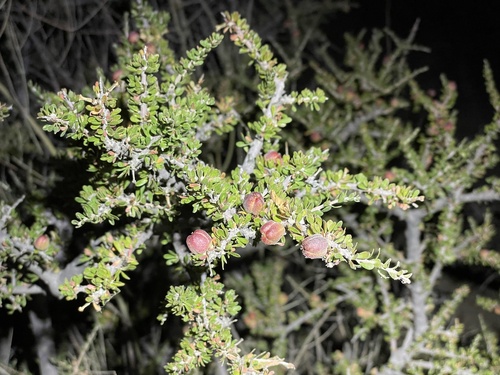
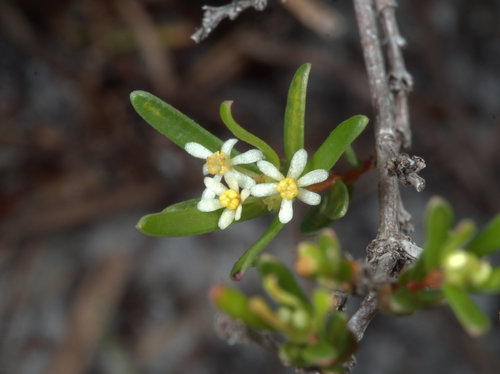
Pseudanthus orientalis is a compact, rigid, glabrous, monoecious shrub. It typically reaches 50 cm (20 in) in height, and has low-lying stems that grow up to 30 cm (12 in) long.
Leaf Shape and Size
Its leaves are linear to narrowly oblong, measuring 3.5–13 mm (0.14–0.51 in) long and 0.7–1.7 mm (0.028–0.067 in) wide.
Leaf Attachment Structures
Each leaf sits on a 0.4–0.6 mm (0.016–0.024 in) long petiole, with pale reddish-brown, broadly triangular stipules 0.5–0.7 mm (0.020–0.028 in) long at the leaf base.
Inflorescence Arrangement
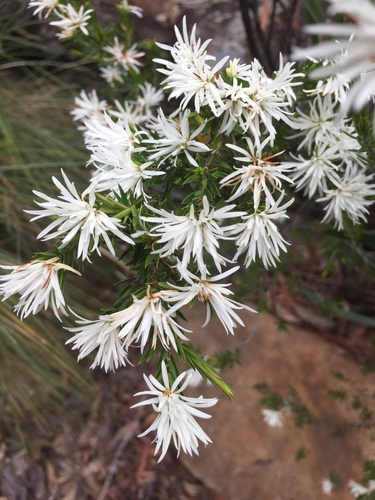
Flowers are arranged singly in leaf axils, but often appear clustered at the ends of branches, with narrowly triangular bracts 0.6–1 mm (0.024–0.039 in) long at their base.
Male Flower Morphology
Male flowers grow on a 1–2 mm (0.039–0.079 in) long pedicel; they usually have 6 narrowly oblong tepals that are pale yellow to creamy-white, 0.9–1.6 mm (0.035–0.063 in) long and 0.4–0.8 mm (0.016–0.031 in) wide, and usually 6 stamens.
Female Flower Morphology
Female flowers are sessile, with 6 pale green tepals that have reddish tips, measuring 1.0–1.4 mm (0.039–0.055 in) long and 0.6–0.7 mm (0.024–0.028 in) wide.
Flowering Period
Flowering has been recorded in most months, with a peak flowering period from August to November.
Fruit Characteristics
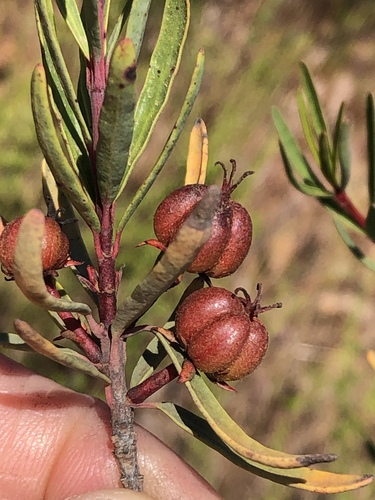
The fruit is a narrowly oval, glossy brown capsule 3.5–4.0 mm (0.14–0.16 in) long.
Habitat and Distribution
This shrub species grows in coastal dunes and coastal heath, distributed along the Australian eastern coast from Shoalwater Bay, Queensland to Botany Bay, New South Wales.