About Proterorhinus semilunaris (Heckel, 1837)
Nomenclature and Size
Proterorhinus semilunaris (Heckel, 1837), commonly called the western tubenose goby, is a small goby fish that most often reaches 12 cm (4.7 in) in length, with an average size of 12.7 cm.
Head and Body Shape
Its body and head are flattened laterally, and the width of the head is usually less than the head's height. The species has a cylindrical body with a flattened ventral surface, which matches the flattened body profile of all tubenose gobies.
Scale Distribution (General)
It has 37–46 large cycloid scales; cycloid scales also cover the crown, nape, upper edges of the operculums, origins of the pectoral fins, belly, and posterior part of the throat.
Scale Distribution (Lateral and Head)
This species lacks scales on its lateral line, while the rows above the lateral line hold 45 to 48 scales. Small scales cover the top of the head behind the eyes and along the body midline.
Mouth and Jaw Features
Its jaws are equal in length, and it has a wide, slightly subterminal mouth with large lips and no barbels.
Ventral Fin and Sucker Structure
It has an abdominal sucker without distinct blades, and its ventral fins are fused into a single suction cup shape.
Swim Bladder Status
The species has no swim bladder.
Distinction from P. marmoratus
It can be distinguished from the closely related marine tubenose goby P. marmoratus by its head length, which makes up 28–32% of the fish's standard length.
Dorsal Fin Structure
The posterior membrane of its first dorsal fin reaches the origin of the second dorsal fin. The first dorsal fin has 7 or 8 spines.
Nostril and Eye Features
The anterior naris reaches the upper lip or the uppermost margin of the lower lip; the tubular nostril is 2–4 centimetres (0.79–1.57 in) long. Eye diameter makes up 16–21% of head length.
Caudal Fin Features
The caudal fin is rounded and has a triangular black spot at its base.
Nostril Tube Naming Origin
Like all tubenose gobies, it gets its common name from its distinct nostril tubes. The western tubenose goby has tubular nostrils, with the nostril tube extending to the upper lip.
Distinction from Round Goby
This feature distinguishes it from the round goby, which lacks these nostril tubes; it can also be told apart from the round goby by its long anterior nostrils and lack of a black spot on the posterior base of its dorsal fin.
Body Coloration
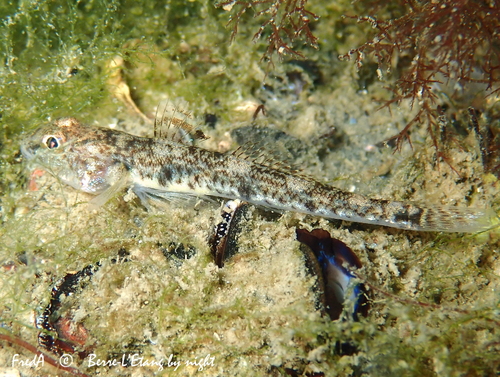
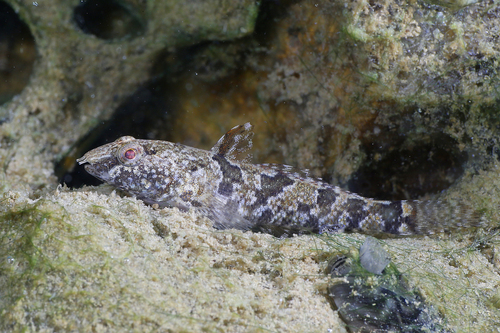
Body coloration ranges from brown to yellowish-gray, with 4–5 dark streaks on the back that transform into spots below the middle of the body. The back and sides also have broad, oblique blotches set against a lighter brown or olive background, while the underside of the fish is cream to white.
Fin Coloration
Fins are typically striped.
Native Range (Basins)
The species is native to fresh waters of the Black Sea basin, and the Maritza and Struma rivers that drain into the Aegean Sea. Its native range includes the Danube River from the delta up to the mouth of the Morava, as well as Danube Lakes from the Prut to Iași.
Native Range (Bulgaria and Western Rivers)
In Bulgaria, it is native to the Kamchiya, Ropotamo, Veleka, and Rezovska rivers. It also inhabits the basins of the Dniester and Southern Bug rivers.
Native Range (Dnieper and Azov Basin)
In the Dnieper river, its natural range extends from the estuary up to the Trubizh River. Within the Sea of Azov basin, it lives in the Don River, Seversky Donets (up to Sviatohirsk), and the Kuban River estuary.
Native Range (Lake Habitat)
It also inhabits Lake Neusiedler.
Non-Native Range (Eurasia)
As a non-native invasive species, it has been recorded in Eurasia in the upper reaches of the Danube and Dnieper rivers, the North Sea basin's Rhine-Main system, and the Vistula. Between 2008 and 2010, it was recorded in the Meuse River along the border between Belgium and the Netherlands.
Non-Native Range (North America Introduction)
This species was introduced to the St. Clair River from Eastern Europe via ship ballast water. It is thought to have spread to Canada and the broader Great Lakes region through use as live bait.
Non-Native Range (North America Spread)
By the early 2000s, it had spread north to the Minnesota-Wisconsin border and east to the border of New York and Pennsylvania.
General Habitat Preferences
Proterorhinus semilunaris inhabits freshwater areas, specifically shallow shore water less than 5 meters deep with slow movement, high plant cover, and abundant macrophytes in lakes and rivers.
Macrophyte Association (Detroit River)
In the Detroit River, tubenose gobies are positively associated with complex macrophytes in the fall, and negatively associated with these macrophytes in the spring and summer.
Dissolved Oxygen Tolerance
The species can withstand extremely low levels of dissolved oxygen.
Nesting Behavior
It creates nests under rocks and logs in shallow water, and individuals aggressively defend their nest sites.
Great Lakes Habitat Potential
These nesting preferences mean the species could potentially inhabit the shallow waters of all five Great Lakes. Currently, the species is not spreading rapidly, but if it expands its range it could become a threat to native Great Lakes species.
Lifespan
Females of this species can live up to 5 years, while males generally have shorter lifespans. Males guard nesting sites to protect their eggs and young.
Spawning Behavior
Spawning occurs multiple times during the warmer months of the year, making the species rather prolific.
Potential Ecological Threat
While the species is not spreading rapidly at present, this prolific spawning could create a threat to the native species rainbow darters and Northern madtoms.