About Pionus senilis (Spix, 1824)
Common Name & Size
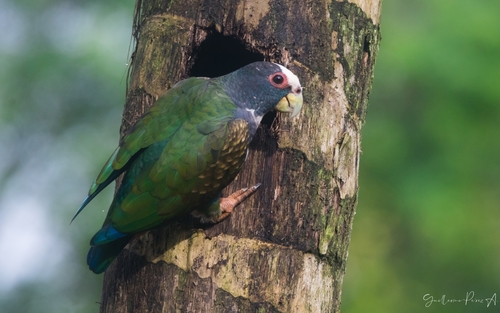
Pionus senilis, commonly known as the white-crowned parrot, is a medium-sized parrot reaching approximately 24 centimeters in length.
General Body Features
It has a broad body, short tail, dark brown iris, a brownish-pink eye ring, and a yellowish bill with a slight green tint.
Head & Throat Coloration
Its forehead, crown, and lores are pure white, with additional white patches on the chin and center of the throat.
Belly Coloration
The belly is mainly green.
Breast Feather Pattern
Feathers on the breast have green base color, with dark blue and purplish-blue tips and a light blue subterminal band.
Cheek & Hindneck Feather Pattern
This scaly feather pattern is also present on the cheeks and hindneck, where feathers have a green base, with light bluish-green and purplish-blue coloration on the subterminal band.
Mantle, Back & Scapular Features
The mantle and back are soft, shiny, and reddish brown; the scapulars are green, with reddish and yellowish-brown tips and outer webs.
Upper Wing Covert Features
Primary coverts are violet blue, and greater coverts are green. The lesser and median coverts are reddish-brown with paler tips, which gives the wing a spotty appearance.
Rump & Tail Covert Features
The rump and upper tail coverts are a brighter green, and the undertail coverts are red.
Wing Coloration
The upper wing has brown patches, and the underwing is pale bluish-green.
Sexual Dimorphism
Both sexes share identical physical characteristics.
Juvenile Plumage
Juvenile white-crowned parrots have green covering the head, hindneck, and breast, with light yellowish cheeks and crown.
General Distribution Range
The white-crowned parrot is widely sympatric across Mexico and western Panama.
Similar Species Overview
It has two commonly noted similar species.
First Similar Species: Brown-hooded Parrot
The first is the brown-hooded parrot (Pyrillia haematotis), which has a brown head and white lores, but lacks a white crown and red undertail coverts. Its body is mainly green, it has visible red axillaries during flight, it has rapid wingbeats, and it produces a high-pitched voice.
Second Similar Species: Blue-headed Parrot
The second similar species is the blue-headed parrot (Pionus menstruus), which is mainly green with a bright blue head and neck, red undertail coverts, and yellowish wing coverts.
Movement & Feeding Behavior
In the wild, the white-crowned parrot has fast wingbeats, and climbs onto branches while feeding.
Social Grouping
It is most often found in pairs or small flocks, except during breeding seasons.
Anti-predator Behavior
It is very cautious: when approached, it will fly away while screeching loudly.
Vocalization Characteristics
Its harsh voice produces screeches like kreeek-kreeek or kree-ah-kee-ah during flight, but the parrot can become quiet and unnoticeable when in the tree canopy.
Pionus Genus Composition
The Pionus genus includes eight species: the white-crowned, white-capped, dusky, blue-headed, bronze-winged, Maximilian, red-billed, and plum-crowned Pionus, all native to Central and South America.
Rarity Status in Genus
Of these eight Pionus species, the white-crowned parrot is the rarest.
Core Distribution Slope
The white-crowned parrot lives on the Caribbean slope of Central America, ranging from southeast Mexico to western Panama.
Detailed Distribution Areas
It is found in southeastern Mexico, from southern Tamaulipas and eastern San Luis Potosí through Campeche and Quintana Roo into Costa Rica, and on both slopes (Chiriquí and western Bocas del Toro) in western Panama.
Population Abundance Hotspot
While the species is distributed across a large area, it reaches its highest abundance in Costa Rica.
Population Trend
Despite being hunted for food, persecuted as a crop pest, trapped for the bird trade, and losing its habitat to deforestation, its population remains classified as stable.
General Habitat Type
Its habitat is the humid tropical zone, including forest and woodland with local pine-oak growth and savanna.
Habitat Elevation & Modified Areas
It is most common in the lowlands and foothills of the Caribbean slope, but has also been recorded in forest edges and cultivated areas that include pastures, scattered trees, and wooded streams.
Diet
Its major food sources are ripening seeds, palm fruits, and crops.
Captive Popularity
Pionus parrots are the earliest known captive parrots, and they have become popular companion birds due to their convenient size and even temperament.
Captive Adaptability
However, most retain wild behaviors, and their ability to adapt to life as a pet varies widely.
Captive Care Consideration
Poor adaptive ability can lead to a range of behavioral problems, so understanding the species' wild behavior and habits can help bird keepers improve their birds' living conditions.