About Amphibolurus muricatus (White, 1790)
Species Introduction
Jacky dragon (Amphibolurus muricatus) is a lizard species with characteristic morphological features.
Base Body Coloration
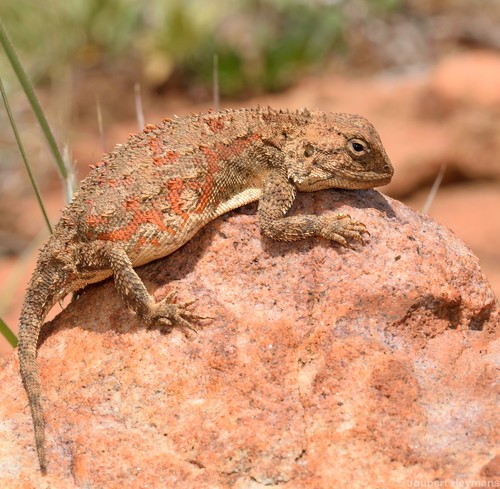
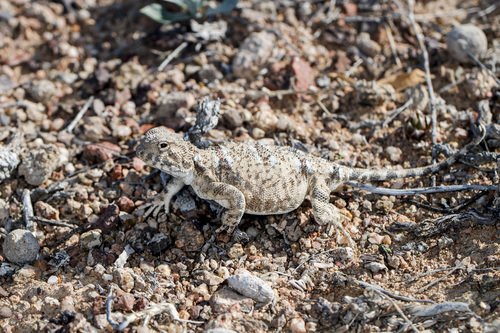
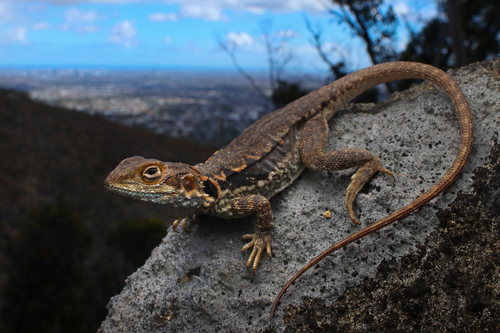
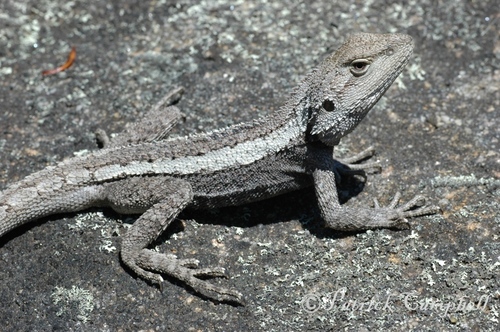
Its base body color ranges from pale grey to dark brown, with dark patches running along the middle of the back. These dark patches are broken up by pale blotches that often blend to form a continuous stripe from above the arm to the groin.
Facial Markings
A dark brown bar runs between the eye and ear, but unlike many other dragon lizard species, it has no dark stripe between the nostril and eye. The lips and lower jaw are typically lighter in color than the rest of the head.
Mouth Lining Coloration
A defining feature is the bright yellow lining of the mouth, though some individuals have orange-red coloring at the inner corners of the mouth – this trait may have led to its alternative common name of blood-sucker.
Crest Features
It can be clearly identified by five distinct crests: a nuchal crest that connects to a vertebral row of enlarged scales, a paravertebral row running from the nape to the base of the tail separated from the vertebral row by two or three scales, and one dorsolateral row on each side of the body.
Scale Characteristics
The hind legs are covered by a mix of large spinose scales and small keeled scales, and spinose scales are also present on the sides of the neck.
Tympanum Features
The tympanum (eardrum) is medium-sized and quite easy to see.
Total Length
The average total length including the tail is 230 mm (9 in), with the largest recorded individual reaching 445 mm (17.5 in). The tail is typically twice as long as the body.
Body Mass
The average body mass is 30 g, while the largest recorded individuals weigh around 67 g.
Sexual Dimorphism
Head size can be used to distinguish between sexes, as males usually have noticeably larger heads.
Geographic Distribution
Jacky dragons are distributed along the southeastern coast of Australia, ranging as far north as central Queensland, and occurring through New South Wales, Victoria, and into the southeastern portion of South Australia.
Primary Habitat
They most commonly inhabit dry sclerophyll forests and woodlands. They are found in the eastern highlands, but do not live in alpine areas.
Arboreal Behavior
They are semiarboreal, and individuals are frequently observed perching on fallen or standing timber.
Gravid Female Period
Gravid female jacky dragons occur from October to February, and females can lay up to eight eggs per clutch. Clutch size is positively correlated with female body size.
Clutch Laying Habits
Most adult females lay at least one clutch every summer, and they typically lay their clutches under bark or decaying vegetation over sandy deposits.
Hatchling Emergence
Hatchlings first appear at the end of December, and become abundant by February. Newly hatched jacky dragons are usually around 75 mm (3 in) in total length.
Temperature-Dependent Sex Determination
Hatchling sex is determined by nest temperature, a mechanism called temperature-dependent sex determination (TSD). In this species, low and high nest temperatures produce female hatchlings, while medium temperatures produce male hatchlings.
Seasonal Sex Ratio Pattern
As a result, clutches laid earlier in the season produce mostly male offspring.
Nest Temperature Control Hypothesis
Researcher Shine has proposed that hatchling sex is determined soon after egg-laying, when the mother still has substantial control over nest temperature.
TSD Evolution Hypothesis Contradiction
This finding may contradict the common hypothesis that TSD evolved in lizards to match offspring sex to unpredictable environmental conditions at the time of laying, a pattern thought to hold for turtles, tuataras, and crocodiles.
Current TSD Evolution Research
Recent research instead suggests that TSD evolved in lizards to ensure the reproductive success of offspring.
Sexual Maturity Timeline
Jacky dragons reach sexual maturity quickly: females can produce their first clutches within one year of hatching.
Lifespan
The average lifespan of the jacky dragon is four years, which is much shorter than the average lifespan of most lizard species.