About Podolobium procumbens (F.Muell.) Crisp & P.H.Weston
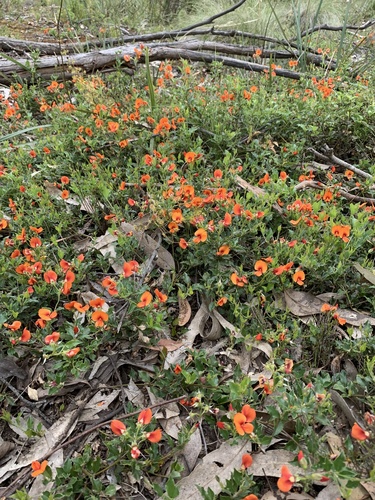
Podolobium procumbens is a low, spreading shrub that reaches up to 0.3 m (1 ft 0 in) in height. It has smooth stems and forms a lignotuber. Its leaves are arranged oppositely or in whorls, and are oval-shaped, measuring 1–2.5 cm (0.39–0.98 in) long and 6–18 mm (0.24–0.71 in) wide. The upper leaf surface is smooth, wavy, shiny and veined, while the lower surface has occasional hairs. Leaves end in a pointed apex and are borne on a 3 mm (0.12 in) long petiole. Inflorescences form as small clusters at branch ends or in leaf axils, and are borne on a silky pedicel 4–10 mm (0.16–0.39 in) long. The bracteoles are narrow lance-shaped. The calyx is 6–9 mm (0.24–0.35 in) long and covered in flattened, soft, short hairs. The corolla is 10–14 mm (0.39–0.55 in) long, and is orange with red markings. The standard petal is nearly orb-shaped, orange with a red centre; the wing petals are orange; and the keel is reddish. Flowering takes place from November to January. The fruit is an oblong pod 10–15 mm (0.39–0.59 in) long, which can be straight or curved, and is covered with long, straight, soft hairs. This species, commonly known as trailing shaggy-pea, grows in sclerophyll forests and woodland in Victoria and south-eastern New South Wales.