About Senna glutinosa (DC.) Randell
Taxon Identity and Growth Form
Senna glutinosa (DC.) Randell is an erect or straggling shrub or small tree, more or less hairless, that typically reaches 0.3–4 m (1 ft 0 in – 13 ft 1 in) in height.
Surface Texture
Its stems, leaves, and outer flower structures are sticky.
Leaf Structure
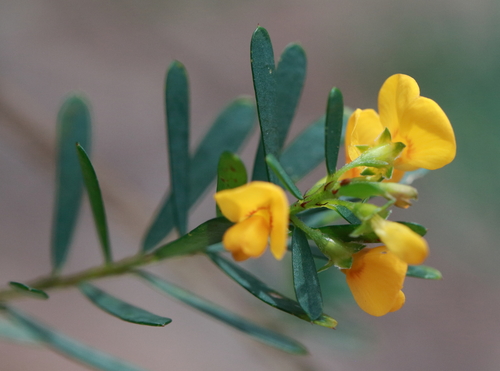
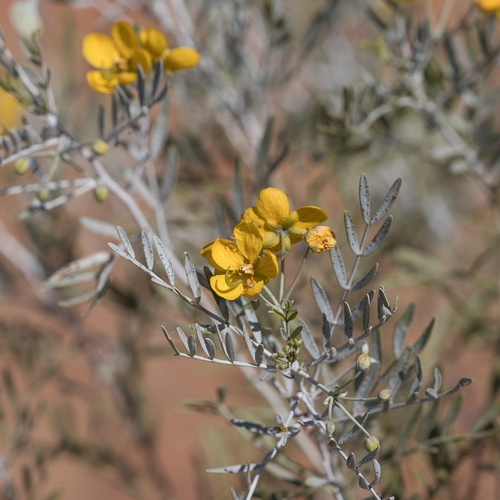
The leaves are pinnate, with up to seven pairs of leaflets spaced more than 6 mm (0.24 in) apart, growing on a petiole longer than 6 mm (0.24 in).
Leaflet Variation
Leaflet size and shape vary by subspecies.
Flower Arrangement and Color
This species produces yellow flowers clustered near the ends of branches.
Sepal Characteristics
Its sepals are oval, greenish-yellow, and 8–10 mm (0.31–0.39 in) long.
Petal Characteristics
The petals are oval, 11–15 mm (0.43–0.59 in) long.
Stamen Characteristics
Each flower has ten fertile stamens, with anthers 4–5 mm (0.16–0.20 in) long.
Fruit Characteristics
The fruit is a flat pod 50–70 mm (2.0–2.8 in) long and 10–20 mm (0.39–0.79 in) wide.
General Distribution
Senna glutinosa grows in arid shrubland across all mainland Australian states and the Northern Territory, with the exception of Victoria.
Subspecies Ranges
The different subspecies have distinct ranges: subspecies chatelainiana grows in central west Western Australia; subspecies glutinosa occurs from north-west Western Australia through the Northern Territory to north-western South Australia; subspecies × luerssenii grows from the central coast of Western Australia to near the Northern Territory border; and subspecies pruinosa is found from north-western Western Australia to far northern South Australia, far western Queensland, and far western New South Wales.