About Podocnemis unifilis Troschel, 1848
Maximum Size and Weight
Podocnemis unifilis is a large turtle that reaches a maximum length of 45 cm and a maximum weight of 8 kg.
Carapace Characteristics
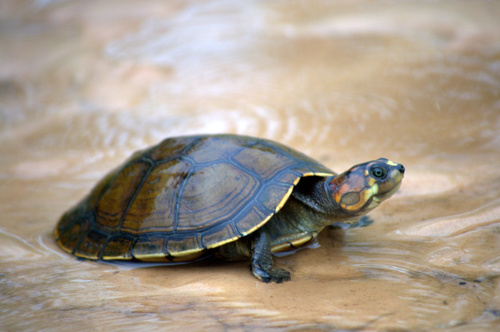
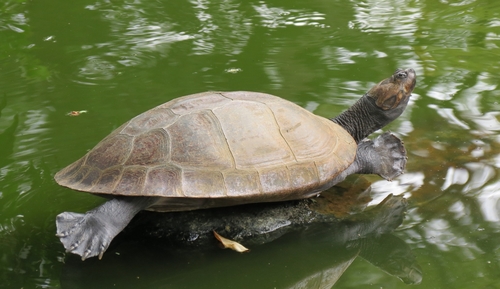
This species can be identified by its black or brown oval upper shell (carapace), which has distinct low keels on the second and third scutes.
Head Markings
Yellow spots on the sides of the head give the species its common name; these spots are most visible in juveniles and fade as individuals age.
Sexual Size Dimorphism
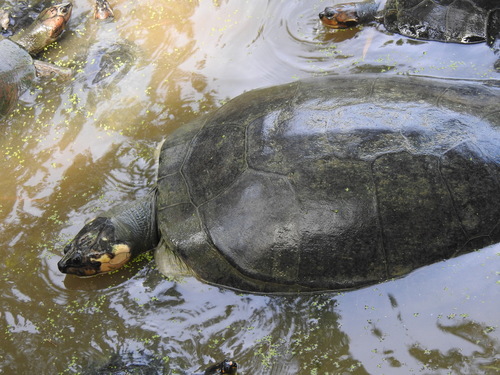
Females can grow up to twice as large as males.
Native Range
Podocnemis unifilis is native to the Amazon and Orinoco basins of South America, as well as the river systems of the Guianas.
Typical Habitat
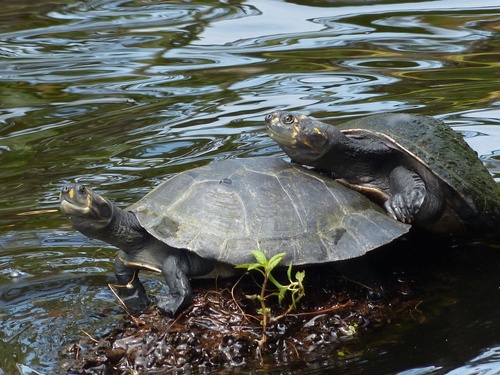
It inhabits naturally calm waters including tributaries and large lakes.
Flood Season Movement
During flood season, these turtles may move into flooded forests or floodplain lakes.
Adult Diet
Their diet consists of fruits, seeds, weeds, aquatic plants, fish, and small invertebrates.
Clutch Size
Females produce two clutches of eggs per year, with each clutch holding between four and 35 eggs.
Nesting and Incubation Period
Females build nests in sandy areas along river banks, and eggs hatch between 66 and 159 days after being laid.
Nesting Timing
Egg laying takes place at the peak of the dry season to prevent nests from being washed away by rainy season floods.
Temperature-Dependent Sex Determination
Eggs incubated below 32 degrees Celsius develop into males, while those incubated above 32 degrees Celsius develop into females.
Hatchling Foraging Behavior
Within a few days of hatching, young turtles begin to forage for food on their own.
Hatchling Diet
The diet of young turtles includes vegetable matter, grasses, fruits, leaves, carrion, and mollusks.