About Podocnemis expansa (Schweigger, 1812)
Nomenclature
The Arrau turtle, scientifically named Podocnemis expansa, has multiple common names including the South American river turtle, giant South American turtle, giant Amazon River turtle, Arrau sideneck turtle, and Amazon River turtle; it is often referred to simply as the Arrau.
Size Distinction
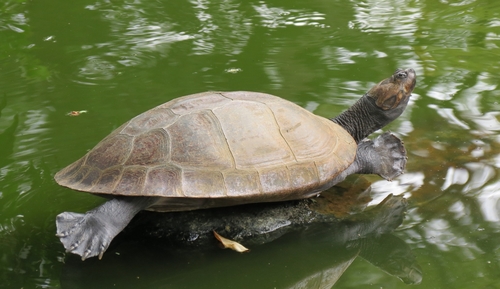
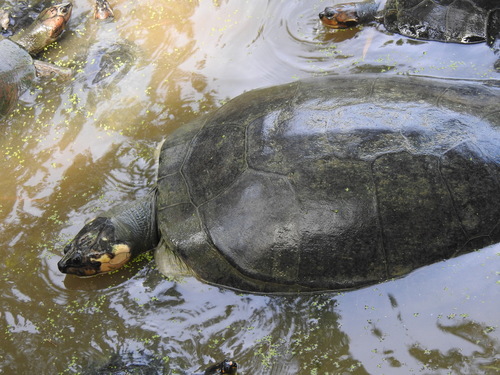
This species is the largest of all side-neck turtles (Pleurodira), and also the largest freshwater turtle native to Latin America.
Diet and Nesting Behavior Basics
Arrau turtles feed primarily on plant material, and they typically nest in large groups on beaches.
Threats
The Arrau turtle faces serious threats from hunting of adult individuals, egg collection, pollution, habitat loss, and dam construction.
Geographical Range
Arrau turtles inhabit the Amazon, Orinoco, and Essequibo basins across Brazil, Bolivia, Peru, Ecuador, Colombia, Venezuela, and Guyana.
Vagrant Records
Occasionally, individual turtles end up in Trinidad, most often after flood events.
Habitat Types
They occupy deep rivers, ponds, freshwater lagoons, and flooded forest, and can live in white-water, black-water, and clear-water environments.
Breeding Migration
As the breeding season approaches, Arrau turtles migrate to specific egg-laying sites.
Colonial Nesting Benefit
In many locations, large groups of turtles gather to nest on beaches, a behavior that lowers individual risk from predators.
Nesting Colony Size
Some beaches host as many as 500 nesting females.
Mating Location
Mating takes place in the water.
Basking Behavior Pre-Nesting
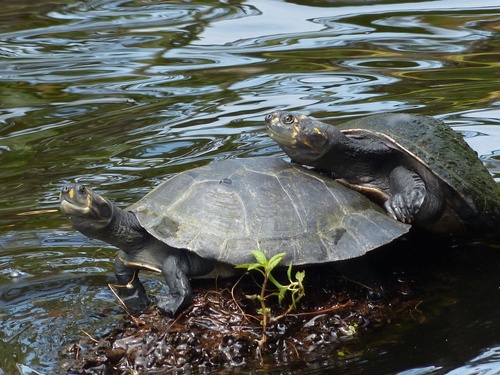
During and just before the nesting season, the turtles frequently bask, usually in groups.
Basking Function Hypothesis
Researchers suspect that the extra heat from basking speeds up ovulation in female turtles.
Terrestrial Occurrence
At all other times of year, the species is generally not found on land.
Anti-Predator Behavior On Land
When on land, Arrau turtles are very shy, and will retreat into the water at the slightest sign of danger.
Clutch Size
A female Arrau turtle lays an average of 75 to 123 eggs per clutch, and the average clutch size varies by region.
Nest Excavation
She digs a 60 to 80 cm (2.0 to 2.6 ft) deep nest on the beach at night to deposit the eggs.
Egg Laying Timing
Eggs are laid during the low water season, and hatch when water levels begin to rise.
Flood Risk To Nests
If water levels rise too quickly or too early, the nest becomes flooded and the unhatched young die.
Hatching Success Rate
If predators do not dig up the nest, hatching success is usually high, with an average rate of 83%.
Incubation Period
Eggs hatch after approximately 50 days.
Temperature-Dependent Sex Determination
The sex of hatchlings is determined by nest temperature: higher temperatures produce females, while lower temperatures produce males.
Hatchling Size And Dispersal
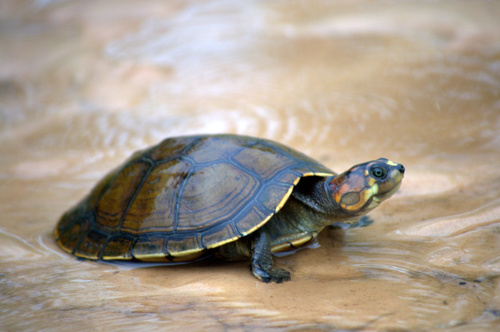
When they hatch, young turtles are around 5 cm (2 in) long, and move directly toward the water.
Hatchling Survival Rate
However, many predators target hatchlings as they emerge, and only about five percent of all hatchlings ever reach adult feeding grounds.
Post-Hatching Parental Association
When eggs hatch, female Arrau turtles produce sounds that attract the newly hatched young, and the group stays together for a period in the flooded forest.
Vocalization Function
Vocalizations play an important role in the social life of Arrau turtles.
Recorded Vocalization Types
In addition to the call that connects females to their newly hatched young, four distinct primary sounds have been recorded during the nesting season: one used during migration, one before basking, one while nesting at night, and one when the turtle is in the water after nesting.
Known Lifespan
In the wild, Arrau turtles can live to 20 years of age or older, and captive individuals have lived for at least 25 years.
Estimated Maximum Lifespan
Scientific models estimate that the largest individual Arrau turtles may be as old as 80 years.