About Podocnemis lewyana Duméril, 1852
Sexual Dimorphism Overview
Magdalena River turtles (Podocnemis lewyana) exhibit sexual dimorphism.
Shell Characteristics
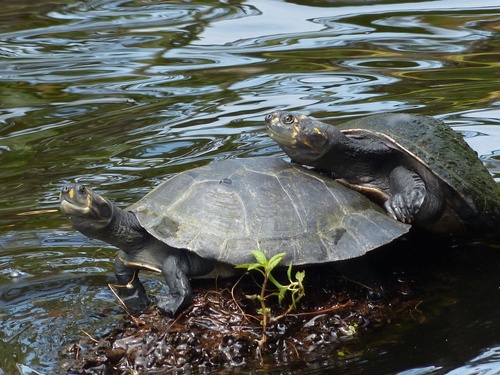
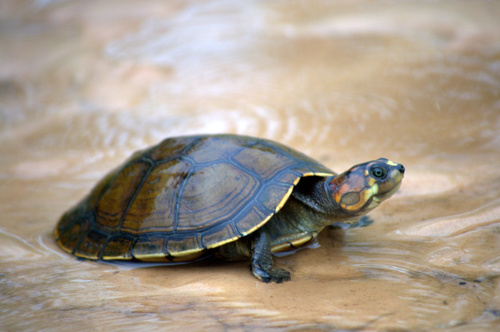
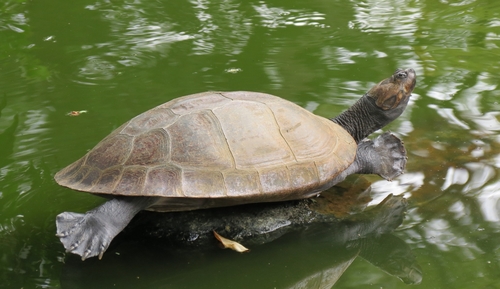
Both males and females have a shell made up of shield-like plates that are primarily brown.
Head and Neck Structure
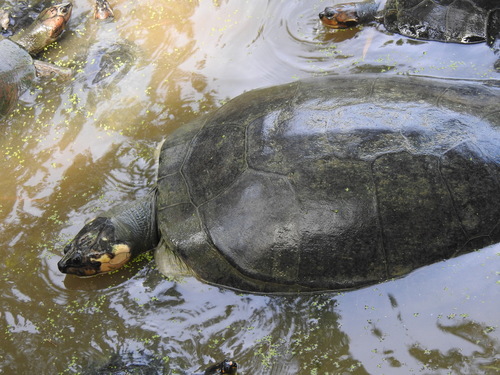
Their necks connect to a robust head. Males have grayish-brown head scales, while females have head scales that are more reddish-brown.
Adult Size and Weight
On average, adult males weigh 1.6 kg and have a carapace length of 24.6 cm, while adult females average 5.6 kg in weight and 37 cm in carapace length.
Feeding Behavior
This species is generally considered mostly herbivorous, but opportunistic insectivorous behavior has been observed. Juveniles sometimes act as piscivores, hunting fish.
Wild Lifespan
In the wild, the average lifespan of Magdalena River turtles is 10 to 15 years.
Reproductive Mode
Magdalena River turtles are iteroparous.
Sexual Maturity Age
Males reach sexual maturity at 3 to 4 years old, while females reach sexual maturity at 5 to 6 years old.
Nest Site Selection
Females build nests on sandy riverbanks formed in shallow water areas.
Nesting Seasons
This species has two separate nesting seasons each year: December to January, and June to July. It is not currently known whether individual females will nest during both seasons in the same year.
Seasonal Egg Traits
Higher total egg counts are seen during the June to July nesting season, while average egg weight is significantly higher during the December to January nesting season. Because egg weight is positively correlated to hatching weight, researchers have proposed that protecting both nesting seasons is equally important.
Clutch Size
The average clutch size for this species is 22 eggs.
Sex Determination Mechanism
Embryos in these eggs have temperature-dependent sex determination.
Pivotal Incubation Temperature
The species’ pivotal temperature, which is the incubation temperature that produces an even 1:1 sex ratio, is 33.4 °C.
Temperature Effect on Hatchling Sex
Incubation temperatures below this pivotal temperature produce a higher percentage of male hatchlings, while temperatures above it produce a higher percentage of female hatchlings.
Climate Change Concern
Researchers have raised concerns about how climate change may affect this evolved developmental strategy.