About Plethodon wehrlei Fowler & Dunn, 1917
Dorsal Body Coloration
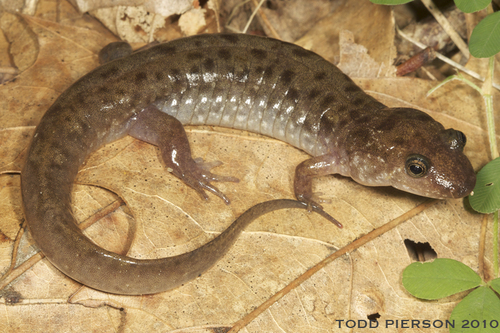
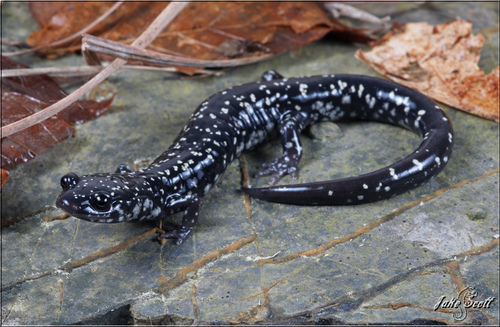
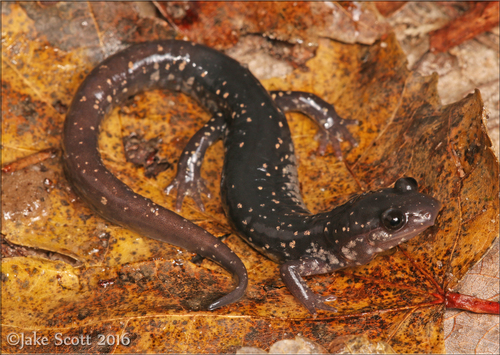
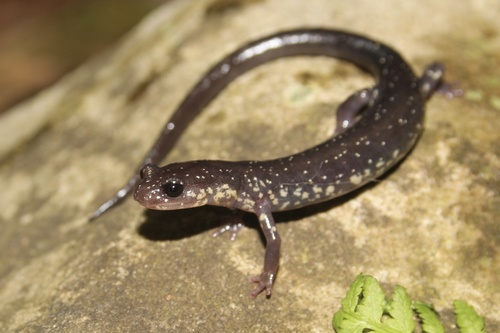
Plethodon wehrlei, commonly known as Wehrle's salamander, has a bluish-black body with large, scattered white spots on its back.
Lateral Body Coloration
Its sides are covered in spots and blotches that range from white to yellow.
Ventral Body Coloration
The belly and ventral surface of the tail are solid gray, while the throat and upper chest usually have white or yellowish blotches.
Adult Size
Adult individuals of this species reach a total length between 10 and 17 centimeters, or 3.9 to 6.7 inches.
Geographic Range
Geographically, Wehrle's salamander ranges from New York south to Virginia.
Taxonomic Reclassification of Southwest Virginia/North Carolina Populations
Populations previously classified as this species in southwestern Virginia and northwestern North Carolina were reclassified as a separate species, the Blacksburg salamander (P. jacksoni), a reclassification that was confirmed by a 2019 study.
Taxonomic Reclassification of Virginia Cave Population
An isolated cave-dwelling population in Virginia was also reclassified as a distinct species, the Dixie Caverns salamander (P. dixi), which was also reaffirmed in the 2019 study.
Taxonomic Reclassification of Cumberland Plateau Population
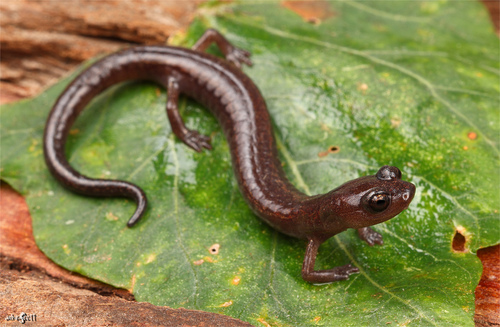
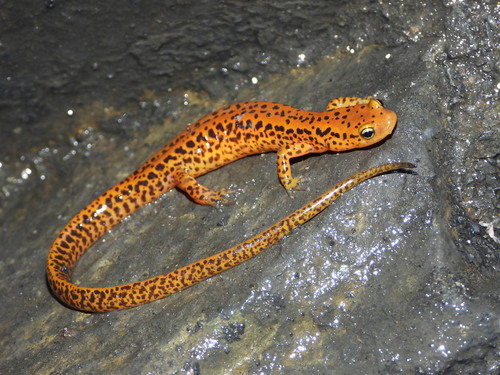
The population on the Cumberland Plateau, once considered a yellow-spotted color morph of P. wehrlei, is now recognized as a new species, the yellow-spotted woodland salamander (P. pauleyi), described in the 2019 study.
Activity Pattern
For behavior and habitat, this salamander stays under cover during the day, and emerges to forage at night.
Forested Hillside Habitat
It inhabits forested hillsides in the Appalachian Plateau, where it hides during the day beneath stones or rocks.
Additional Habitat Locations
It is also found at cave entrances, in deep rock crevices, and in burrows under rocks and logs.
Mating Period
Regarding reproduction, mating takes place from fall through spring.
Egg Laying
A large cluster of eggs is laid in early summer, placed in damp logs, soil, moss, or cave crevices.
Reproduction Frequency
Reproduction occurs on a biennial or irregular schedule, with many mature females not breeding each year.