About Plethodon teyahalee Hairston, 1950
Common Name and Basal Appearance
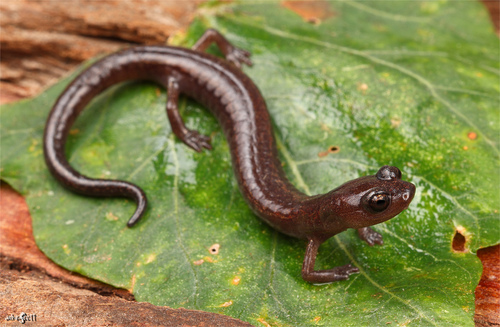
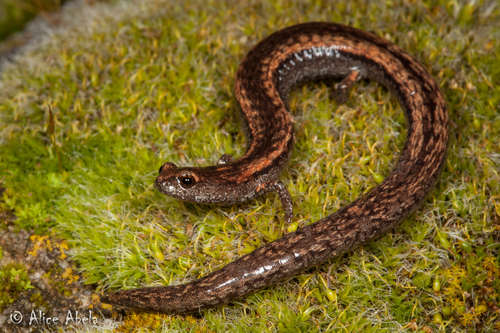
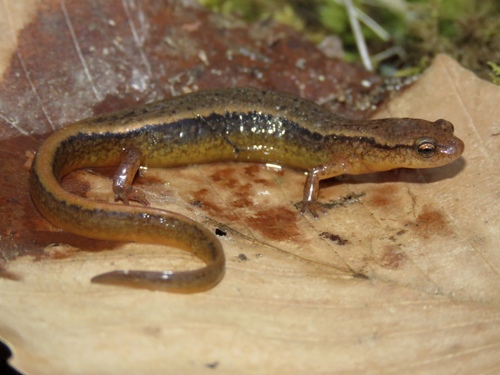
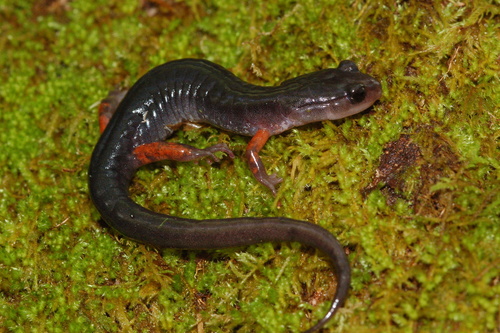
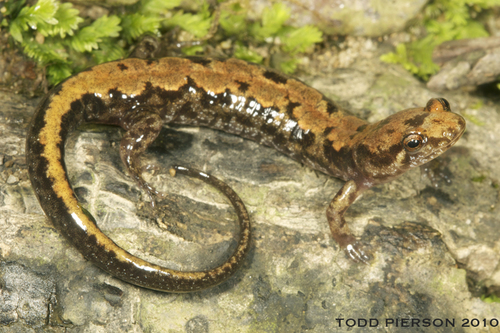
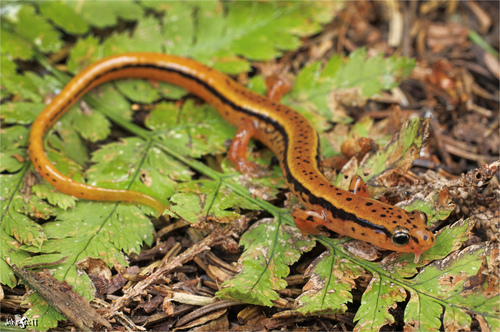
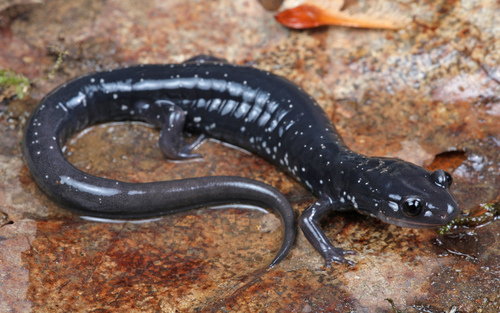
Plethodon teyahalee, commonly called the Southern Appalachian Salamander, is a large black salamander. It has very small white spots on its back and larger white spots along its sides.
Sexual Dimorphism
Females of this species are typically larger than males, a trait that helps them carry eggs.
Ventral Coloration
The species’ belly is usually slate gray, and the chin is generally lighter in color than the belly.
Adult Size
Adult individuals reach a total length between 7 and 17 cm (4.75 to 6.75 inches).
Costal Grooves
Approximately 16 costal grooves are present along each lateral side of the body.
Endemic Range
This salamander is endemic to the southern Appalachian Mountains in the southeastern United States. It occurs in small areas of northern Georgia, northwestern South Carolina, western North Carolina west of the French Broad River, and small sections of eastern Tennessee, including parts of the Great Smoky Mountains.
Altitudinal Range and Broad Habitat
Its altitudinal range extends up to 1,550 m, and its natural habitat is temperate Appalachian forest.
Low Elevation Habitat Restriction
Plethodon teyahalee inhabits low elevations in moist deciduous forests and woodlands. It is restricted to these lower elevations because more aggressive related salamander species that live at higher elevations displace it downward.
Environmental Adaptability
As generalists, this species can thrive in a range of environments with varying moisture and temperature conditions. This adaptability, combined with its resilience to threats such as logging and other habitat disturbances, helps it survive changing conditions.
Moisture-Related Behavior
It forages and reproduces on the forest floor, then moves to moist microhabitats, cover objects, or retreat holes to avoid dehydration when it begins to dry out.
Retreat Hole Usage
Unlike many related species, individual P. teyahalee within their native range use multiple retreat holes. This pattern suggests the species can occupy drier areas, requiring more frequent movement to refuges to prevent desiccation.
Conspecific Reproduction
P. teyahalee reproduces with other individuals of the species within its shared elevation range.
Interspecific Hybridization Background
It also hybridizes with other Plethodon species at different elevations, a behavior that has been studied in Plethodon for over 50 years, beginning with work by Hairston and Highton. Hybridization produces offspring that carry traits from both parent species.
Common Hybridization Partners
P. teyahalee often hybridizes with high-elevation species including the Red-Legged Salamander (P. shermani) and the Cheoah Bald Salamander (P. cheoah).
Hybrid Trait Example
For example, hybrid offspring can inherit the red leg trait from P. shermani and the white spotting trait from P. teyahalee.