About Plethodon jacksoni Newman, 1954
Taxonomic Background
Plethodon jacksoni, formally described by Newman in 1954, is extremely similar in appearance to Wehrle's salamander (P. wehrlei) in both body proportions and coloration.
General Body Structure
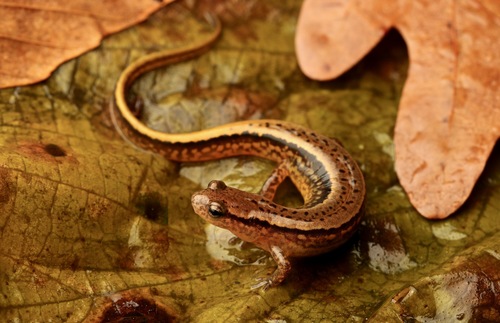
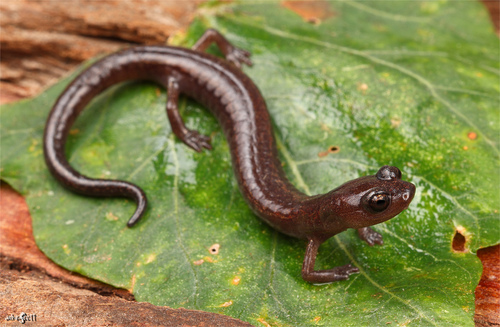
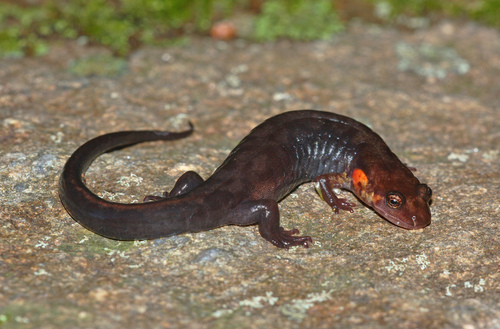
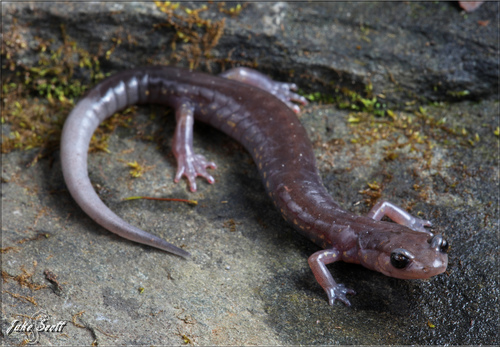
This species has a slender build, a rounded head, large eyes, and a short snout.
Male Size
Males reach a maximum total length of 13.5 cm (5.3 in), with an average length of 11.6 cm (4.6 in).
Female Size
Females grow to a maximum total length of 13.3 cm (5.2 in), with an average length of 12.5 cm (4.9 in).
Congeneric Size Comparison
In general size comparison, P. jacksoni is larger than P. dixi and smaller than P. wehrlei.
Sexual Dimorphism
Mature males have a prominent mental gland on the chin and noticeable swellings above the base of the tail, while females have proportionally longer bodies than males.
Base Body Coloration
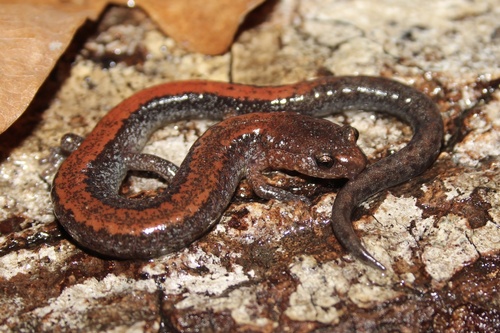
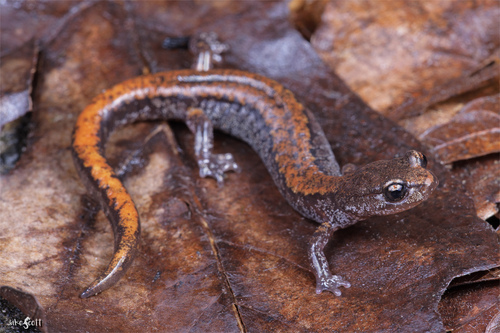
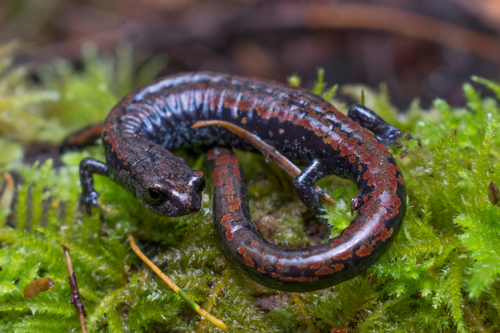
The species' background body color is dark bluish gray, with the back forming the darkest area of the body.
Underside Coloration
The throat and belly are lighter in color, but there is no consistent pattern of light color distribution on the underside across individual specimens.
Limb and Side Markings
Distinctive white blotches typically appear on the sides and limbs, and sometimes extend onto the belly.
Dorsal Mottling
Silvery mottling and small white flecks may be present on the back and tail.
Dorsal Spot Variation
A small number of individuals, including the species' holotype specimen, have sparse but distinct reddish-orange spots on the back.
Habitat Type
The natural habitat of Plethodon jacksoni is temperate forest.
Surface Shelter Sites
In late winter and early spring, individuals can be found sheltering under rocks and logs on dry hillsides.
Cave Dwelling Behavior
Some members of the species live inside caves, even during parts of the year when they cannot be observed on the surface.
Virginia Distribution
Plethodon jacksoni is most commonly found in Montgomery County, Virginia, and has also been recorded in Giles County, Craig County, and possibly Pittsylvania County in the state.
Southern Range Extension
A population of "southern wehrlei" salamanders, which may be closely related to P. jacksoni or fall within this species, occurs as far south as Stokes and Alleghany counties in northwestern North Carolina.