About Plethodon hubrichti Thurow, 1957
Adult Dorsal Coloration
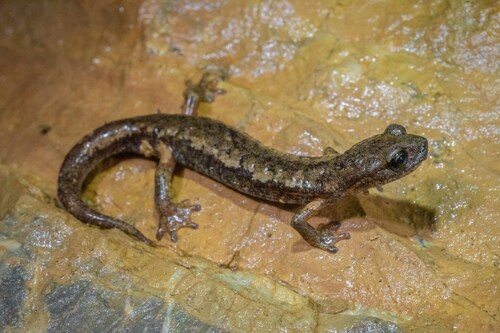
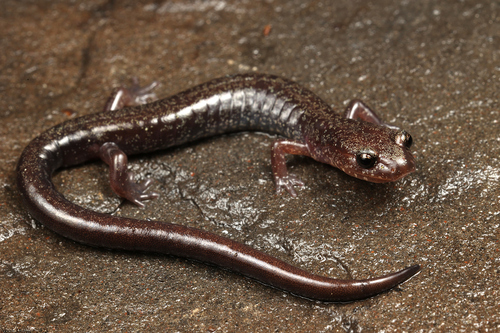
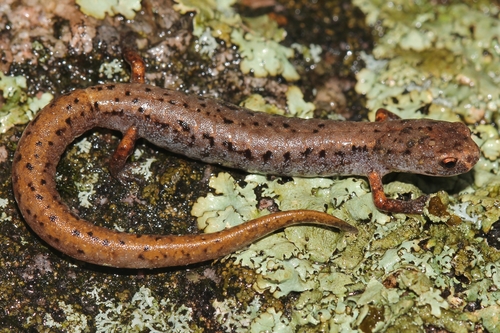
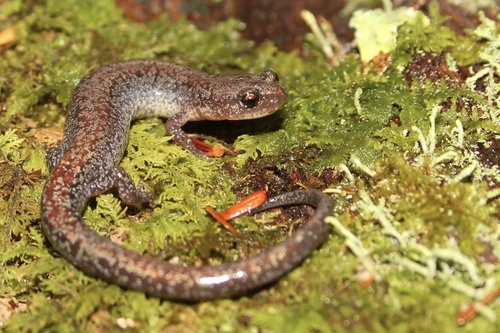
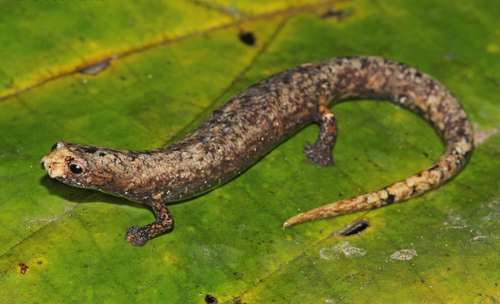
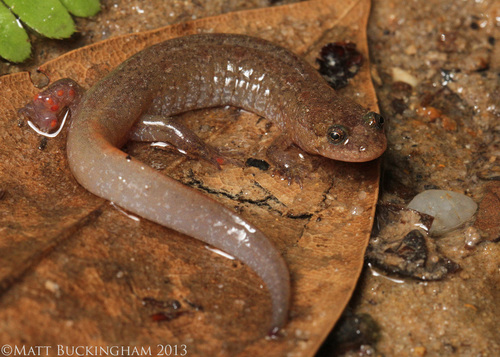
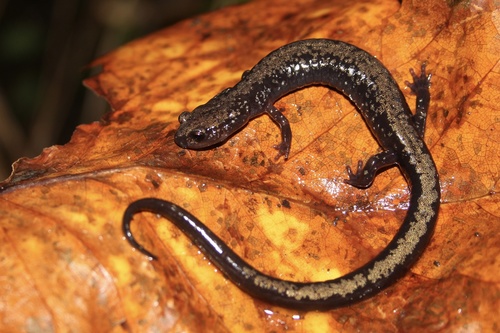
Adult Peaks of Otter salamanders (Plethodon hubrichti) have a dark-brown back covered with heavy brassy flecking along their entire length.
Ventral and Side Coloration
Their back and sides may also have faint white speckling, while the unspotted belly ranges from light to charcoal grey.
Male Secondary Sexual Trait
Males have small mental glands located just behind the chin.
Similar Species Comparison
This species is superficially similar to the Cheat Mountain salamander (P. nettingi), but differs by having a higher concentration of metallic flecking on the back, and typically 19 costal grooves, compared to the 17–19 variable costal grooves of P. nettingi.
Neonatal Dorsal Pattern
Though Petranka reported that hatchlings have a distinct dorsal stripe made of reddish spots, this pattern was not seen in over 100 observed neonates, which all have a uniform dark-grey back.
Brassy Fleck Development
Brassy flecks start to develop once salamanders reach approximately 25 mm in snout-to-vent length.
Historical Plethodon Species Group Composition
In the early 1950s, the small P. cinereus species group within the genus Plethodon included only three species: the southern ravine salamander (P. richmondi), the Cheat Mountain salamander (P. nettingi), and the eastern red-backed salamander (P. cinereus).
Species Description Timeline
Numerous additional members of the genus have been described since that time, including the Peaks of Otter salamander.
Geographic Distribution
The Peaks of Otter salamander is endemic to a 19-kilometer stretch along the Blue Ridge Parkway in the Peaks of Otter area of the Blue Ridge Mountains, in Bedford, Botetourt, and Rockbridge Counties of west-central Virginia.
Habitat and Elevation Range
It occupies forest floor habitats and is generally found at elevations above 845 m.
Allopatric Density Elevation Trend
In areas where P. hubrichti occurs alone without sympatry with the Eastern Red-backed salamander (P. cinereus), surface-active salamander densities decrease as elevation decreases.
Allopatric Population Study Design
Reichenbach and Brophy conducted a study between 2008 and 2010 on these allopatric P. hubrichti populations across elevations ranging from 488 to 1143 m. They measured eggs per female, percentage of gravid females, surface-active salamander density, temperature, and relative humidity.
Study Demographic Findings
Surface-active salamander densities, survival rates, growth rates, eggs per female, and overall reproductive output all decreased with decreasing elevation. These decreases were linked to higher temperatures and lower relative humidity that occur at lower elevations.
Environmental Sensitivity
As a montane species, P. hubrichti is affected by even small changes to these environmental factors. This sensitivity to habitat changes prevents the species from inhabiting lower elevations, where its range is abiotically limited by warmer temperatures and drier conditions.
Distribution Research Conservation Value
Understanding the reasons for the Peaks of Otter salamander's extremely restricted distribution greatly supports its conservation.
Core Range Population Density
Previous work has shown that at optimal elevations in the core of its range, P. hubrichti dominates the local salamander community and can reach high population densities (Reichenbach & Sattler, 2007).
Timber Harvest Impact at Optimal Elevation
At optimal elevation, after shelterwood cuts (partial tree removal), Peaks of Otter salamander densities did not decline following timber harvesting.
Timber Harvest Risk at Low Elevation
However, if the same shelterwood cuts were carried out in lower elevation areas, the already sparse P. hubrichti populations would likely be negatively affected, since opening the forest canopy would increase temperatures and decrease relative humidity. These changes would exceed or move closer to the species' tolerable limits, potentially extirpating the species from these low elevations or reducing its population densities.
Habitat Conservation Recommendation
For this reason, it is important to conserve mature hardwood forests, especially in lower elevation areas at the edge of the Peaks of Otter salamander's distribution, which host more fragile salamander habitats.
First Nest Observation Details
The first documented observations of a P. hubrichti nest were made in spring and summer of 2005 at a study site near Onion Mountain in Bedford County.
Nest and Egg Description
A cluster of approximately 10 eggs, each 5.5 mm in diameter and attended by a brooding female, was found under a rock embedded in soil, hanging from the ceiling of a soil chamber.
Egg Development Timeline
After 42 to 48 days of development, motile embryos with visible eyes were observed inside the eggs, and hatchlings were found at the nest site 16 days later.
Clutch Size Range
The number of eggs per female ranges from 1 to 12, with a mean of 8.5 (95% CI 8.2–8.9).
Clutch Size Correlates
The number of eggs per female increases directly with body mass and elevation, reaching a maximum of 12 eggs per female at 1000 m, then decreases slightly above 1000 m.
Gravid Female Elevation Trend
While females at higher, near-optimal elevations typically produce more eggs per individual, a greater percentage of females are gravid at lower elevations.
Reproductive Output Calculation
Combining data on salamander densities, number of eggs per female, and percentage of gravid females allowed researchers to calculate reproductive output for populations at different elevations.
Reproductive Output Elevation Pattern
Though females at lower elevations reproduce more frequently than females near optimal elevations, the overall pattern of reproductive output matches the pattern for eggs per female: reproductive output increases from low elevations to a maximum near 900 m, then declines above that elevation.
Local Abundance Pattern
Compared to many other terrestrial plethodontid salamanders, the Peaks of Otter salamander has an unusually small distribution, but it can be locally abundant within that range.
Vulnerability Drivers
The species' extremely limited range and narrow environmental requirements put it in a vulnerable position, as it is easily threatened by forest disturbance.
Individual Movement Limitation
The Peaks of Otter salamander is not evenly distributed across its range, and normal individual movements are restricted to an area of approximately 1 m; any habitat alteration could therefore fragment the population and harm the species' long-term survival.
Population Density and Home Range Estimates
Mark-recapture studies estimate a population density of 450 salamanders per 100 m2, with a median individual home range of 0.6 m2.
Age Class Habitat Use
Adults and juveniles mostly live under cover objects such as rocks and logs, and they actively defend these territories against conspecifics. Neonates and young-of-the-year (YOY) are more commonly found in leaf litter.
Size Class Growth Rates
Growth rates have also been estimated for different size classes: YOY salamanders have a growth rate of 0.10 mm per day, salamanders initially between 31 and 40 mm snout-to-vent length have a rate of 0.09 mm per day, and salamanders originally between 41 and 50 mm grow 0.08 mm per day.
Activity Timing
The Peaks of Otter salamander is primarily active at night, between 8:00 and midnight (9–11 pm in spring, 10–12 pm in summer, and 8–11 pm in autumn).
Surface Activity Microhabitat
Surface-active individuals are most commonly found associated with vegetation when available, and with leaf litter dampened by recent rainfall.
Rainfall Activity Correlation
The proportion of the population active at the surface immediately after rainfall increases linearly with the length of time between rainfall events.
Foraging and Moisture Requirements
Plethodon salamanders feed on invertebrate prey that is more commonly found at the surface, but require moist conditions for cutaneous respiration, so they retreat underground when surface moisture is low. After longer periods without rain, salamanders presumably have less access to food, so a larger proportion of the population may be seen foraging at the surface after rain.
Congeneric Temperature Tolerance Comparison
Comparing P. hubrichti to the wide-ranging P. cinereus helps explain why P. hubrichti is restricted to elevations greater than 488 m. P. cinereus can tolerate a broader range of temperatures than P. hubrichti, while P. hubrichti can survive at lower temperatures than P. cinereus.
Physiological Range Limitations
P. hubrichti has a lower critical thermal maximum (the temperature at which an organism cannot function) and higher dehydration rates than P. cinereus, which restricts it to higher elevations. These traits allow P. hubrichti to thrive at higher elevations but also make it more susceptible to physiological stress from changes in temperature and humidity.
Low Elevation Foraging Limitation
Higher temperatures and lower relative humidity prevent P. hubrichti from widely inhabiting lower elevations due to reduced foraging efficiency.
Thermal and Moisture Regulation Strategies
As poor thermoregulators, the species relies on nocturnal activity, burrowing, and refuges such as rocks and logs to reach ideal thermal and moisture conditions. Salamanders typically burrow deep into soil to escape winter cold, summer heat, and dry or otherwise unfavorable conditions.
Moisture-Dependent Activity
Due to their dependence on moisture, they are most active above the surface immediately following a rainfall event.
Optimal Elevation Foraging Behavior
In the optimal elevation range of 900 to 1000 m, P. hubrichti can primarily forage on top of vegetation, where it forages with the greatest efficiency.
Suboptimal Elevation Foraging Tradeoffs
Poorer environmental conditions at lower elevations force P. hubrichti to forage in less ideal areas such as under rocks and logs to avoid drying out. This restricted, less efficient foraging combined with general physiological stress likely causes the reduced reproductive output and survival rates seen in lower elevation populations.
High Elevation Limiting Factors
Shortened active seasons at elevations above the optimum, caused by lower temperatures, can also affect surface-active salamander density and reproductive output.
Interspecific Competition Ecological Relevance
Interspecific competition is an important limiting factor for population size, biomass, species richness, and home range sizes for many species. Given P. hubrichti's limited distribution, it is important to understand how interspecific competition affects the species.
Congeneric Range Overlap
The much more widespread red-backed salamander (P. cinereus) surrounds most of P. hubrichti's range.
Competition Distribution Hypothesis
Interspecific competition between the Peaks of Otter salamander and the red-backed salamander has generally been thought to limit P. hubrichti's distribution, as the two species are considered equal competitors.
Species Morphological Similarity
As closely related Plethodon species, P. cinereus and P. hubrichti share a number of behavioral similarities in addition to similar size: 6.5–12.5 cm total length for P. cinereus, and 8–13 cm total length for P. hubrichti.
Shared Behavioral Traits
Shared behaviors include nocturnal foraging in humid conditions, preference for prey without a hard cuticle, and defense of a limited home range under 1 square meter made up of leaf litter surrounding cover objects. Both species show aggression and territoriality.
Shared Demographic Traits
Linear movements, home ranges, growth rates, and adult survival rates are similar for both species.
Allopatric vs Sympatric Density
Adult P. hubrichti densities at 13 allopatric sites range from 1.6 to 3.3 salamanders per m2, while in sympatry with P. cinereus the density is 0.6 salamanders per m2. The combined density of both species at one sympatric site (1.1 salamanders per m2) is comparable to densities of P. hubrichti alone at nearby allopatric sites.
Competition Density Evidence
The reduced density of P. hubrichti in sympatry with P. cinereus suggests that resources are split through interspecific competition.
Primary Limiting Factor
The Peaks of Otter salamander is environmentally restricted, and abiotic climatic features likely act as the primary limiting factor for P. hubrichti.
Allopatric Zone Competition Dynamic
P. cinereus has lower environmental sensitivity, and its range is prevented from encroaching into allopatric P. hubrichti zones by interspecific competition with P. hubrichti.
Sympatric Zone Stability
The sympatric zones of the red-backed salamander and Peaks of Otter salamander are relatively static. When species proportions were compared over a 10-year period at an undisturbed forest sympatric site, no significant change was observed, with P. hubrichti making up 60-70% of salamanders found.
Timber Harvest Sympatric Zone Risk
However, most of the remaining sympatric zone is located within timber harvesting areas, where deforestation may alter the environmental factors that maintain the balance between the two species.
Proposed Competition Research
To confirm the role of interspecific competition in sympatric areas of P. hubrichti and P. cinereus, removal studies would need to be conducted where P. cinereus is removed from experimental plots to test if P. hubrichti numbers increase, similar to what Hairston (1980) found when P. jordani was removed from plots shared with P. glutinosus.
Ecosystem Role
Plethodontid salamanders like the Peaks of Otter salamander regulate populations of detritivorous invertebrates such as earthworms, and store nutrients within forest ecosystems.
Bioindicator Value
Due to their critical role in forest health, and their susceptibility to habitat disruptions, plethodontid salamander populations are strong indicators of overall ecosystem health.