About Platysaurus broadleyi Branch & Whiting, 1997
Common Name & Juvenile Female Dorsal Markings
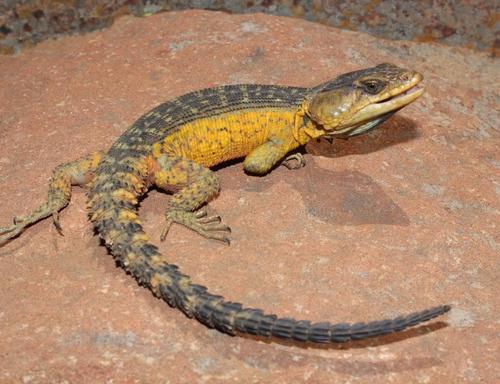
For Platysaurus broadleyi, commonly known as the Augrabies flat lizard, females and juveniles have a dark brown back marked with three thick cream stripes. These stripes may be broken into spots, or have spots between them.
Juvenile Female Ventral Coloration
Their belly is white, sometimes with a black spot, and the rear belly is orange.
Juvenile Female Tail Coloration
Their tail is straw-coloured.
Adult Male Body Coloration
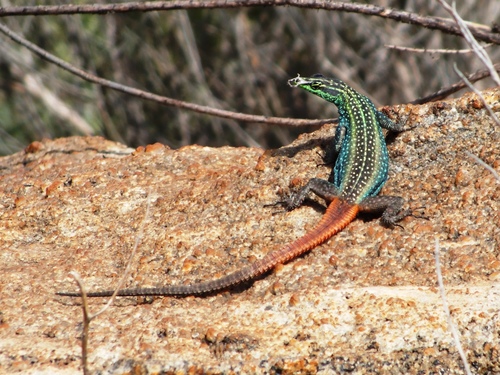
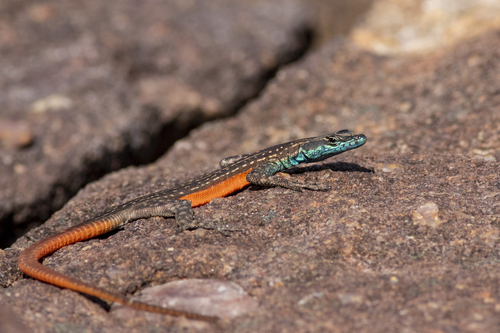
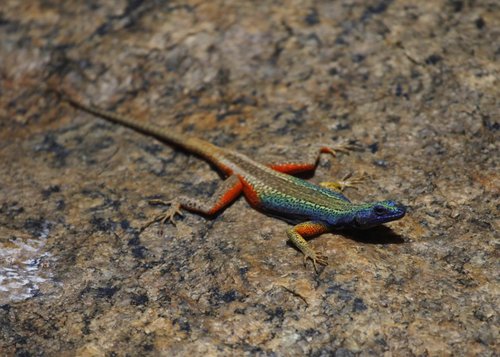
Adult males have a bluish head and a greenish back, with a darker central area and remaining traces of the juvenile stripes and spots.
Adult Male Limb and Ventral Coloration
Adult male forelimbs range from yellow to orange, the throat is dark blue, the belly is black at the front and turns orange near the tail, the upper surface of the tail is tan, and the tail sides and underside are orange.
Coloration Function and Predation Risk
This bright colouration helps males attract females, but also makes them easy for predators like kestrels to spot. Females have much more subdued colouration, so they are less likely to be preyed on.
Taxonomic Distinction
The Augrabies flat lizard is very similar to the Cape flat lizard (Platysaurus capensis) in scalation, but differs in having finer scales on the top of the forelimbs.
Size
It is medium-sized for its genus, and can reach a snout-to-vent length (SVL) of 8.4 cm (3.3 in).
Geographic Range
The geographic range of the Augrabies flat lizard covers 200 kilometres, centered on Augrabies Falls and extending west to Pella in the Northern Cape, South Africa. This range includes river valleys along the lower Orange River, in Northern Cape Province's Gordonia District.
Habitat and Altitude
The preferred natural habitat of P. broadleyi is rocky areas in both savanna and shrubland, at altitudes between 610 and 730 m (2,000 to 2,400 ft).