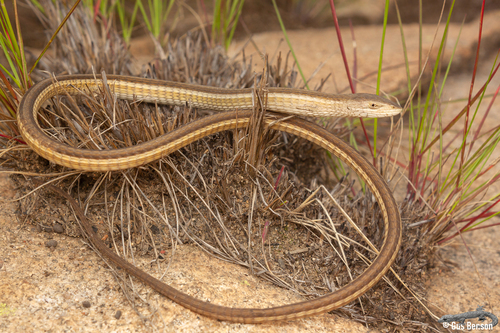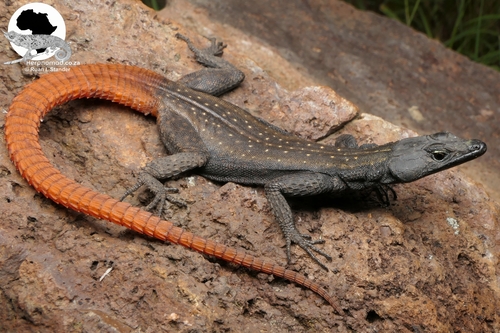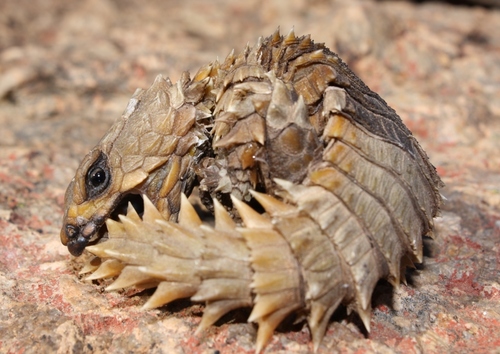
About Ouroborus cataphractus (Boie, 1828)
Coloration
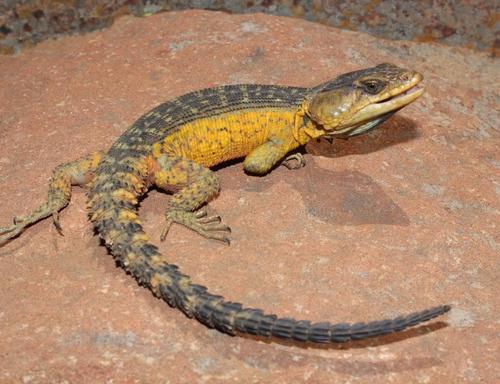
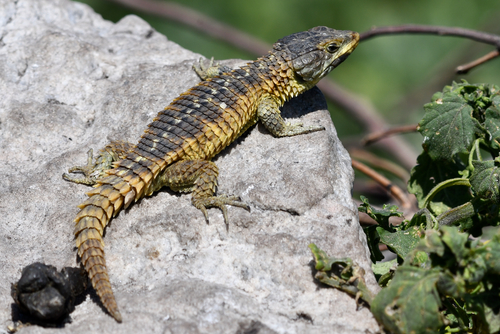
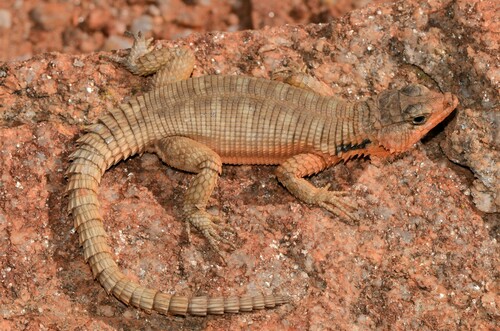
Ouroborus cataphractus, commonly called the armadillo girdled lizard, has body colouration ranging from light brown to dark brown. Its underbelly is yellow with a blackish pattern, with the most distinct pattern found under the chin.
Size
The species ranges from 7.5 to 9 cm (3.0 to 3.5 in) in snout-vent length (SVL), and may reach a maximum total length of 20 cm (8 in).
Geographic Range
This species is endemic to the Succulent Karoo biome in the Northern and Western Cape provinces of South Africa. Its distribution extends from the southern Richtersveld to the Piketberg Mountains and the southern Tankwa Karoo National Park.
Habitat
It lives on rock outcrops on mountain slopes, and prefers sandstone substrate.
Reproductive Traits
Armadillo girdled lizards are one of the few lizard species that do not lay eggs. Females give birth to one or two live young, and may even feed their offspring, a behaviour that is also unusual for lizards.
Birth Frequency
Females give birth at most once per year, and some females skip a year between births.
2002 Study Methodology
A 2002 study regularly marked and recaptured 106 individuals across 27 groups from May to September.
Site Fidelity Findings
In this study, groups with higher site fidelity had greater distances between neighbouring groups, while groups with lower fidelity had smaller distances between neighbouring groups. Neighbouring distance correlates with site fidelity in this species.
Male Reproductive Cycles
Male armadillo girdled lizards follow either a prenuptial or postnuptial reproductive cycle.
Prenuptial Cycle
The more common of the two is the prenuptial cycle, where males have the highest sperm count during fall and winter.
Postnuptial Cycle
For males following the postnuptial cycle, sperm production peaks in late summer.