About Pittosporum rubiginosum A.Cunn.
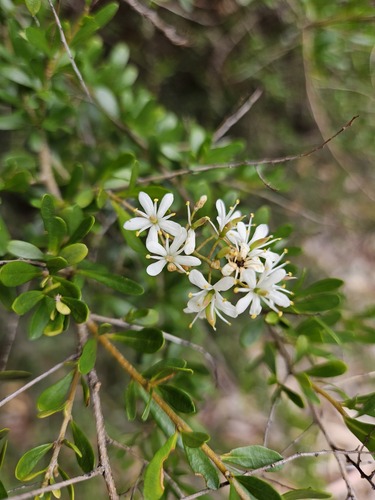
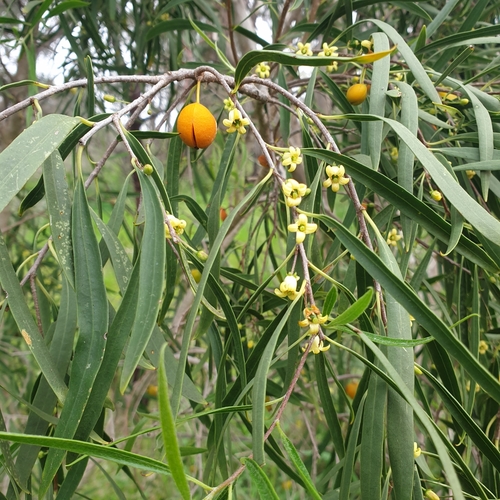
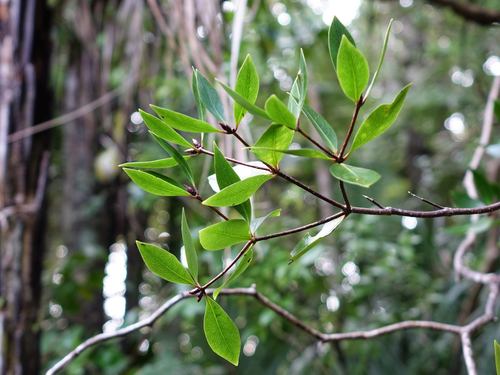
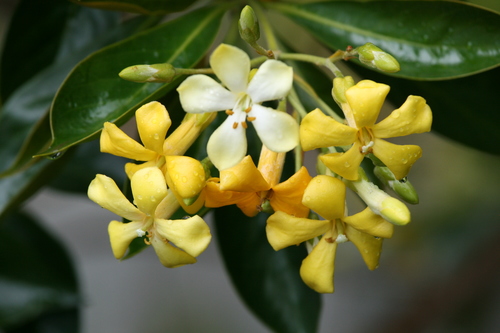
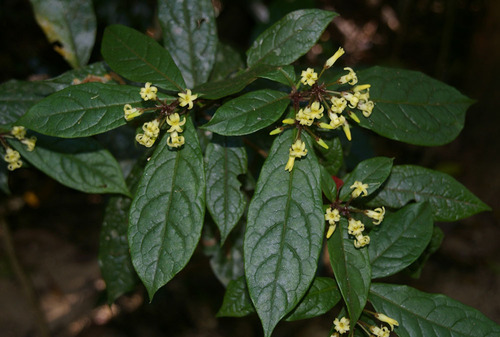
Pittosporum rubiginosum A.Cunn., commonly known as the hairy red pittosporum, is a spindly shrub with changing appearance as it matures. It usually grows to around 3 m (9.8 ft) tall, and rarely can reach 6 m (20 ft). Its leaves are dark green on the upper surface and typically purple underneath. Both sides of the leaves are glabrescent: they start out hairy and become hairless as they age. Leaf size and shape differ substantially between juvenile and mature growth stages. Seedling leaves are densely hairy; leaves on juvenile plants measure around 2.5 by 1.3 cm (1.0 by 0.5 in), while mature plant leaves measure around 24 by 8 cm (9.4 by 3.1 in). Leaves at all growth stages have very short petioles and are mucronate, meaning they have a fine sharp point at the leaf tip. This species grows in different forms depending on altitude: plants in upland forest more often retain a juvenile appearance, while plants in lowlands more often develop mature forms. The inflorescence may have a single flower or an umbel with many flowers. Inflorescences grow either at the end of branches or in leaf axils, and can be up to 9.5 cm (3.7 in) long. The white flowers grow on densely hairy pedicels around 20 mm (0.8 in) long. Sepals are up to 9 mm (0.4 in) long, and petals are around 16 mm (0.6 in) long. The fruit is an ellipsoid (rugby ball-shaped) orange-yellow capsule, around 23 mm (0.9 in) long and 15 mm (0.6 in) wide. When mature, it splits open along a longitudinal line to reveal a cluster of bright red sticky seeds packed tightly together. This species' natural range extends from Cape York Peninsula to Tully, Australia, from sea level up to around 1,500 m (4,900 ft) altitude. It grows as an understorey shrub in lowland and upland rainforest. The fruit of this species is eaten by southern cassowaries (Casuarius casuarius), giant white-tailed rats (Uromys caudimaculatus), and other native rodents.