About Billardiera variifolia DC.
Species Identity and Growth Form
Billardiera variifolia DC. is a twining shrub or climber that typically grows up to 2.5 metres (8 feet 2 inches) in height.
Leaf Type Classification
A single individual of this species bears three types of leaves: seedling leaves, intermediate leaves, and adult leaves.
Seedling Leaf Characteristics
Seedling leaves are egg-shaped, with irregular lobes or teeth, and measure 20–25 mm (0.79–0.98 in) long and 9–11 mm (0.35–0.43 in) wide.
Adult Leaf Characteristics
Adult leaves are narrowly elliptic, sessile, with wavy edges, and measure 15–20 mm (0.59–0.79 in) long and 3–4 mm (0.12–0.16 in) wide.
Inflorescence Bract Characteristics
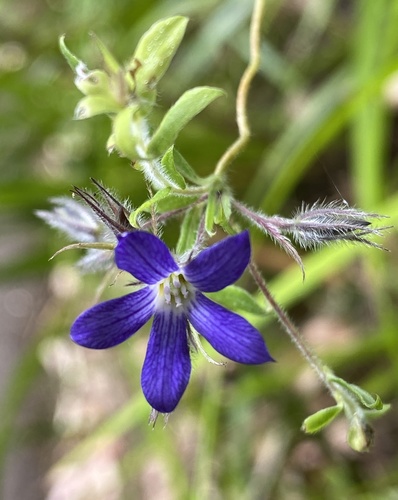
Its flowers are grouped, with densely shaggy-hairy, sepal-like bracts 2 mm (0.079 in) long at the base of the group.
Sepal Characteristics
The sepals are 4.0–5.5 mm (0.16–0.22 in) long, green with purple streaks, and covered in shaggy hairs.
Petal Characteristics
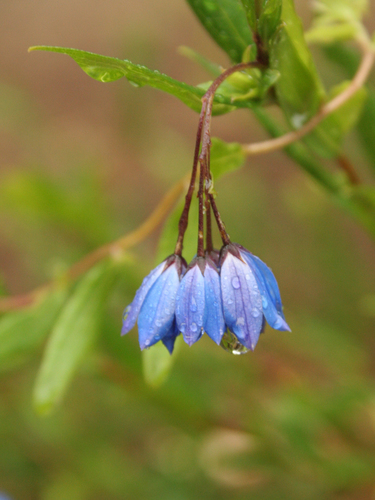
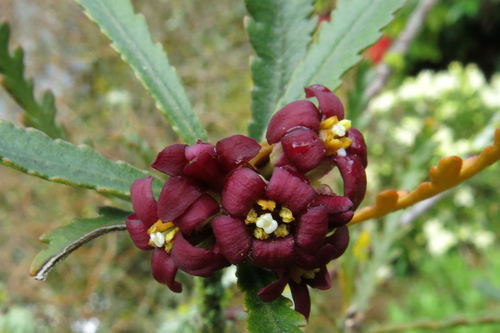
The petals are deep purple, fading to blue as they age, spatula-shaped, and 10–15 mm (0.39–0.59 in) long.
Flowering Period
Flowering occurs either from October to December, or from January to May.
Mature Fruit Characteristics
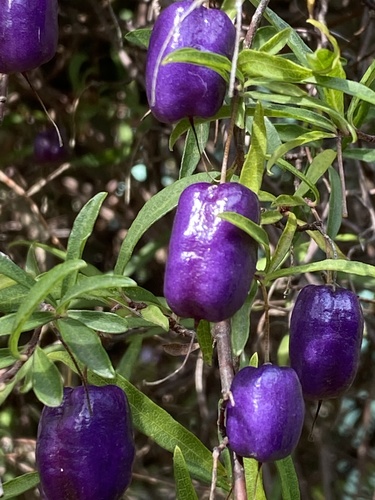
The mature fruit is a spindle-shaped berry that is 20–24 mm (0.79–0.94 in) long.
Habitat Context
This species grows in open woodland, often near creeks and in gullies, and is frequently found growing alongside Billardiera drummondii.
Geographic Distribution
It occurs in the Avon Wheatbelt, Esperance Plains, Jarrah Forest, Swan Coastal Plain and Warren bioregions of south-western Western Australia, and is particularly common in the Albany and Stirling Ranges areas.