About Pinus mugo Turra
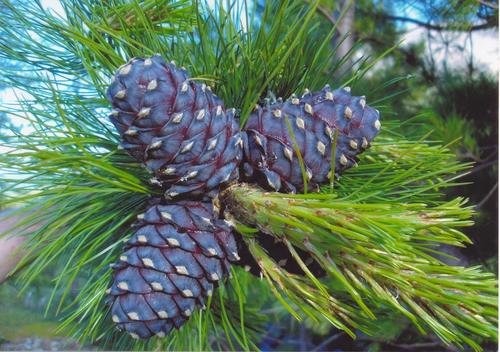
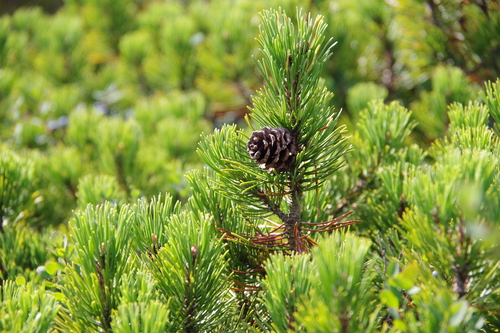
This species, Pinus mugo Turra, has dark green needle-shaped leaves that grow in pairs, and measure 3–7 centimetres (1+1⁄4–2+3⁄4 inches) in length. Its cones are nut-brown, and 2.5–5.5 cm (1–2+1⁄8 in) long. Pinus mugo is native to subalpine zones of the Pyrenees, Alps, Ore Mountains, Carpathians, northern and central Apennines, and higher mountains of the Balkan Peninsula, including Rila, Pirin, Korab, and the Accursed Mountains. It most commonly grows at elevations between 1,000–2,200 m (3,281–7,218 ft). Occurrences at lower elevations down to 200 m (656 ft) are found in the northern part of its native range in Germany and Poland, while occurrences at higher elevations up to 2,700 m (8,858 ft) are found in the southern part of its native range in Bulgaria and the Pyrenees. It is also found in Bjeshkët e Nemuna National Park in Kosovo. Pinus mugo was introduced to Scandinavia, Finland, and the Baltic region in the late 1700s and 1800s, when it was planted in coastal regions to stabilize sand dunes, and later planted as an ornamental around residences. In Denmark, Norway, and Sweden, the species has naturalized and become invasive, displacing fragile dune and dune heath habitats. In Estonia and Lithuania, Pinus mugo only naturalizes occasionally outside plantations, and sometimes becomes established in raised bogs. Ecologically, Pinus mugo is classed as a wilding conifer, and spreads as an invasive species in the high country of New Zealand, coastal Denmark, and other areas of Scandinavia. Pinus mugo is widely cultivated as an ornamental plant. It is used as a small tree or shrub, planted in gardens and in larger pots and planters. It is also used in Japanese-style garden landscapes, and for larger bonsai specimens. In Kosovo, its trunk is used as construction material for the traditional mountain vernacular architecture called "Bosonica". Mugo pine is used in cooking. Young cones can be processed into a syrup known as "pinecone syrup", "pine cone syrup", or mugolio. Buds and young cones are harvested from the wild in spring, then left to dry in the sun through summer and into autumn. The cones and buds gradually drip syrup, which is then boiled down to a concentrate and combined with sugar. An alternative preparation method macerates the pinecones in sugar, ferments the mixture, then strains it.