About Pinus strobus var. chiapensis Martínez
Taxonomy
This taxon, Pinus strobus var. chiapensis Martínez, belongs to the white pine group (Pinus subgenus Strobus).
Leaf Fascicle Structure
Like most members of this group, its needle-shaped leaves grow in fascicles (bundles), most commonly of five, and rarely three or four, with a deciduous sheath.
Needle Characteristics
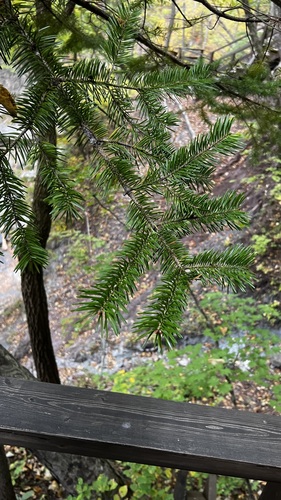
The needles are flexible, bluish-green, finely serrated, and measure 5–13 cm (2–5 in) long.
Seed Cone Morphology
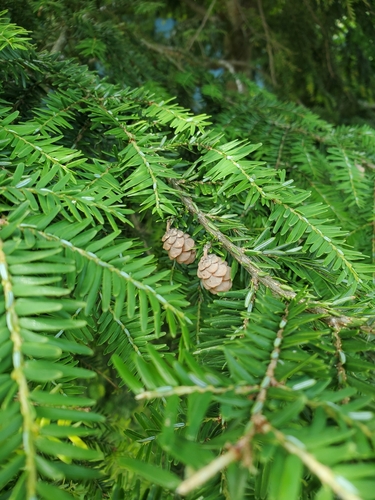
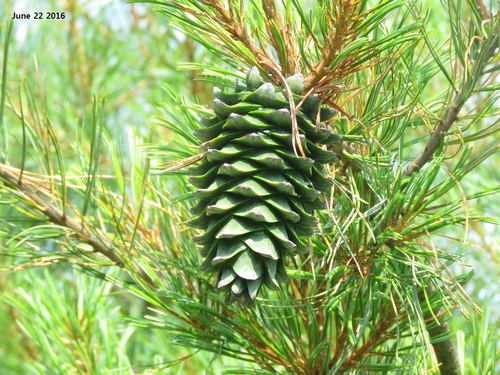
Its seed cones are slender, 8–16 cm (3+1⁄4–6+1⁄4 in) long (rarely longer), 4–5 cm (1+1⁄2–2 in) broad when open, with scales that have a rounded apex, slightly reflexed tip, and are often resinous.
Seed Structure
The seeds are 4–5 mm (5⁄32–3⁄16 in) long, with a slender 15–20 mm (5⁄8–3⁄4 in) wing, and are dispersed by wind.
Cone Production Cycle
Peak cone production occurs every 3 to 5 years.
Branch Arrangement
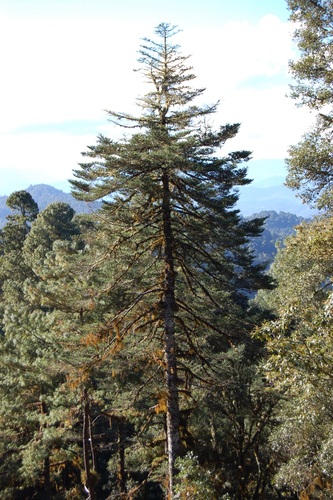
Branches grow in spaced whorls of five or six, roughly 18 inches apart along the trunk, arranged like spokes on a wagon wheel.
Pollination Outcomes
Eastern white pine is self-fertile, but self-pollinated seeds usually produce weak, stunted, malformed seedlings.
Mature Tree Lifespan
Mature trees are most often 200–250 years old, and some individuals live over 400 years.
Record Tree Ages
One tree growing near Syracuse, New York, was dated to 458 years old in the late 1980s, and trees in Michigan and Wisconsin have been dated to roughly 500 years old.
Root Development
During propagation, white pines first develop strong, dominant roots similar to taproots, then later grow lateral roots from terminal shoots.
Wood Coloration
Freshly cut eastern white pine wood is yellowish white or pale straw-colored, but wood from aged trees darkens to a deep, rich golden tan.
Pumpkin Pine Variant
Occasionally, light brown boards are found with unusual yellowish-golden or reddish-brown hues; this highly valued variant is known as "pumpkin pine".
Pumpkin Pine Color Causes
Researchers think slow-growing pines in old-growth forests accumulate colored compounds in their heartwood, but genetic factors and soil conditions may also contribute to the development of this rich color.
Wood Use
This wood is popular with patternmakers because it is easy to work.
Native Biome
Pinus strobus grows in the nearctic temperate broadleaf and mixed forests biome of eastern North America.
Habitat Adaptability
It prefers well-drained or sandy soils and humid climates, but can also grow in boggy areas and rocky highlands.
Forest Canopy Position
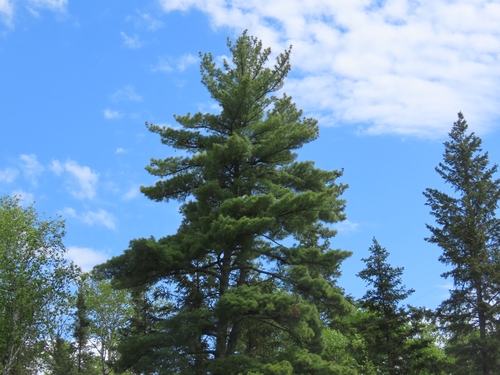
In mixed forests, this dominant tree grows taller than many other trees, including large broadleaf hardwoods.
Wildlife Value
It provides food and shelter for many forest birds, such as the red crossbill, and small mammals such as squirrels.
Fossil Record
Fossilized white pine leaves and pollen have been discovered by Brian Axsmith, a paleobotanist at the University of South Alabama, in the Gulf Coastal Plain, where the tree no longer grows naturally.
Historical Forest Range
Originally, eastern white pine forests covered most of north-central and northeastern North America.
Old-Growth Remaining Percentage
After extensive logging from the 18th century to the early 20th century, only 1% of the original old-growth forests remain today.
Protected Old-Growth Sites (US National Park)
Old-growth (virgin) stands of eastern white pine are protected in Great Smoky Mountains National Park.
Protected Old-Growth Sites (Canada and US)
Other protected areas confirmed to have virgin stands by the Eastern Native Tree Society include: Algonquin Provincial Park, Quetico Provincial Park, Algoma Highlands in Ontario, and Sainte-Marguerite River Old Forest in Quebec, Canada; Estivant Pines, Huron Mountains, Porcupine Mountains State Park, and Sylvania Wilderness Area in the Upper Peninsula of Michigan, United States; Hartwick Pines State Park in the Lower Peninsula of Michigan; Menominee Indian Reservation in Wisconsin; Lost 40 Scientific and Natural Area (SNA) and Boundary Waters Canoe Area Wilderness in Minnesota; White Pines State Park, Illinois; Cook Forest State Park, Hearts Content Scenic Area, and Anders Run Natural Area in Pennsylvania; and the Linville Gorge Wilderness in North Carolina, United States.
Dispersed Old-Growth Specimens (USA)
Small groves or individual old-growth eastern white pine specimens are found across the species' entire range in the USA, including Ordway Grove, Maine; Ice Glen, Massachusetts; and Adirondack Park, New York.
Old-Field Succession Stands
Many sites with noticeably large specimens are the result of advanced old-field ecological succession; the tall stands in Mohawk Trail State Forest and William Cullen Bryant Homestead in Massachusetts are examples of this.
Introduced Naturalized Range
As an introduced species, P. strobus is now naturalizing in the Outer Western Carpathians subdivision of the Carpathian Mountains in the Czech Republic and southern Poland, having spread from specimens originally planted as ornamental trees.
Mammal Herbivory
In its ecology, cottontail rabbits, snowshoe hares, and porcupines eat its bark.
Squirrel Feeding Habits
Red squirrels eat its cones to extract the seeds.
Seed Consumers
Its seeds are also eaten by crossbills, pine siskins, and white-tailed deer.
Traditional Uses Overview
Native American communities have traditional uses for this tree.
Adirondack Etymology
The name "Adirondack", an Iroquois word meaning "tree-eater", referred to their neighbors (most commonly known as the Algonquians), who collected the inner bark of P. strobus, Picea rubens, and other species during periods of winter starvation.
Inner Bark Processing
The soft, white inner cambial bark was carefully separated from the hard, dark outer bark and dried.
Inner Bark Food Use
When pounded, it can be used as flour or mixed to extend other starchy food supplies.
Ojibwe Cone Use
The young staminate cones were stewed with meat by the Ojibwe people, and were reported to be sweet and not pitchy.
Seed Edibility
In addition, the seeds are sweet and nutritious, though not as flavorful as seeds from some western nut pines.
Resin Waterproofing Use
Pine resin (sap) was used by various tribes to waterproof baskets, pails, and boats.
Resin Medicinal Use
The Ojibwe also used pine resin to successfully treat infections.
Ornamental Cultivation
P. strobus is cultivated by plant nurseries as an ornamental tree for planting in gardens and parks.
Cultivation Growth Traits
The species is low-maintenance and grows quickly when used as a specimen tree.
Specialized Cultivation Uses
It can also be trained as a hedge with regular shearing, and some cultivars are used for bonsai.