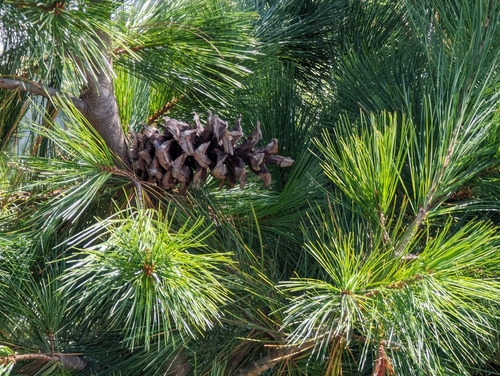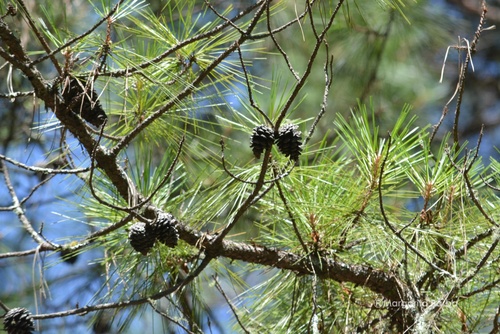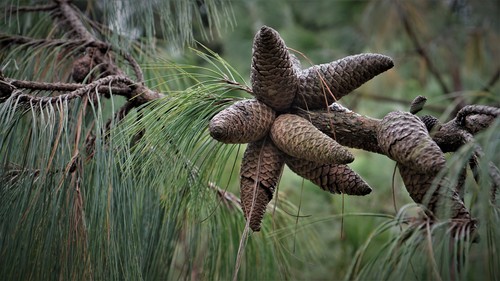
About Pinus patula Schiede ex Schltdl. & Cham.
Nomenclature and Common Names
Pinus patula Schiede ex Schltdl. & Cham. is a tree, with common names including patula pine, spreading-leaved pine, and Mexican weeping pine; in Spanish, it is called pino patula or pino llorón. The species epithet 'patula' comes from Latin, meaning 'spreading'.
Native Distribution and Elevation Range
This tree is native to the highlands of Mexico, where it grows between 18° and 24° North latitude, at elevations of 1,800–2,700 m (5,900–8,900 ft) above sea level. It can reach a maximum height of 30 m (98 ft).
Temperature Tolerance
Pinus patula can only tolerate short periods of temperatures as low as −10 °C (14 °F), but handles occasional dips below 0 °C (32 °F) well. It is moderately drought-tolerant, and is more drought tolerant than Pinus taeda.
Native Range Rainfall
In its native range, average annual rainfall is between 750 and 2000 mm. Most of this rainfall occurs in summer, but a small part of its habitat in the State of Veracruz on the Sierra Madre Oriental receives rain year-round.
High-Altitude Introductions
It is planted at high altitudes in Ecuador (up to 3500 m), Bolivia, Colombia (up to 3300 m), Kenya, Tanzania, Angola, Zimbabwe, Papua New Guinea, and Hawaii (up to 3000 m). In Hawaii, it is replacing native alpine grassland.
Lower-Altitude Cultivation
It is cultivated at lower altitudes than its native Mexican range in Southern Brazil, South Africa, India, and the Argentine provinces of Córdoba and San Luis. In these regions, it is planted for forestation on land that was originally covered by bushland.
Australian Introduction
It has been introduced near sea level in New South Wales, Australia, where it spreads naturally via wind. It grows very well in New South Wales because rainfall there is more abundant in summer, matching its native precipitation pattern.
New Zealand Introduction
It was also introduced to New Zealand for commercial purposes and is now fully naturalized there.
Cultivation in the United Kingdom
In the United Kingdom, it is grown as an ornamental tree for parks and gardens, and has earned the Royal Horticultural Society's Award of Garden Merit.
Timber Characteristics
When freshly cut, its timber has a pale pink to salmon color, is moderately soft and brittle, and has a strong scent of aniseed.