About Tsuga chinensis (Franch.) E.Pritz.
Outer Bark Characteristics
Tsuga chinensis is a large tree with blackish brown scaly bark that has irregular longitudinal breaks and very inconspicuous lenticels. Its outer bark is around 6 mm thick, and consists of alternating tiered layers of pale yellowish brown corky bark and brown lignified fibrous bark. The newly formed periderm is purplish red.
Inner Bark Characteristics
The inner bark is 4 to 5 mm (0.16 to 0.20 inches) thick, pale reddish brown in colour, and fibrous in texture, with minute, almost inconspicuous sclereid (stone cell) groups. Both the cambium and newly formed phloem are nearly inconspicuous.
Wood Characteristics
Freshly cut wood is pale yellowish white with inconspicuous wood rays. Its branchlets bear leaf-cushions.
Leaf Arrangement and Shape
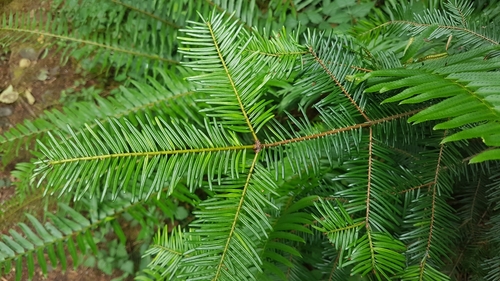
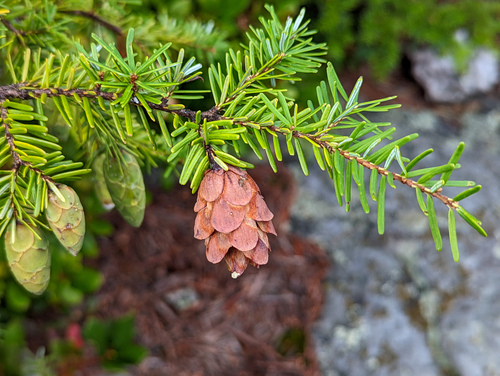
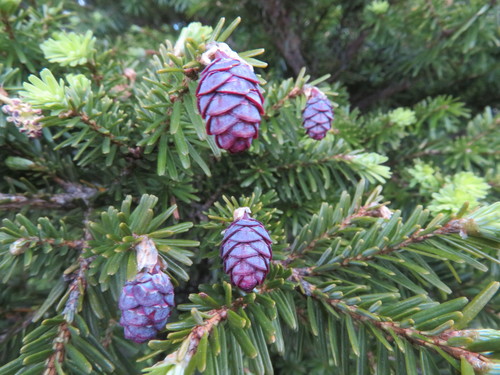
Leaves are arranged spirally in a more or less two-ranked pattern; they are linear and flat, and coloured olive green. The upper surface of the leaf is grooved and keeled, while the underside has two white stomatic bands.
Leaf Size and Petiole
Leaf apexes are emerginate, and leaves measure 16 to 20 mm (0.63 to 0.79 inches) long. Petioles are crooked.
Foliage Comparison
The foliage is very similar to that of Tsuga heterophylla, but T. chinensis has nodding shoots, paler, more sparse stomatic bands, and a paler yellowish-green colour on the upper leaf surface.
Stamenate Flowers
Stamenate flowers grow singly on one-year-old shoots, or in groups of 1 to 5 on two-year-old shoots. They are dull purple in colour and measure around 8 mm (0.31 inches).
Pistillate Flowers
Pistillate flowers grow terminally on very short shoots; they are nodding, rosy-purple, and around 6 mm (0.24 inches) in length.
Cone Appearance and Size
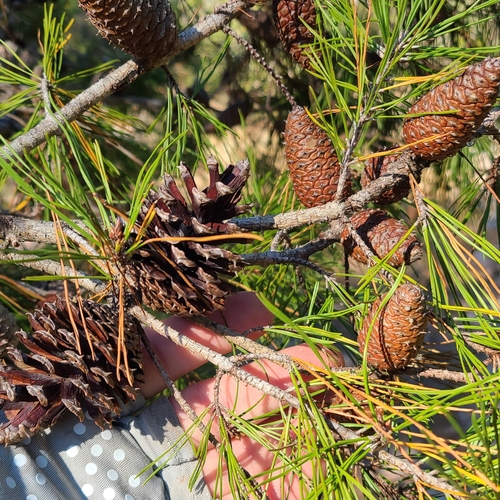
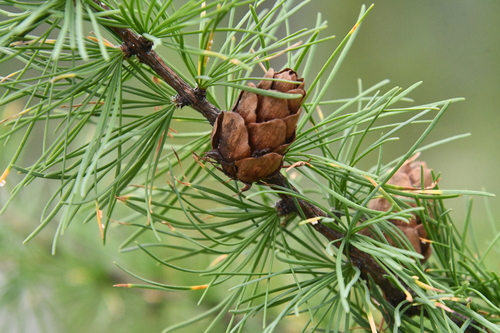
Mature cones are green when young, later turning red-brown, and are long-ovoid in shape. They measure 2 to 2.5 cm (0.079 to 0.098 inches) long by around 1 cm (0.39 inches) wide, and are pendulous.
Cone Scales and Bracts
Cone scales are large and suborbicular with longitudinal streaks. Bracts are small and two-lobed at the apex.
Seed Characteristics
Seeds are winged, and measure around 7 mm (0.28 inches) long when including the wing.
Geographic Distribution
Tsuga chinensis occurs in Taiwan, China (from Tibet to southern Shanxi province and Guangdong province), and northern Ha Giang province in Vietnam.
Elevation Range in Southern Range
At the southern edge of its range, this species is only found at high mountain elevations: in Vietnam, it occurs only at 1,300 to 1,700 m (4,300 to 5,600 feet) above sea level.
Elevation Range in China
In China, it grows at altitudes between 1,000 to 3,500 m (3,300 to 11,500 feet) across the provinces of Anhui, Fujian, southern Gansu, Guangdong, Guangxi, northern Guizhou, western Henan, western Hubei, Hunan, Jiangxi, southern Shaanxi, Sichuan, Tibet, Yunnan, and Zhejiang. This range covers the southern half of China, with a few populations extending farther north.
Habitat Type
It grows primarily in mixed forests near river basins, in mountains, and in valleys.
Distribution in Taiwan
In Taiwan, it is mainly found in Nantou County and Taoyuan City at 1,700 to 3,500 m (5,600 to 11,500 feet) in mixed broadleaf forests, and is present in Taiwan's Yushan National Park and Lalashan Preserve, as well as China's Hailuogou Glacier Park in Sichuan province.
Timber Uses
Timber from Tsuga chinensis is used for construction, furniture making, and as mine support.
Bark Uses
Its bark has a high tannin content, and tannins extracted from it are commonly used as a dye.
Resin and Oil Uses
The trunk is harvested as a source of resin. Roots, trunk, and branches are all used to produce aromatic oils, valued for their pleasing scent.