About Pinus densiflora Siebold & Zucc.
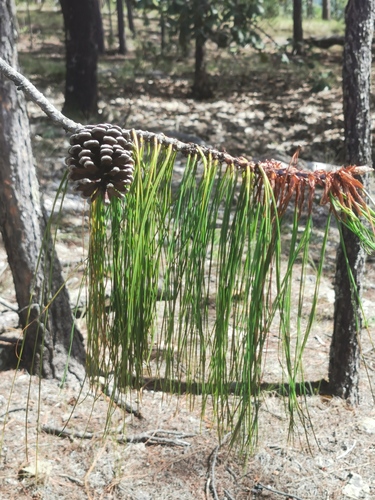
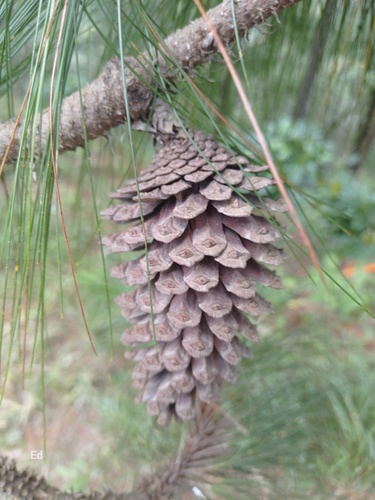
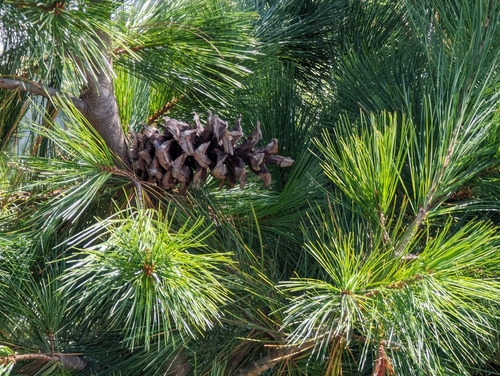
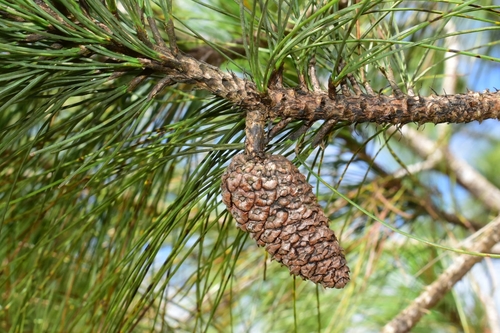
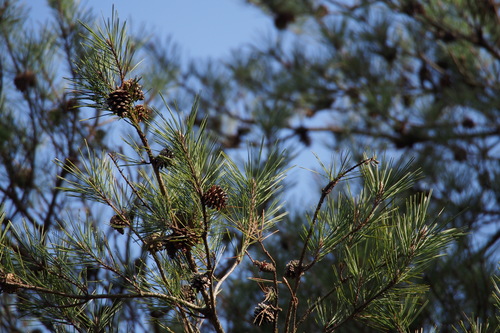
Pinus densiflora Siebold & Zucc. is a tree that reaches 20–35 metres (66–115 feet) in height, with a crown that can grow up to 30 metres (98 feet) across. Its bark is orange-red, cracked into irregular scale-like pieces. The heartwood is reddish-brown, while the sapwood is light reddish-yellow. Its leaves are needle-like, borne two per fascicle; most are 8–12 centimetres (3–4+1⁄2 inches) long, though short individuals may have leaves only 5–6 cm long. Leaf edges have fine serrations, stomatal lines appear on both leaf sides, each leaf contains two vascular bundles and around three to nine resin canals. Branchlets are covered with whitish powder. Male cones are light reddish yellow, and grow clustered in the lower part of new branches. Female cones are light reddish purple, and are either solitary or clustered in groups of two to three. Mature cones measure 4–7 cm (1+1⁄2–3 in) long, are dark brown-yellow or light brown-yellow, and open when mature. Seed scales are usually thin, and seeds are winged. In China, populations of this species follow a distinct geographic pattern of variation: the more northward the population, the shorter the needles tend to be, the whitish powder on branchlets is sometimes less or only partly obvious, and cone color is paler, being light brown-yellow. This species is closely related to Scots pine, and differs from it by having longer, more slender mid-green leaves that lack the glaucous-blue tone seen in Scots pine needles. Pinus densiflora is a popular ornamental tree with several cultivars, and its foliage turns yellowish in winter. It prefers full sun and grows best in well-drained, slightly acidic soil. Its native range includes Japan, the Korean peninsula, northeastern China (Heilongjiang, Jilin, Liaoning, Shandong and northeastern Jiangsu), and the extreme southeast of Russia (southern Primorsky Krai, Siberia). Pinus densiflora has high resistance to strong wind, making it an excellent tree species for afforestation in stony mountains, barren soil, and sandy land. Its timber can be used for construction, electric poles, sleepers, mine ore pillars, furniture, and as a raw material for wood fiber industry. The trunk produces large amounts of resin, which can be processed to extract rosin and turpentine. Essential oil can be extracted from its leaves. In northeast China, matsutake mushrooms rely on Pinus densiflora to grow; Jilin Tianfozhishan National Nature Reserve protects matsutake, Pinus densiflora, and their associated ecosystem as its main conservation targets. The wood of Pinus densiflora has natural anti-corrosion and anti-mildew properties, and natural preservatives and natural wood anti-mold agents can be extracted from it. Pinus densiflora has non-stinging needles and flexible branches, so it is easy to shape for penjing.