About Abies balsamea (L.) Mill.
Scientific Name
Abies balsamea (L.) Mill.
Description
Tree Size and Crown
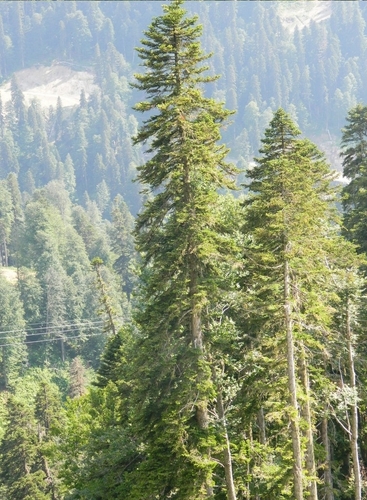
Balsam fir is a small to medium-sized evergreen tree, typically growing 14–20 metres (46–66 ft) tall, and occasionally reaching 27 metres (89 ft) in height. It has a narrow conical crown made up of dense, dark-green leaves.
Bark Characteristics
The bark of young trees is smooth, grey, and covered with resin blisters that tend to spray resin when ruptured; on old trees, the bark becomes rough, fissured or scaly.
Leaf Dimensions and Surface Features
Its leaves are flat, needle-like, and measure 15 to 30 mm (5⁄8 to 1+1⁄8 in) long. They are dark green on the upper surface, often with a small patch of stomata near the tip, and have two white stomatal bands on the lower surface, with a slightly notched tip.
Leaf Arrangement
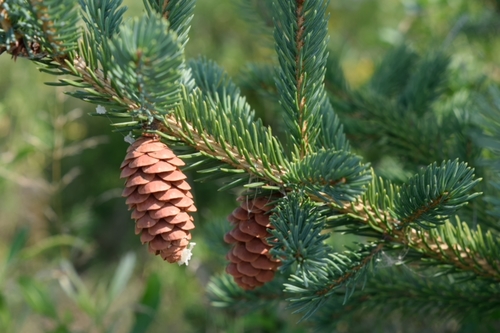
Leaves are arranged spirally on the shoot, but their leaf bases are twisted so the leaves appear to form two more-or-less horizontal rows on either side of the shoot. Needles get shorter and thicker the higher they grow on the tree.
Seed Cone Features
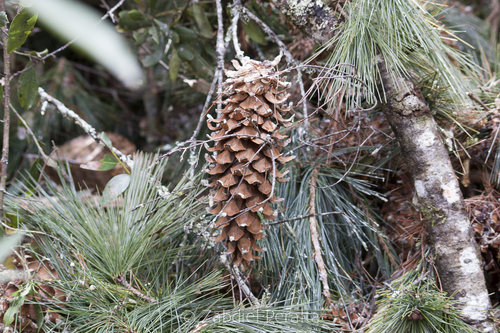
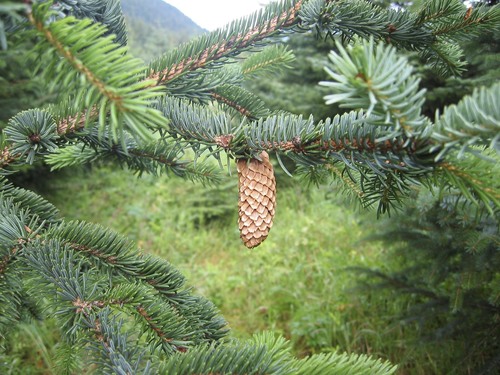
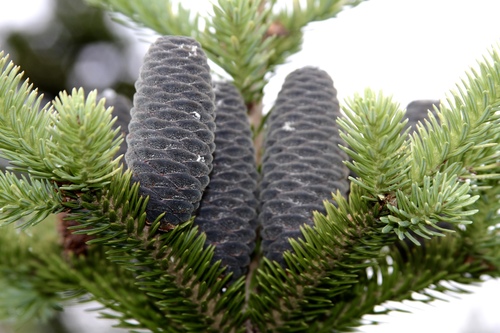
The erect seed cones are 40 to 80 mm (1+1⁄2 to 3+1⁄4 in) long, dark purple when young, ripening brown, and disintegrate to release winged seeds in September.
Reproduction
Male Organ Development Timeline
Male reproductive organs generally develop and emerge earlier than female organs. Male organs contain microsporangia that divide to form sporogenous tissue, made of cells that become archesporial cells.
Microspore Formation
These develop into microspores (pollen-mother cells) once they become rounded and fill with starch grains. When microspores undergo meiosis in spring, four haploid microspores are produced, which eventually develop into pollen grains.
Pollen Release
Once the male strobilus matures, the microsporangia become exposed, and pollen is released.
Female Strobilus Structure
Female megasporangiate strobili are larger than male ones. They contain bracts and megasporophylls, each of which holds two ovules arranged in a spiral.
Megagametophyte Development
These develop a nucellus in which a mother cell forms. Meiosis occurs, producing a megaspore that is the first cell of the megagametophyte.
Ovum and Endosperm Formation
As cell division proceeds, the megaspore nucleus thickens, and cell differentiation produces prothallial tissue that contains an ovum. The remaining undifferentiated cells then form endosperm.
Fertilization Process
When male structures release pollen grains, some land on the female strobilus and reach the ovule. A pollen tube then begins to grow, and eventually sperm and egg meet, resulting in fertilization.
Ecology
Climatic Requirements
Balsam fir is very shade-tolerant, and typically grows in cool climates, ideally with a mean annual temperature of 4 °C (40 °F), with consistent root moisture. Low moisture and high temperature are key factors that limit the species' range.
Swamp Forest Habitat
Balsam fir most commonly grows in four forest types:
- Swamp: Swamp forest types never dry out completely, so balsam fir has constant access to water. The ground is covered in sphagnum and other mosses. In swamps, balsam fir grows densely, slowly, and is slender.
Flat Forest Habitat
- Flat: Sometimes called "dry swamps", these areas drain better than swamps but still retain moisture well. The ground is covered by fern moss, and ground rot may occur. In flat areas, balsam fir grows fast, reaching a large, tall size, and grows mixed with red spruce.
Hardwood Slope Habitat
- Hardwood slope: This is a well-drained area where ground rot is common, and leaf litter covers the forest floor. Balsam fir grows fast to a large, tall size alongside large hardwood trees such as yellow birch, sugar maple, and beech.
Mountain Top Habitat
- Mountain top: On mountain tops, stands of balsam fir occasionally develop fir waves. They often grow at elevations between 760 to 1,520 m (2,500 to 5,000 ft), growing in pure strands or alongside black spruce, white spruce, white birch, and trembling aspen. Growth here is similar to that in swamps, with slow growth producing slender, short trees. Some low branches touch the ground and may root to form an independent new tree.
Faunal Interactions
Balsam fir foliage is browsed by moose and deer. Its seeds are eaten by American red squirrels, grouse, and pine mice; the tree also provides food for crossbills and chickadees, as well as shelter for moose, snowshoe hares, white-tailed deer, ruffed grouse, and other small mammals and songbirds. Its needles are eaten by some lepidopteran caterpillars, including the Io moth (Automeris io).
Cold Hardiness
Abies balsamea is one of the most cold-hardy trees known, surviving temperatures as low as −45 °C (−49 °F) (USDA Hardiness Zone 2). As of 1996, specimens have even shown no ill effects after being immersed in liquid nitrogen at −196 °C (−320.8 °F).
Lifespan and Record Specimens
It is short-lived by conifer standards; the oldest known specimen was 245 years old as of 1996. The tallest and widest recorded specimen has a height of 31.7 metres (104 ft) and a diameter at breast height of 406 centimetres (160 in).
Medicinal Uses
Traditional Native American Use
For thousands of years, Native Americans used balsam fir for medicinal and therapeutic purposes. The needles are eaten directly off the tree by many animals and humans; higher doses are consumed as tea.
Vitamin C Content
Balsam fir contains vitamin C, which has been studied for its effects on bacterial and viral infections. Balsam fir's essential oil and some of its compounds have demonstrated effectiveness against ticks.
Other uses
Canada Balsam Applications
The resin is used to produce Canada balsam, which was traditionally used as a cold remedy and as a glue for glasses, optical instrument components, and for preparing permanent mounts of microscope specimens.
Scurvy Cure Claim
Based on its use as a traditional remedy and the relatively high ascorbic acid content of its needles, historian Jacques Mathieu has argued that balsam fir was the "aneda" that cured scurvy during Jacques Cartier's second expedition into Canada.
Wood and Oil Uses
Its wood is milled for framing lumber (it is part of SPF lumber), siding, and is pulped for paper manufacture. Balsam fir oil is an EPA-approved nontoxic rodent repellent. Balsam fir is also used as an air freshener and as incense.