About Pinus contorta Douglas ex Loudon
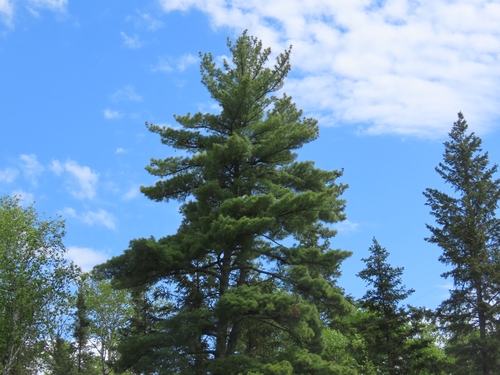
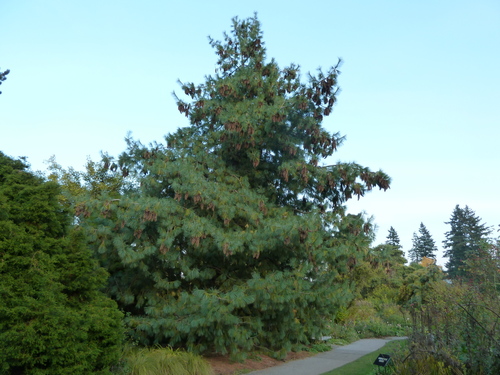
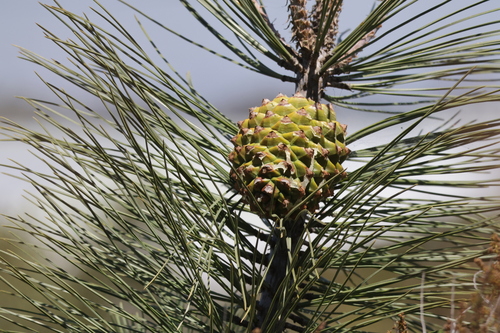
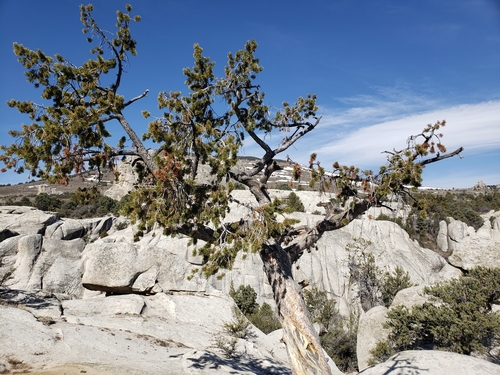
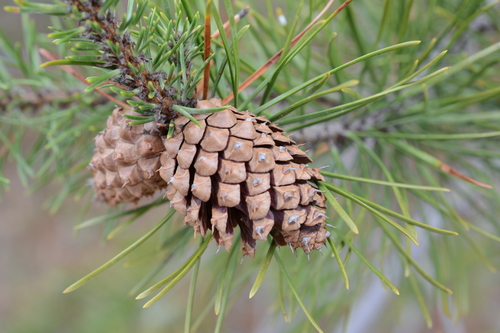
Pinus contorta Douglas ex Loudon, also commonly called black pine, scrub pine, and coast pine, grows as an evergreen shrub or tree depending on its subspecies. The shrub form is krummholz, reaching approximately 1 to 3 meters (3 to 10 ft) in height. Thin trees with narrow crowns can grow 40 to 50 m (130 to 160 ft) tall, and reach up to 2 m (7 ft) in diameter at chest height; the murrayana subspecies is the tallest of the forms. Most often, the crown is rounded and the tree apex is flattened, though trees growing in dense forests develop a slim, conical crown. Twin tree formation is common in some populations in British Columbia. Its elastic branches grow upright or overhang, are difficult to break, and are covered with short shoots that are easy to remove. The species epithet contorta refers to the twisted, bent growth of coastal shore pines, as well as the species' twisted needles. P. contorta subsp. latifolia will hybridize with the closely related jack pine (Pinus banksiana). Bark characteristics vary by subspecies: lodgepole pine bark is thin, scaly, and grayish brown, while shore pine bark is somewhat thick, corky, and fissures into a checkered pattern. Some lodgepole pines growing at low elevations have been reported to have features closer to shore pines, including bark traits. Tamarack pine can live for centuries, and lodgepole pines in Yellowstone National Park have been recorded surviving over 300 years. Pinus contorta is native to western North America, where it occurs from upper dry montane forests to the subalpine region. It is found on the western side of the Cascades, inland British Columbia, and the Rocky Mountains of Alberta, except in areas that are too high and too dry. Lodgepole pine tolerates relatively hostile environments, including high-elevation volcanic rock at Crater Lake in Central Oregon, and thin soils on the eastern slope of the Cascades. Further south, the species grows at higher elevations up to 3,350 m (10,990 ft) above sea level, particularly in southern Colorado. It is rare in lowland rain forests. Shore pine grows in very infertile coastal soils ranging from Southeast Alaska to Northern California. Lodgepole and shore pine grow intermingled (and appear to hybridize) north of Puget Sound. Less dependent on fire than other subspecies, tamarack pine grows in California's upper mountains and grows intermingled with lodgepole pine in Oregon. Pinus contorta also occurs in the closed-cone pine forest of coastal California. Pinus contorta is a fire-adapted species that typically regenerates densely after wildfire. The species characteristically has poor self-pruning and thin bark, which leads to mature tree death following fire. However, heat from fire triggers the opening of its serotinous cones to release seeds, allowing the species to regenerate effectively after fire and persist as an early successional species in forest habitats. Some populations rely more heavily on other regeneration modes instead of fire; wind throw, ice storms, and landslides also act as stand-replacing disturbances that enable regeneration. The natural fire regime for this species is primarily driven by climate, with fires occurring most often after years of drought. Upper montane to subalpine forests where this species grows receive abundant winter moisture from snow. Dense stands of this species inhibit understory establishment and allow ladder fuel to form, and surface fires are rare regardless of stand conditions. As a result, this species' habitat is dominated by infrequent but severe fires. Three climate oscillations play a major role in driving drought conditions that lead to severe fires: the Pacific decadal oscillation (PDO), Atlantic multidecadal oscillation (AMO), and El Niño (ENSO). Combinations of these oscillations in positive or negative phases alter water availability for these forests; the combination of positive AMO, negative ENSO, and negative PDO leads to drought and increased likelihood of severe subalpine fire. The fungus Suillus tomentosus forms specialized tuberculate ectomycorrhizal structures with the roots of lodgepole pine (Pinus contorta var. latifolia). These structures host concentrated populations of nitrogen-fixing bacteria that contribute significant nitrogen to support tree growth, allowing the pines to colonize nutrient-poor sites. Porcupines feed on the inner bark of lodgepole pine. Native Americans consumed the inner bark of lodgepole pine to prevent starvation for both themselves and their horses. The edibility of the lodgepole pine cambium layer depends on its thickness, consistency, and sweetness. Indigenous peoples of the Pacific Northwest and California used different parts of the plant internally and externally as traditional medicine for various ailments. Shore pine gum was used both medicinally and as a chewing gum. Pinus contorta is cultivated as an ornamental tree by the horticulture industry. Plant nurseries grow Pinus contorta subsp. contorta and Pinus contorta subsp. murrayana for use in traditional and wildlife gardens, and as smaller native plant selections for natural landscaping. Smaller varieties and cultivars of shore pine are also used in container gardening, including as large bonsai specimens. Notable cultivars of this species include 'Chief Joseph', a dwarf variety of Pinus contorta var. latifolia grown for its yellow winter needles, and 'Spaan's Dwarf', a dwarf variety of Pinus contorta var. contorta that grows wider than it grows tall. The 'Chief Joseph' cultivar has received the Royal Horticultural Society's Award of Garden Merit.