About Pimelea spinescens Rye
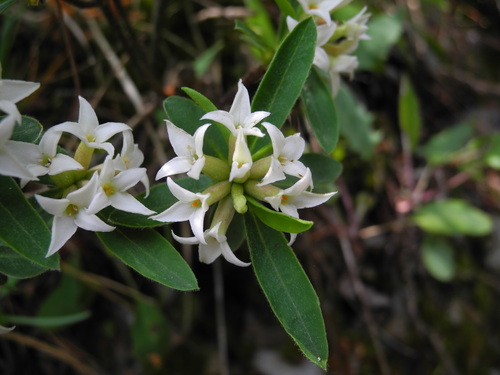
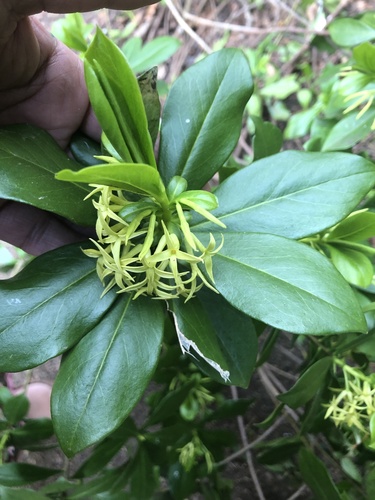
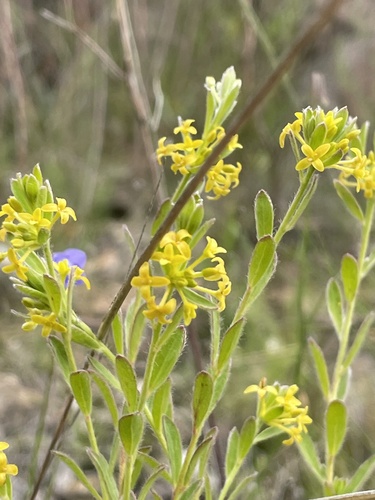
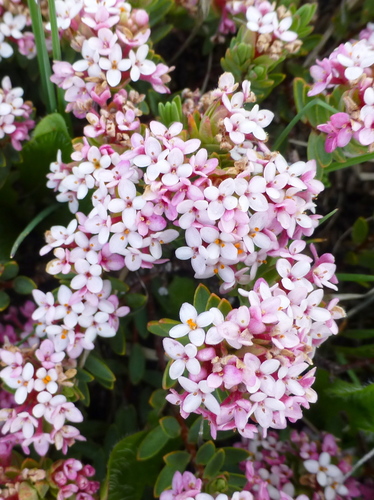
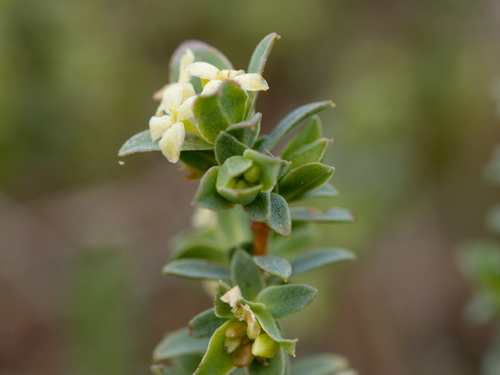
Pimelea spinescens Rye is a spreading, stunted, long-lived undershrub that usually reaches 5 to 30 centimeters (2.0 to 11.8 inches) in height. It has a deep taproot, and its stems are hairless, turning spiny as they mature. The leaves are narrowly elliptic or elliptic, measuring 2 to 10 millimeters (0.079 to 0.394 inches) long and 1 to 3 millimeters (0.039 to 0.118 inches) wide. Its flowers are arranged in clusters of 6 to 12, surrounded by 4 elliptic, stalkless, leaf-like involucral bracts that are 3 to 7 millimeters (0.12 to 0.28 inches) long and 1.5 to 4 millimeters (0.059 to 0.157 inches) wide. Male and female flowers usually grow on separate plants, and flowers can be white, cream-colored, or yellow. Clusters of male flowers grow upright, while clusters of female flowers droop. The flower tube is 1.5 to 3 millimeters (0.059 to 0.118 inches) long, the sepals are 1 to 2 millimeters (0.039 to 0.079 inches) long, and the stamens are shorter than the sepals. Flowering takes place in June and July. Subspecies pubiflora was considered extinct because it had not been collected since 1901, but it was rediscovered in 1980 growing in grassy woodland in the Wimmera region of Victoria. Subspecies spinescens grows mainly in grassland and open shrubland in the area between Melbourne, Horsham and Echuca.