About Pimelea curviflora R.Br.
Nomenclature and General Growth Form
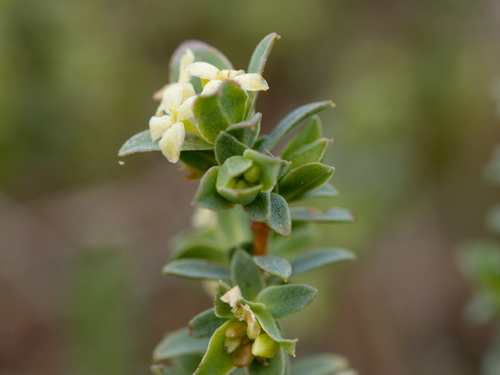
Pimelea curviflora R.Br., commonly known as curved rice-flower, is a small woody understory shrub that grows 20–150 cm (7.9–59.1 in) tall, with soft hairy stems.
Leaf Shape and Size
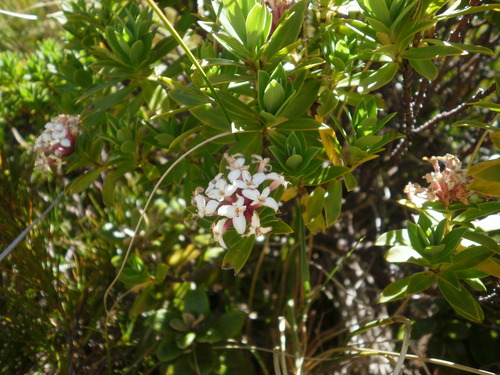
Its yellowish-green leaves are elliptic, lance-shaped, or egg-shaped, measuring 5–20 mm (0.20–0.79 in) long and 2–8 mm (0.079–0.315 in) wide, and are hairy on both sides.
Leaf Arrangement and Structure
Leaves are arranged in opposite pairs or alternately, borne on a short petiole, and end in a pointed tip.
Leaf Surface Hairs
Hairs on the upper leaf surface are spreading or flattened, becoming silky, short, and somewhat less twisted; the upper leaf surface is either smooth or covered with shorter hairs.
Leaf Color Variation
Leaf color may be uniform, or vary between the upper and lower surfaces.
Flower Quantity and Type
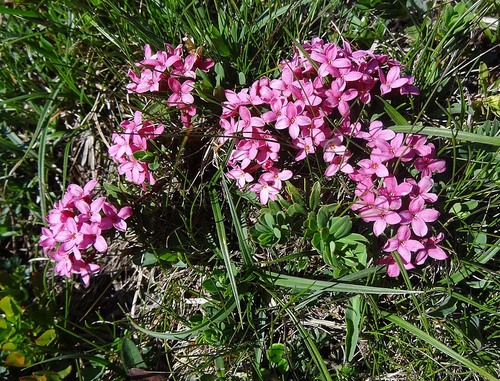
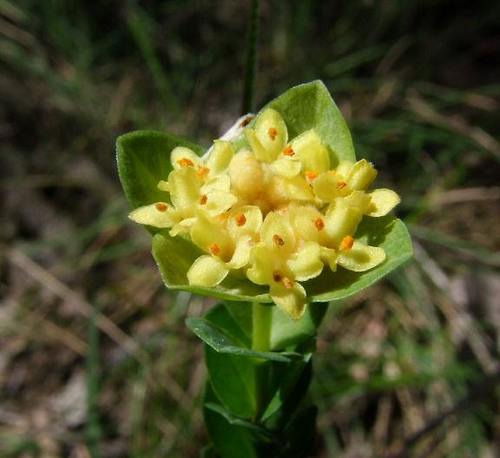
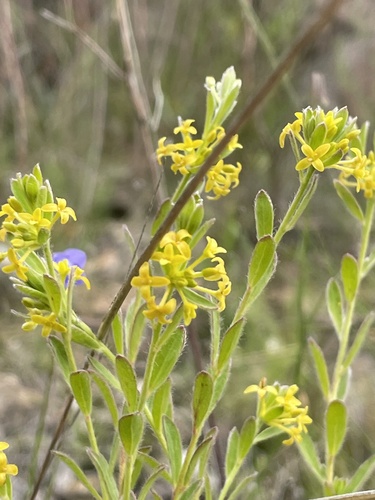
The plant produces 6 to 20 compact green-yellow, sometimes reddish, flowers that are either female or bisexual.
Floral Tube Characteristics
Each flower has a 5–12 mm (0.20–0.47 in) long floral tube that flares at the tip and is usually hairy.
Flower Arrangement
Flowers are arranged in heads at the end of branches or in leaf axils.
Flower Bracts
Flower bracts may be absent or not conspicuous.
Style and Pedicel Traits
The style is 2–5 mm (0.079–0.197 in) long, sometimes shorter in female flowers, and pedicels are hairy.
Fruit Characteristics
The dry, green fruit are 2–4 mm (0.079–0.157 in) long.
Flowering Period
Flowering occurs from late spring to early summer.
Species Distribution Range
Curved rice-flower is a variable, widespread species that grows in New South Wales, south-eastern South Australia, and south-eastern Queensland, on or near the Great Dividing Range and in coastal areas from Brisbane to Adelaide.
Additional State Distribution
It also grows in Victoria (including montane woodland, where it is common and widespread) and Tasmania.
General Habitat and Soil
It inhabits forests, grassland, and woodlands among acacia, eucalypt, and callitris, usually growing on clay and shale soils, and also occurs in rainforest among vine thickets.
Variety acuta Range and Habitat
Several varieties have distinct ranges and habitats: Variety acuta grows in forest and woodland at altitudes between 750 and 1,500 m (2,460 and 4,920 ft), ranging from near Mount Kosciuszko to the Budawang Range in New South Wales and the Australian Capital Territory.
Variety curviflora Range and Habitat
Variety curviflora is restricted to coastal areas around Sydney, where it grows on sandstone.
Variety divergens Distribution
Variety divergens is widespread across the coast, ranges, and western slopes from the Boyne River in Queensland to the Sydney region.
Variety gracilis Range and Habitat
Variety gracilis usually grows in forest, sometimes on rocky sites, and is widespread from extreme south-eastern Queensland, through eastern New South Wales and southern Victoria, to south-eastern South Australia and northern Tasmania.
Variety sericea Range and Habitat
Variety sericea grows in sandy soil in open forest, and is widespread from extreme south-eastern Queensland, through eastern New South Wales and Victoria, to south-eastern South Australia and the Furneaux Group islands in Tasmania.
Variety subglabrata Range and Habitat
Variety subglabrata grows in scrub and pastures from the Goulburn River to Nowra in New South Wales.