About Pimelea serpyllifolia R.Br.
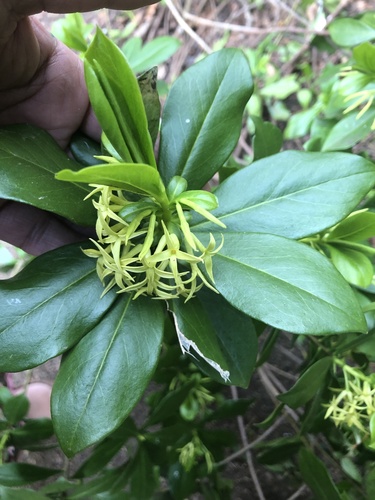
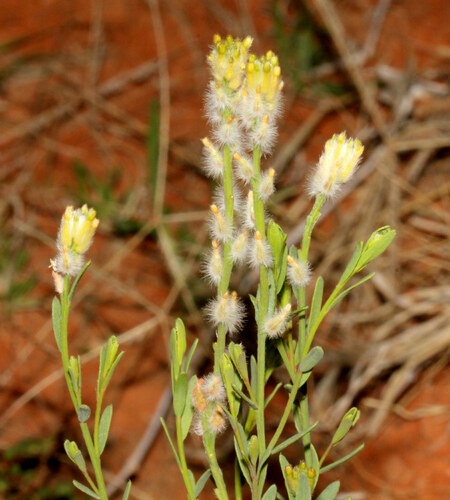
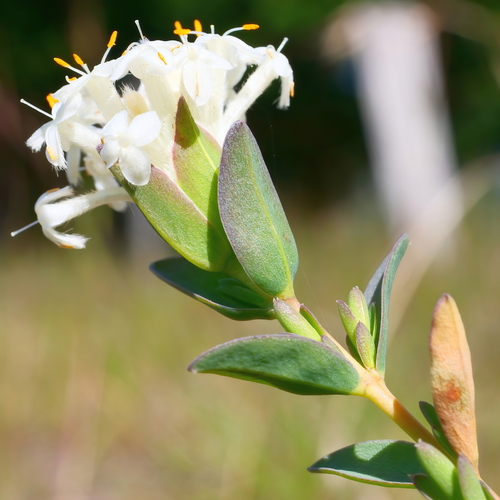
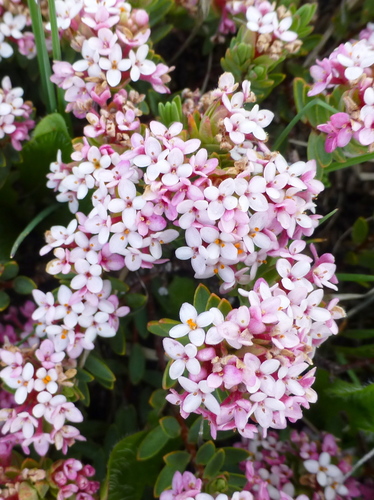
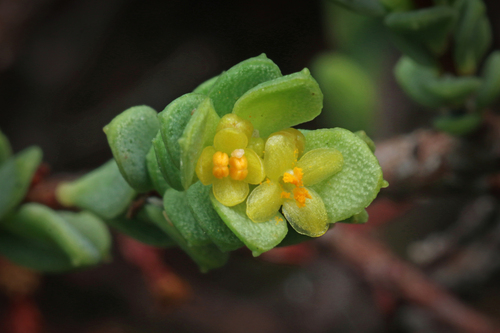
Pimelea serpyllifolia R.Br. is an erect shrub that typically reaches a height of 0.1 to 1.5 meters (3.9 inches to 4 feet 11.1 inches). In exposed positions, it rarely becomes stunted or grows prostrate. Its stems are glabrous, and leaves are arranged in opposite pairs, crowded along the stems. Leaves range from narrowly elliptic to spatula-shaped, are 4 to 12 millimeters long and 2 to 4 millimeters wide, are glabrous, and have the same shade of green on both surfaces. Flowers grow in compact heads that hold 4 to 12 individual blooms, which can be yellow, yellowish-green, or white. Each flower head is surrounded by 2 or 4 sessile, elliptic involucral bracts that measure 2 to 6 millimeters long and 1 to 4 millimeters wide. This species is dioecious, meaning female and male flowers grow on separate plants. On female plants, the floral tube is 1.5 to 2.5 millimeters long, and the sepals are 0.8 to 1 millimeter long. On male plants, the floral tube is 1.8 to 2.5 millimeters long, and the sepals are 1.0 to 1.7 millimeters long. Pimelea serpyllifolia has two accepted subspecies with different distributions and habitats. Subspecies serpyllifolia grows in shrubland and woodland, mostly in near-coastal areas of Victoria and South Australia, and also occurs in far north-western Victoria. It also has small populations near Euston in far south-western New South Wales, near Eucla in Western Australia, in a small number of locations in north-eastern Tasmania, and on the Bass Strait Islands. Subspecies occidentalis grows in near-coastal areas between Israelite Bay and Twilight Cove in southern Western Australia.