About Pimelea ligustrina Labill.
Growth Form
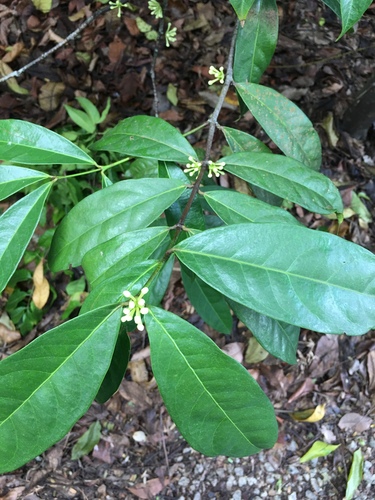
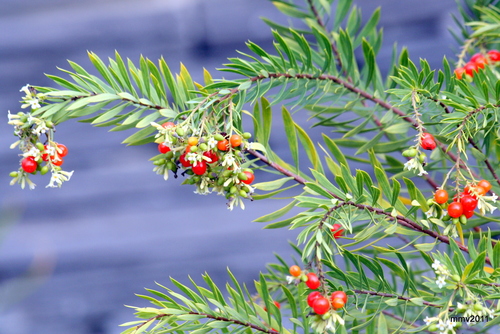
Pimelea ligustrina Labill. is a shrub that typically grows to a height of 0.2–3 m (7.9 in – 9 ft 10.1 in) and has smooth, hairless (glabrous) stems.
Leaf Arrangement and Shape
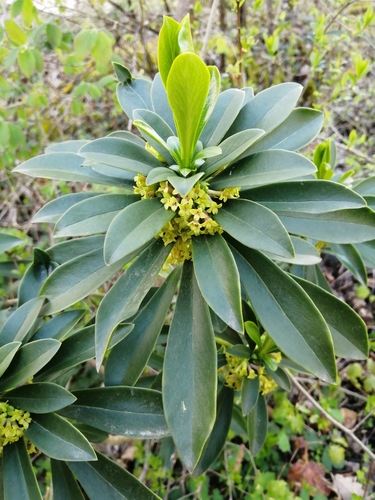
Its leaves are arranged in opposite pairs, and are lance-shaped (with the narrower end at the base) or narrowly elliptic.
Leaf Size and Petiole
Most leaves are 15–90 mm (0.59–3.54 in) long and 7–20 mm (0.28–0.79 in) wide, and grow on a short stalk (petiole).
Flower Sex and Color
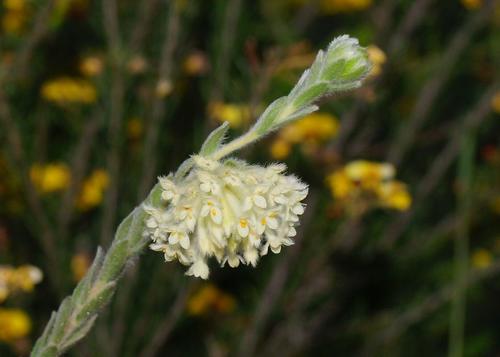
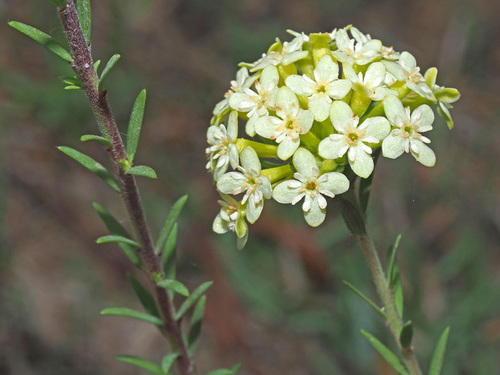
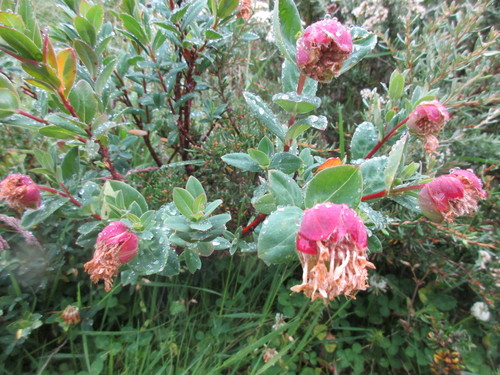
The flowers are either bisexual or female, and are creamy white or white, rarely pink.
Flower Clusters and Involucral Bracts
They are arranged in large, erect clusters, surrounded by 4 or 8 lance-shaped to broadly elliptic involucral bracts that are 5–18 mm (0.20–0.71 in) long and 3–14 mm (0.12–0.55 in) wide.
Floral Tube and Sepals
The floral tube is 5.5–13 mm (0.22–0.51 in) long, the sepals are 1.5–5 mm (0.059–0.197 in) long and hairy on the outer surface.
Flowering Period Variation
Flowering time differs between subspecies.
Fruit Characteristics
The fruit is green and 3–5 mm (0.12–0.20 in) long.
Species Distribution Range
This species of pimelea is found in the Australian Capital Territory and all Australian states except Western Australia.
Subspecies ciliata Habitat and Distribution
Subspecies ciliata grows in forest, snow gum woodland and heath above 1,400 m (4,600 ft) in areas south from the Brindabella Range in New South Wales, the Australian Capital Territory and eastern Victoria.
Subspecies hypericina Habitat and Distribution
Subspecies hypericina grows on the margins of wet forest and rainforest, mainly between the Gibraltar Range and Mount Cambewarra in New South Wales.
Subspecies ligustrina Habitat and Distribution
Subspecies ligustrina is widely distributed in forest below 1,400 m (4,600 ft) in south-east Queensland, eastern New South Wales, the Australian Capital Territory, southern Victoria, the far south-east of South Australia, and Tasmania.
Ecological Role
Ecologically, this pimelea acts as a food plant for caterpillars of the yellow-spot blue butterfly.