About Picea orientalis (L.) Peterm.
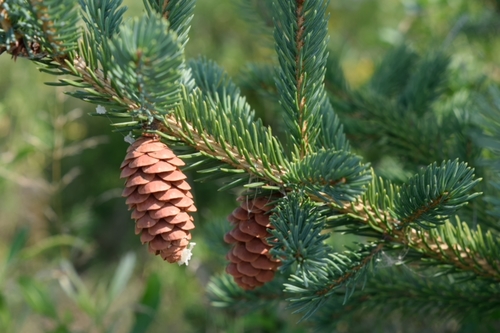
Picea orientalis (L.) Peterm., commonly called Caucasian Spruce, is a large coniferous evergreen tree. It typically grows 30–45 m (98–148 feet) tall, and can exceptionally reach 57 m in height. Its trunk diameter can grow up to 1.5 m, with exceptional specimens reaching 4 m across. This tree is native to regions including the Caucasus, and is also found in Northern Iran, where its population has declined due to deforestation. Its shoots are buff-brown and moderately covered in fine hairs (pubescent). Its needle-like leaves are the shortest of any spruce, measuring 6–8 mm long, rhombic in cross-section, and dark green with faint, inconspicuous stomatal lines. Its cones are slender cylindric-conical, 5–9 cm long and 1.5 cm broad. They are red to purple when young, mature to dark brown 5–7 months after pollination, and bear stiff, smoothly rounded scales. Caucasian Spruce is a popular ornamental tree for large gardens. It is valued in northern Europe and the United States for its attractive foliage and ability to grow in a wide variety of soils. It is also grown on a small scale in forestry for Christmas trees, timber, and paper production. However, it grows more slowly than Norway spruce, so it has less economic importance outside its native range. The straight species Picea orientalis, along with its cultivars 'Aurea' and 'Skylands', has been awarded the Royal Horticultural Society's Award of Garden Merit. A commonly cultivated ornamental cultivar is Picea orientalis 'Aureospicata', which produces gold-coloured young foliage each spring.