About Picea engelmannii Parry ex Engelm.
Nomenclature and Habit
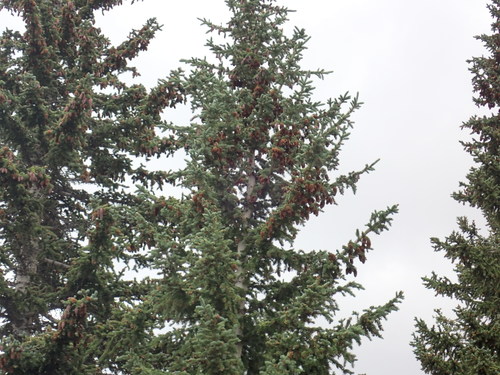
Picea engelmannii Parry ex Engelm., commonly called Engelmann spruce, is a medium-sized to large evergreen tree.
Size
It typically reaches 25–40 metres (82–131 feet) in height, with exceptional specimens growing up to 65 m (213 ft) tall, and has a maximum trunk diameter of 1.5 m (4 ft 11 in).
Bark Characteristics
Its reddish bark is thin and scaly, and it flakes off in small circular plates 5–10 centimetres (2–4 in) across.
Crown Shape
Young trees have a narrow conical crown, which becomes cylindrical as the tree ages.
Shoot Characteristics
Shoots are buff-brown to orange-brown, usually densely covered in fine hairs, and bear prominent pulvini.
Leaf Morphology
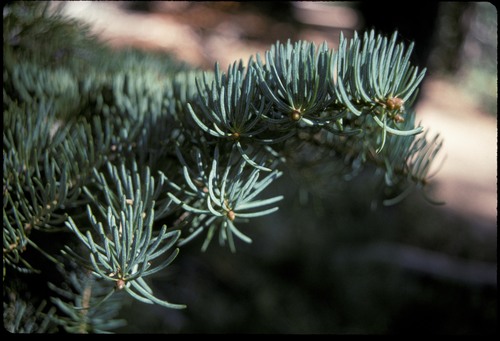
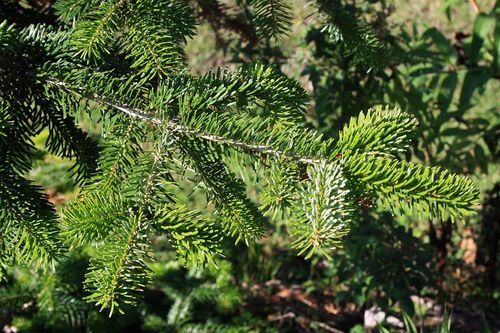
Leaves are needle-like, 15–30 millimetres (5⁄8–1+1⁄8 in) long, flexible, and rhombic in cross-section.
Leaf Coloration and Stomata
They are glaucous blue-green on the upper surface with several thin lines of stomata, and blue-white on the lower surface with two broad bands of stomata.
Leaf Odour
Crushed needles produce a pungent odour.
Pollen Cones
In spring, around 1 cm (0.39 in) purple cones emerge, and release yellow pollen when blown by wind.
Mature Seed Cone Shape and Size
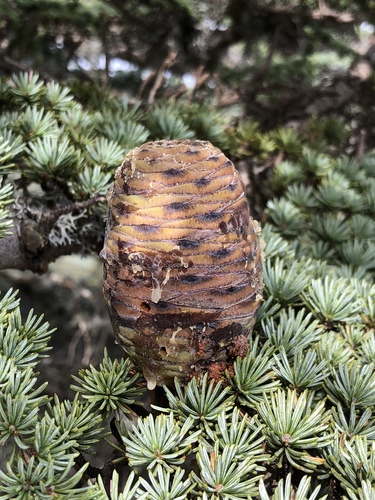
Mature seed cones are pendulous and slender cylindrical, measuring 2.5–8 cm (0.98–3.15 in) long and 1.5 cm (0.59 in) broad when closed, opening to 3 cm (1.2 in) broad.
Cone Scale Characteristics
They have thin, flexible scales 1.5–2 cm (0.59–0.79 in) long with a wavy margin.
Cone Coloration and Maturation
Cones are reddish to dark purple when young, and mature to light brown 4–7 months after pollination.
Seed Characteristics
Seeds are black, 2–3 mm (0.079–0.118 in) long, with a slender light brown wing 5–8 mm (0.20–0.31 in) long.
Alpine Growth Form
Along the edge of alpine tundras, this species grows in a low, shrubby krummholz form.
Habitat Preferences
Engelmann spruce is primarily a high-elevation mountain tree that reaches the tree line in many areas, but grows in cool, watered canyons at lower elevations.
Elevation Range
It occurs at elevations ranging from 520–3,650 m (1,710–11,980 ft) above sea level, and rarely grows lower in the northwestern part of its range.
Native Distribution
It is native to western North America, common in the Rocky Mountains and on the east slopes of the Cascade Range.
Range Extent
Its range extends from central British Columbia to southern Oregon in the Cascades, and across Montana, Idaho, and Colorado; it grows more sparsely on sky islands in Arizona and New Mexico, and has two isolated populations in northern Mexico.
Regional Population Details
It also grows in the canyons of the Idaho Panhandle, and occurs in limited numbers in the northeastern Olympic Mountains, which host some exceptionally large specimens, including one that measures 2.1 m (7 ft) in diameter and 55 m (179 ft) tall.
Cascade Range Distribution
In the Cascade Range, it is found mostly on eastern slopes at elevations of 900–1,800 m (3,000–5,900 ft), and it is abundant across the Rocky Mountains.
Additional Distribution Locations
It can also be found in the Monashee and Selkirk Mountains, and in the highlands surrounding the Interior Plateau.
Snowpack and Transpiration
In ecology, small Engelmann spruce saplings have greatly reduced transpiration when covered by snowpack.
Regeneration Limitations
When snowpack is lost, saplings have increased transpiration; combined with low sapwood water reserves and extended soil frost in windswept areas, this may prevent the species from regenerating in open areas both above and below the tree line.
Sapling Survival Requirements
Water uptake and water stored in roots are both critical for the survival of subalpine Engelmann spruce saplings that are exposed above the snowpack from late winter to early spring.
Late Winter Water Needs
For exposed trees, available soil water is often critical in late winter when transpirational demands increase.
Elevation-Specific Damage Sources
Cuticular damage from windblown ice is probably the main source of harm at the tree line, while desiccation damage is more impactful at lower elevations.
Tree Line Growth Trait
Despite wind damage, this species tends to grow taller than other tree species at the tree line.
Shade Tolerance and Fire Dependency
It is shade tolerant, but less so than subalpine fir, which makes it somewhat dependent on fire to outcompete other species.
Fire Vulnerability
However, its thin bark and shallow roots leave it vulnerable to fire.
Pest Threats
Spruce bark beetles attack this tree, and are particularly deadly to long-established old-growth stands.
Natural Disturbance Vulnerability
The species is also susceptible to damage from avalanches.
Post-Fire Foraging Habitat
Old-growth Engelmann spruce forests do not provide high-quality forage for most animals, but they become useful foraging habitat after wildfires, as fires often burn completely through these stands, allowing many other plants, especially deciduous species, to become established.
Faunal Associations
Trout use streams shaded by Engelmann spruce, and aphids create galls that hang from the tree that resemble cones when they dry out.
Traditional Uses
Native Americans made various medicines from the resin and foliage of this species.
Economic Importance Overview
Engelmann spruce is economically important for its light, moderately strong wood.
Common Wood Uses
It is harvested for paper production and general construction.
Musical Instrument Use
Wood from slow-grown high-elevation trees is especially valued for making soundboards for musical instruments including acoustic guitars, harps, violins, and pianos.
Food Container Use
Because the wood is odourless and contains little resin, it has been used for food containers such as barrels.
Christmas Tree Use
It is also used to a small extent as a Christmas tree.