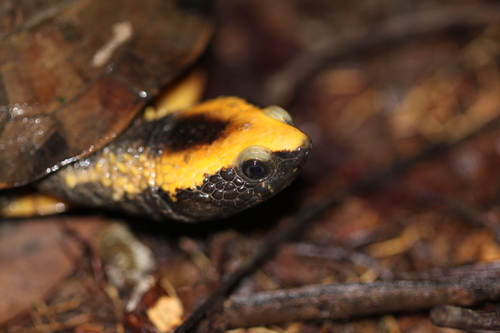
About Phrynops hilarii (Duméril & Bibron, 1835)
Taxonomic Naming
Phrynops hilarii, first formally described by Duméril & Bibron in 1835, has an oval, flattened carapace.
Size and Weight
This species reaches a maximum straight-line carapace length of approximately 40 cm (16 in), with adults reaching an approximate weight of 5 kg (11 lb).
Carapace Coloration
The carapace is most often dark brown, olive, or gray, and is marked by a yellow border.
Head Morphology
Its head is large and flat, with a gray to olive coloration on the upper surface, a pointed snout, and two bicolored chin barbels.
Head Markings
Each side of the head features a black band that starts at the muzzle, crosses over the eyes, and extends back to the neck.
Confirmed Distribution
This species is distributed across southern Brazil, specifically in the states of Santa Catarina and Rio Grande do Sul, extending southward and westward into Uruguay and Argentina.
Unconfirmed Distribution Records
There are unconfirmed records of its presence in Paraguay and Bolivia.
Habitat
Phrynops hilarii lives in streams, lakes, and swamps that have abundant aquatic vegetation and soft bottoms.