About Phodopus sungorus (Pallas, 1773)
Taxonomic Context
This description covers the physical characteristics of the winter white dwarf hamster, Phodopus sungorus.
Coat Texture
Its coat is less woolly than the coat of Campbell's dwarf hamster.
Initial Color Morphs
Along with its natural standard coloration, winter white dwarf hamsters can also have sapphire, sapphire pearl, or normal pearl color patterns.
Body Measurements
Their head and body length measures 70–90 mm, their tail length measures 5–15 mm, and their hind legs measure 11–15 mm.
Seasonal Weight Fluctuation
Body weight changes dramatically across the year, and reaches its lowest point during winter.
Adult Weight Range
In males, body weight ranges from 19 to 45 grams (0.67 to 1.59 oz), while in females it ranges from 19 to 36 grams (0.67 to 1.27 oz).
Captive vs Wild Weight
Individuals kept in human care are slightly heavier than wild counterparts.
Captive Lifespan
The average lifespan of the winter white dwarf hamster is one to three years in captivity, though some captive individuals may live longer.
Wild Lifespan
In the wild, this species is known to live as little as one year.
Summer Back Fur Color
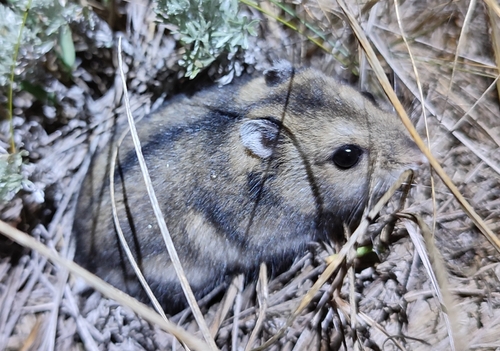
In summer, the fur on the back of the winter white hamster changes from ash-grey to dark brown, or sometimes takes on a pale brown tint.
Summer Face Markings
The face becomes grey or brown, while the mouth area, whisker area, and ears are slightly lighter.
Facial Feature Edging
The outer edges of the ears and the rims of the eyes have black edges.
Head Coloration
The rest of the head is dark brown or black.
Dorsal Stripe
A black-brown dorsal stripe runs from the head down to the tail.
Ventral Coloration
The throat, belly, tail, and limbs are white.
Ear Appearance
The ears are grey with a pinkish tint, with scattered black hairs.
Underside Hair Color
Hairs on the underside are completely white.
Ventral Fur Extension
The light-colored coat of the underside extends upward onto the shoulders, flanks, and hips in three upward-curving arches.
Dorsoventral Fur Boundary
These upward arches form three curved lines that separate the light underside fur from the darker black-brown fur of the upper body.
Non-Hybrid Color Morphs
In addition to its typical natural coloration, winter white dwarf hamsters can also have pearl, sapphire, sapphire pearl, and marbled colorations.
Hybrid-Associated Color Origin
Other color variants exist, but these are strongly suspected to only appear in hybrid crosses between winter white dwarf hamsters and Campbell's dwarf hamsters.
Hybrid-Associated Morph List
These less common, hybrid-associated colorations include mandarin, blue, argente, yellow blue fawn, camel, brown, cream, merle, and umbrous.
Winter Coat Characteristics
In winter, the fur becomes more dense, and sometimes develops a grey tint on the head.
First Winter Coat Retention
More than 10% of captive winter white dwarf hamsters retain their summer coat through their first winter.
Second Winter Coat Change
By their second winter, only a small number of individuals will change into a full winter coat, and winter coloration becomes less pronounced.
Winter Moulting Timeline
Moulting into winter fur starts in October or November and finishes in December.
Summer Moulting Timeline
Moulting into summer fur starts in January or February and finishes in March or early April.
Moulting Progression Pattern
Moulting, whether for summer or winter fur, begins on the head and along the back spine, then progresses outward to the sides, legs, and underside.
Summer Hair Length
Summer hairs grow longer, reaching approximately ten millimetres in length.
Hair Pigmentation Controls
Hair pigmentation is controlled by the hormone prolactin and color genetics.
Winter Coat Photoperiod Requirement
A day length of less than 14 hours is required to initiate the change to winter coat.
Photoperiod Direction Sensitivity
Some evidence suggests these hamsters can sense directional changes in photoperiod length: one experiment found that a transition from 16 hours of light to 14 hours is enough to initiate a shift to winter coat.
Summer Winter Coat Induction
A change to winter coat can even be triggered in summer by exposure to short day lengths.
Summer Coat Initiation Timing
The shift back to summer coat occurs in autumn, when day length changes again.
Captive Moulting Modification
Captive hamsters kept at constant indoor temperatures start these seasonal coat changes later, and their winter coloration is less pronounced.
Eye Coloration
The eyes of the winter white hamster are black, unless the individual is albino, in which case the eyes are red.