About Phodopus roborovskii (Satunin, 1903)
Common Names
Phodopus roborovskii, commonly called the Roborovski hamster, is also known by other common names including the desert hamster, Robo dwarf hamster, or simply dwarf hamster.
Taxonomic Position & Native Range
It is the smallest of the three hamster species in the genus Phodopus, and is native to the deserts of Central Asia.
Size
Newborn Roborovski hamsters average 1.6 cm (0.6 in) in length; adult individuals grow to 6.3 cm (2.5 in) in length and 16 g (0.56 oz) in weight.
Distinguishing Markings
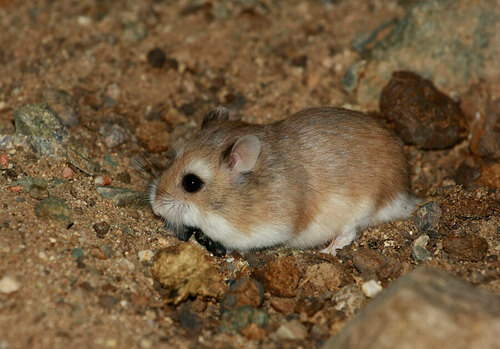
Distinguishing features of the species include eyebrow-like white spots and a complete lack of the dorsal stripe found on all other members of the genus Phodopus.
Lifespan
Roborovski hamsters have an average lifespan of 2 to 4 years, which varies based on living conditions: the maximum recorded lifespan is four years for individuals in captivity, and two years for those in the wild.
Locomotion Speed
This species is known for its speed, and has been recorded running up to 6 miles in a single night.
Etymology
Both the common and scientific name of the species honor Russian explorer Vsevolod Ivanovich Roborovsky, who collected the species' holotype.
Geographical Distribution
Roborovski hamsters inhabit desert regions, including the Lake Zaysan basin in Kazakhstan, plus regions of Tuva, Mongolia, and Xinjiang in China.
Habitat Substrate & Vegetation
They live in areas with loose sand and sparse vegetation, and are rarely found in locations with dense vegetation or solid clay substrates.
Elevation Range
Their habitats sit at elevations ranging from roughly 1,200 metres (3,900 ft) to 1,450 metres (4,760 ft).
Fossil Record
Despite completed research on the species, no fossil record of Phodopus roborovskii has been identified to date.
Physiological Adaptations
Roborovski hamsters are especially well-adapted to steppe and desert habitats because they use water very efficiently.
Burrowing Behavior
They dig and occupy burrows with steep tunnels that can reach as deep as six feet underground.
Activity Pattern
In the wild, Roborovski hamsters are crepuscular, meaning they are most active at dawn and dusk.
Distribution Abundance
The species is more common in the southern portion of its distribution range, including areas like Yulin, Shaanxi, China.
Sightings
Local people in Yulin and the sand dunes of the Ordos Desert commonly report sightings of this hamster.