About Neotoma cinerea (Ord, 1815)
Distinguishing Physical Features
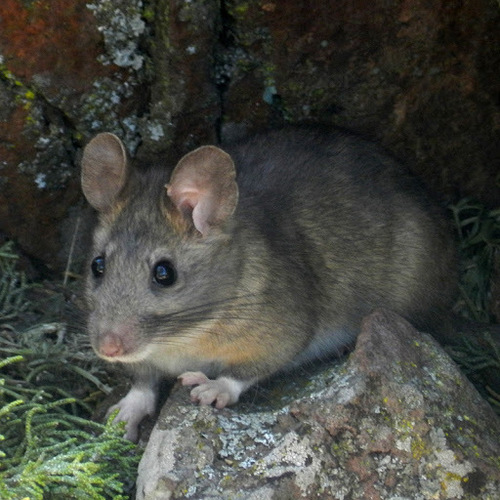
Bushy-tailed woodrats (Neotoma cinerea) can be identified by their large, rounded ears and long, bushy tails. Their upper fur is usually brown, mixed with black hairs, and their undersides and feet are white. The upper body color can range from buff to almost black.
Tail Morphology
Their tails are squirrel-like: bushy and flattened from base to tip.
Climbing Adaptations
These woodrats are skilled climbers with sharp claws. They use their long tails for balance when climbing and jumping, and also for extra warmth.
Sexual Dimorphism
This species is sexually dimorphic: the average male is roughly 50% larger than the average female.
Adult Size and Weight
Adult bushy-tailed woodrats measure 11 to 18 inches (28 to 46 cm) in total length, half of which is the tail, and weigh an average of 1.3 pounds (590 g). This is the largest and most cold-tolerant species of woodrat.
Geographic Range
Bushy-tailed woodrats are found in western North America. Their range extends from arctic Canada south to northern Arizona and New Mexico, and east as far as the western parts of the Dakotas and Nebraska.
Habitat Types
They occupy a wide variety of habitats, from boreal forests to deserts. Their preferred habitat is in and around rocky areas, so they are often found along cliffs, in canyons, on talus slopes, and in open rocky fields. They readily adapt to living in abandoned buildings and mines.
Elevation Range
They can be found from sea level up to 14,000 feet (4,300 m), but toward the southern end of their range, they are increasingly restricted to higher elevations.
Habitat Preference Specifics
These woodrats do not thrive as well in old-growth forests, and are found more frequently and at higher densities in more open habitats.
Male Territorial Behavior
Males establish dominance in their territories through scent marking and physical confrontations. Fights consist largely of biting and scratching, and may cause serious injury.
Breeding Season and Gestation
Breeding takes place in spring and summer, from May through August, with a gestation period of about five weeks. A female can produce one or two litters each year.
Litter Characteristics
Litter size ranges from two to six, with a typical litter of three. Females only have four mammary glands, so larger litters most likely have higher mortality rates.
Female Breeding Physiology
Females have been observed breeding as soon as 12 hours after giving birth, and can be pregnant with one litter while nursing another. In captivity, gestation lasts 27 to 32 days.
Newborn Development
Newborns weigh around 15 g (0.53 oz). Their eyes open at about 15 days old, and weaning occurs between 26 and 30 days old.
Juvenile Dispersal
Males leave their mother at 2 and a half months of age. Females often stay in the same general area as their mother, with overlapping home ranges.
Female Kin Social Dynamics
This is a clear exception to the species’ territorial nature, and this relationship is not currently well understood. Daughters may share food caches with their mother, which increases their likelihood of survival, and the higher female density in the area may also help attract males.
Female Maturity Age
Females breed for the first time when they are one year old.