About Microcarbo niger (Vieillot, 1817)
Size and Comparison to Indian Cormorant
The little cormorant (Microcarbo niger) reaches about 50 centimetres (20 in) in length, and is only slightly smaller than the Indian cormorant (Phalacrocorax fuscicollis). The Indian cormorant can be distinguished by its narrower, longer bill that ends in a prominent hook tip, its blue iris, and a more pointed head profile.
Breeding Adult Plumage
Breeding adult little cormorants have glistening all-black plumage, with small white spots and fine filoplumes on the face. They also have a short crest on the back of the head, and dark eyes, gular skin, and face.
Non-Breeding and Juvenile Plumage
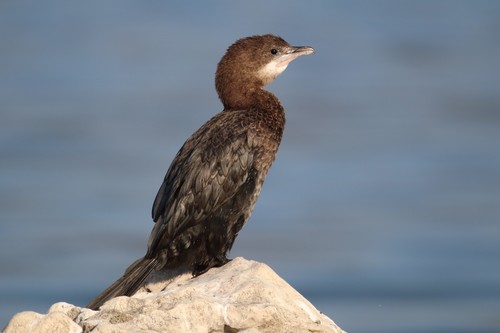
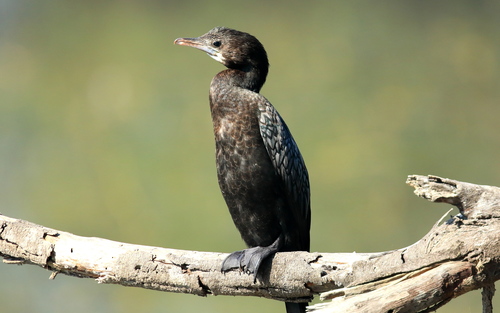
Non-breeding adults and juveniles have brownish plumage, and their bill and gular skin may appear more fleshy. The crest becomes inconspicuous, and a small, clearly marked white patch on the throat is sometimes visible.
Comparison to Pygmy Cormorant
Towards the west of the Indus River valley, the range of the little cormorant can overlap with vagrant pygmy cormorants (Microcarbo pygmaeus). These two species can be difficult to tell apart in the field, and are sometimes even considered the same species.
Sexual Dimorphism
Little cormorant sexes cannot be distinguished in the field, though males tend to be larger. Atypical silvery-grey plumages have been recorded for the species.
Taxonomy and Naming
This species was originally described by Vieillot in 1817 as Hydrocorax niger; the genus name Hydrocorax literally means water crow. It was later grouped with other cormorants in the genus Phalacrocorax, but some studies place the smaller "microcormorants" in the genus Microcarbo instead.
Geographical Distribution
The little cormorant is distributed across India, Sri Lanka, Bangladesh, Pakistan, and lowland Nepal. It also occurs in parts of Myanmar, Thailand, Laos, Cambodia, and Indonesia. It is not found in the Himalayas, though vagrant individuals have been recorded in Ladakh.
Habitat
It lives in wetland habitats, from small village ponds to large lakes, and sometimes tidal estuaries.
Foraging Grouping
Little cormorants typically forage mostly in small loose groups, and are often seen foraging alone. They swim underwater to catch their main prey, fish.
Foraging Environment and Prey Size
A study in northern India found that little cormorants fish in water less than one metre deep, and catch fish around 2–8 centimetres (0.79–3.15 in) in length. They propel themselves underwater using their webbed feet.
Kleptoparasitism
Caught fish are often brought to the surface to be swallowed, and during this time other birds—including other little cormorants, painted storks, gulls, and egrets—may attempt to steal the fish. Unlike little cormorants, Indian cormorants typically fish communally in larger groups.
Wing-spreading Behaviour
Like all other cormorants, little cormorants leave the water and hold their wings out while remaining motionless for a period. This behaviour is often thought to serve the purpose of wing-drying, though this interpretation is debated.
Wing-spreading Study Findings
A study in Sri Lanka found that time spent with spread wings always occurs after the bird has spent time underwater, that the duration of this behaviour correlates with time spent underwater, and that duration is inversely related to air temperature and dryness. These observations support the theory that the behaviour helps dry the birds' wings.
Breeding Season Timing
The little cormorant's breeding season runs from July to September in Pakistan and northern India, from November to February in southern India, and from December to May in Sri Lanka. A study in Bangladesh found little cormorants breed there from May to October.
Courtship Display
Males display at the nest site by fluttering their wings while holding their head back and bill raised, then lowering the bill. After pairing, the male also provides food to the female during courtship feeding.
Nest Construction
Both parents work together to build the nest, which is a stick platform placed on trees, and sometimes even on coconut palms. They may nest in colonies alongside Indian pond herons and little egrets. The nest takes about two weeks to complete.
Egg Laying and Incubation
The eggs are whitish when laid and turn muddy as they age, and incubation begins as soon as the first egg is laid. This leads to asynchronous hatching, so chicks in the same nest can differ substantially in age.
Clutch Details
Clutch size ranges from two to six eggs, which are laid at intervals of about two days. The eggs hatch after 15 to 21 days.
Chick Development
Newly hatched downy chicks have a bare red head. Young little cormorants can leave the nest after around one month.
Vocalizations
Little cormorants are vocal near their nests and roosts, where they produce low roaring sounds. They also make grunts, groans, low-pitched ah-ah-ah calls, and kok-kok-kok calls.
Roosting Behaviour
They roost communally, often alongside other species of waterbirds.
Ectoparasites
The parasitic bird louse Pectinopygus makundi has been documented infecting little cormorant hosts.
Endoparasites
Endoparasitic helminths Hymenolepis childi and Dilepis lepidocolpos have been described from little cormorants in Sri Lanka, while other endoparasites including Neocotylotretus udaipurensis and Syncuaria buckleyi have been described from specimens from India.