About Persoonia pinifolia R.Br.
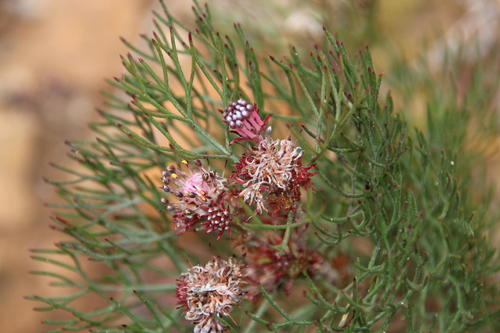
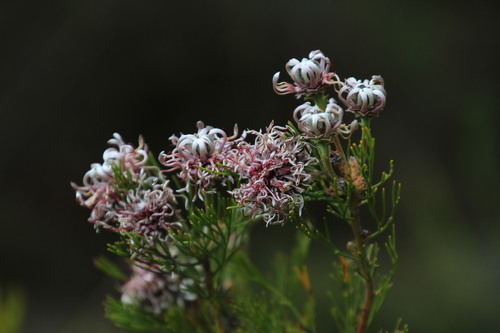
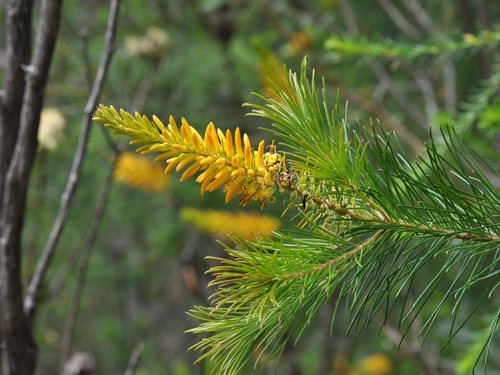
Persoonia pinifolia grows as an upright woody shrub reaching up to 3 metres (10 feet) in both height and width. Its young branches are moderately hairy. The leaves are soft and thread-shaped, measuring 30–70 mm (1–3 in) long and around 0.5 mm (0.02 in) wide. They are moderately hairy when young, becoming hairless (glabrous) as they mature, and their tips are often curved. The flowers are arranged in long racemes at the ends of branches, making them far more visible than the flowers of most other Persoonia species. Each flower has a moderately hairy stalk (pedicel) 1–4 mm (0.04–0.2 in) long, with a small leaf at the base of each flower. Each flower is made of four tepals 8–9 mm (0.3–0.4 in) long, fused at the base with their tips rolled back. The central style is surrounded by four yellow anthers that are also joined at the base with rolled-back tips, so the flower looks like a cross when viewed from the end. Flowering occurs mostly from late winter to summer, though it may happen at other times of the year. After flowering, the plant produces fleshy green drupe fruits that form a cluster resembling a bunch of grapes. In its ecology, birds including pied currawong, satin bowerbird, regent bowerbird, olive-backed oriole, and Lewin's honeyeater take the fruits of P. pinifolia, but it is not known how this activity affects seed dispersal. Unlike most species in the Proteaceae family, Persoonia pinifolia does not have proteoid roots. In horticulture, this species, commonly called pine-leaved geebung, is an attractive garden plant, but it is difficult to propagate from seed or cuttings. Propagation success has been achieved by nicking the seed coating followed by treatment with a gibberellic acid solution. Some clones appear to produce seed that germinates more easily. The species grows reliably in gardens when planted in an open sunny position with good drainage, and requires very little maintenance. Though the individual flowers are small, they are well-displayed, and the plant tolerates reasonably heavy frosts. It works well as a hedge or screen plant, often flowering from January to August and producing distinctive olive-like fruit after flowering. Tissue culture has been found to be successful for propagating P. pinifolia, as it has for some other Persoonia species.