About Adenanthos obovatus Labill.
Growth Form
Adenanthos obovatus is a lignotuberous shrub with many stems growing from a single underground lignotuber. It typically grows around 1 m (3.3 ft) tall and 1.5 m (4.9 ft) wide, though occasional specimens may reach 2 m (6.6 ft) in height.
Leaf Characteristics
Its bright green, oval leaves are sessile, arranged in a spiral pattern on branches, and reach up to 20 mm (0.79 in) long and 15 mm (0.59 in) wide.
Flowering Period
Flowering occurs steadily from April to December, with peak flowering between August and October.
Flower Arrangement
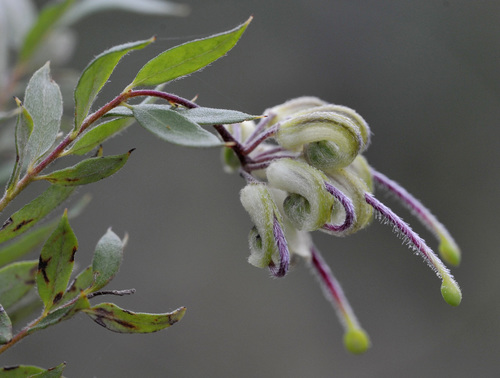
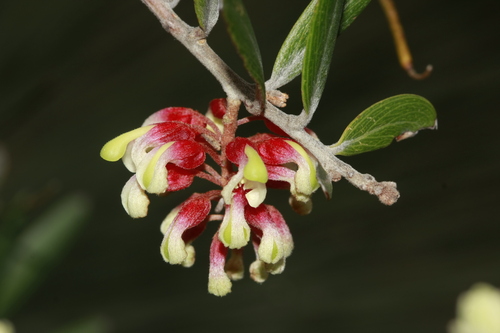
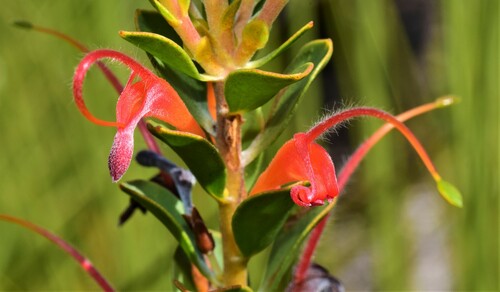
Flowers are red or orange, emerging from leaf axils; they are usually solitary, though occasionally two flowers grow in a single axil.
Floral Structure
Like other Proteaceae species, each flower has a perianth made of four united tepals, and a single style. In A. obovatus, the perianth is around 25 mm (0.98 in) long, and the style around 40 mm (1.6 in).
Flowering Consistency
Even though this species has a six-month long flowering period, only a few flowers are present at any one time. A seven-year study conducted at Harry Waring Marsupial Reserve south of Perth found that flowering remains fairly consistent year to year, even when shrubs are cut back to ground level to simulate bushfire.
Similar Species Comparison
A. obovatus is very similar to A. barbiger. Most populations of A. barbiger have much longer, narrower leaves than A. obovatus, an obvious difference in typical leaf shape.
Intermediate Leaf Variation
However, leaf shape varies across both species, and some southern populations of A. barbiger have leaves that cannot be distinguished from those of A. obovatus.
Distinguishing Taxonomic Features
The most taxonomically important distinguishing features between the two species are: perianth limb shape, which is rounded in A. obovatus and pointed in A. barbiger; bracts, which are glabrous in A. obovatus and hirsute in A. barbiger; and style-end color, which is green in A. obovatus and scarlet in A. barbiger. The two species also have slightly different flower color ranges: A. barbiger produces scarlet to bright red flowers, while A. obovatus produces scarlet to orange flowers.
Soil Preferences
A. obovatus is abundant, widespread, and grows across a wide range of soils, preferring acidic soils with a pH between 3.9 and 5.4. Like most Adenanthos species, it is common on deeply leached siliceous sandplain sand.
Soil Type Occurrences
It also grows on gravelly quartz sand derived from rock outcrops, such as on the rocky hillslopes of the Stirling Range. It is rarely found on gravelly lateritic soils.
Moisture Tolerance
It is one of the few Adenanthos species that grows well in moist environments; it cannot tolerate seasonal waterlogging, a niche occupied by A. detmoldii, but thrives in damp non-waterlogged soils.
Habitat Associations
In line with these soil preferences, A. obovatus is widespread and common in the scrub and heath of Southwest Australia's sandplains, and is also common in sedgelands that develop in the region's moister areas. It is uncommon in forest or woodland areas, as these environments are usually associated with lateritic soils, but it may be found in jarrah or marri forest stands that grow on laterite-free sand.
Climate Range
The climate across its range is Mediterranean, with annual rainfall ranging from 625–1,250 mm (24.6–49.2 in).
Geographic Distribution
This species occurs in coastal regions of Southwest Australia, ranging from Gingin and Muchea north of Perth south to Augusta, and east along the south coast to Green Range east of Albany. It also occurs in the Stirling Range, a possible disjunct population, and at Narrogin, which is a confirmed substantial disjunction.
Disjunct Population Explanation
Nelson tentatively attributes these disjunct populations to natural climate fluctuations: during periods of higher rainfall, the distribution of A. obovatus would have been much more extensive. Reductions in rainfall caused the distribution to contract, but isolated populations were able to survive in favourable refugia.
Primary Pollinator
The western spinebill (Acanthorhynchus superciliosus) is the most frequent visitor to A. obovatus flowers. This is a territorial bird species, and territories are smaller when they contain more A. obovatus bushes.
Pollination Mechanism
The western spinebill's long curved bill fits the tube-like flowers of A. obovatus exactly, so that the pollen-presenter brushes against the bird's head while it probes for nectar. The birds then carry pollen between plants, facilitating fertilization.
Pollen Dispersal Distance
A field study using fluorescent dye to mark pollen found that pollen can be deposited on flowers up to 20 metres (66 feet) away from the original source plant.
Other Flower Visitors
Pollen from A. obovatus has also been recorded on the New Holland honeyeater (Phylidonyris novaehollandiae) and brown honeyeater (Lichmera indistincta). The silvereye (Zosterops lateralis) drinks nectar from A. obovatus flowers, but punctures the flower tube with its short bill.
Larger Honeyeater Interactions
In one field study, larger honeyeaters tended to avoid A. obovatus, likely because they seek more abundant nectar sources elsewhere. These larger species are too heavy for the plant's fine branches, and their bills are too large for the flower tubes.
Mammalian Nectar Use
Field studies in Scott National Park have recorded A. obovatus as a nectar source for the honey possum (Tarsipes rostratus) in winter and spring, from early June to September; A. meisneri replaces it as a nectar source in late spring and summer, from late October to February.
Disease Susceptibility
A. obovatus is highly susceptible to dieback caused by the water mould Phytophthora cinnamomi. Specimens growing in coastal dune vegetation have been reported killed by the fungus Armillaria luteobubalina, with fungal mycelial sheaths forming beneath the bark of the root collar.
Cultivation History
Described by Ken Newbey as "an outstanding ornamental species with average foliage and very attractive in flower", A. obovatus was first cultivated in Great Britain in 1824, and is the most commonly cultivated Adenanthos species in Australia. It flowers for most of the year, attracts honeyeaters very well, and can grow in a range of climates.
Propagation Methods
It is propagated by cuttings taken from the current season's growth; it roots readily from cuttings, and subsequently grows fairly quickly.
Cultivation Requirements
Although it naturally occurs in damp locations, it grows best in light, well-drained soil when cultivated. It prefers a sunny position, and regular hard pruning is recommended to maintain an attractive form.
Cut Flower Use
Wildflowers of this species are harvested by licensed pickers for the cut flower industry, and sold in both local and export markets. Its long curved stems with flowers in the leaf axils have been described as "excellent for picking".