About Adenanthos barbiger Lindl.
Growth Form
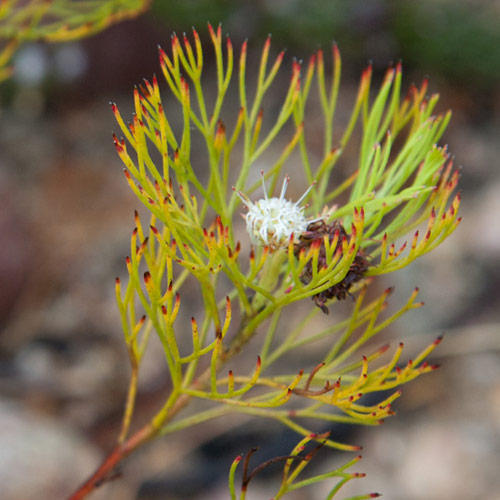
Adenanthos barbiger Lindl. grows as an upright or spreading small shrub, reaching up to 1 metre (3 feet) in height. It often produces many stems that grow from an underground lignotuber.
Branch Characteristics
Young branches are covered in hairs, which are shed as the branches age.
Leaf Morphology
Its leaves are long, thin, and oval-shaped, reaching up to 8 centimetres (3.1 inches) long and around 7 millimetres wide, and they have no petiole.
Flowering Period
Flowers bloom between August and December.
Flower Structure
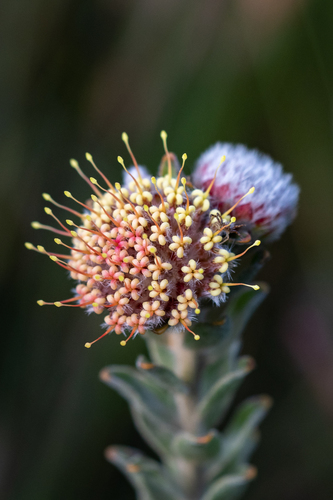
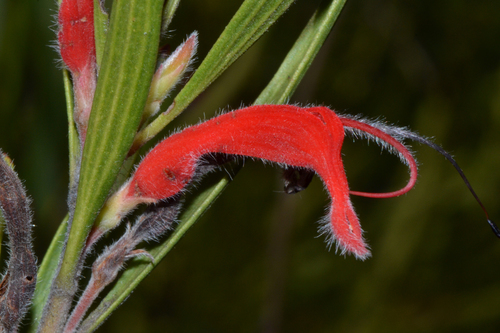
Each flower has a bright red tubular perianth about 25 millimetres (0.98 inches) long, covered in silky white hairs, plus a style about 40 millimetres (1.6 inches) long.
Distribution Range
This species occurs in Western Australia, between the west coast and the Darling Range, ranging north to Toodyay and south to Manjimup. It is common across the northern and southern parts of its range, but is uncommon in the central parts of its range.
Habitat Preferences
It grows mostly in jarrah forest, but is sometimes found in more open habitats, and can grow in a wide range of soil types.
Pathogen Susceptibility
It is highly susceptible to Phytophthora cinnamomi dieback.
Cultivation History
This species was first introduced into cultivation in Great Britain in 1845, but is not widely cultivated today.
Cultivation Traits
It attracts birds well and tolerates frost.
Propagation Method
It can be propagated from cuttings; new shoots taken from the lignotuber root easily when grown under mist.
Cultivation Requirements
It requires well-drained soil and grows well in full sun or partial sun.